A designer’s project spec template should do more than describe a beautiful chandelier. It should help a lighting manufacturer understand the room intent, technical constraints, evidence requirements, approval authority, and delivery context. Without those fields, the supplier has to guess, and the designer loses control of the result.
The best brief is not the longest document. It is the document that prevents the wrong kind of creativity. A manufacturer should have freedom to solve the project, but not freedom to misunderstand the scale, finish, control expectation, installation boundary, or client decision process.
Kinglong Lighting can respond more precisely when designers connect the brief to OEM/ODM customization, real room constraints, and the buyer’s evidence needs. The template below is written for villa and luxury residential projects, but the same logic also helps boutique hotels, show villas, and private club interiors.
Key Takeaways
- A brief is a control document: It should define what the manufacturer may solve and what must not drift.
- Intent needs constraints: Mood words are useful only when paired with dimensions, ceiling, route, controls, material, and service notes.
- Evidence should be named early: Drawings, samples, reports, photos, packing, and inspection formats should be requested before quotation.
- Authority prevents circular approvals: The manufacturer needs to know who can approve concept, sample, engineering, and shipment.
- Templates should be editable: A practical brief gives fields and thresholds, not a decorative essay that no one updates.
A lighting brief is a risk transfer document
A lighting manufacturer brief should make the designer's intent buildable without asking the factory to guess what the project cannot accept.
Designers often think of the brief as a creative communication tool. It is also a risk transfer document. The brief tells the manufacturer which uncertainties belong to design, which belong to engineering, which belong to site, and which must return to the client for approval.
The DOE lighting design page gives a useful boundary because lighting decisions should be judged around the whole space and its use, not only fixture appearance. For project buyers, the practical action is to anchor decorative choices in room function, visual comfort, and use rather than mood adjectives alone.
State what the room must not do
Good briefs include negative constraints. The chandelier must not block a stair view, overpower a dining table, glare into a bedroom, clash with warm stone, require impossible cleaning, or exceed a route limit. These statements are not pessimistic; they give the manufacturer a real design boundary.
A brief that says only elegant, warm, bespoke, and high-end invites generic responses. A brief that says warm vertical sparkle without glare from the upper landing gives the manufacturer a solvable problem. The second version produces better design options and fewer approval loops.
Name what the manufacturer may decide
The designer should say which items are fixed and which are open. Fixed items may include overall drop, finish family, dimming requirement, ceiling point, or maximum module size. Open items may include exact glass density, arm rhythm, internal frame method, packing sequence, or minor component geometry.
This avoids two bad outcomes. The manufacturer does not overstep by redesigning the room. The designer does not waste time approving details that could have been solved by the factory within a clear boundary.
The template starts with intent and non-negotiables
The first page of the brief should make the project readable in five minutes. It should name the project, room, design goal, client sensitivity, target date, and non-negotiable constraints. The manufacturer should understand why the fixture matters before reading technical fields.
The DOE TM-30 FAQ gives a useful boundary because color quality needs more precise language than warm, cool, or beautiful when materials are being approved. For project buyers, the practical action is to describe color and material appearance with a clearer vocabulary than simply warm, neutral, or luxury.
Use a room-intent block
The room-intent block should include project type, room name, design sentence, primary viewing positions, desired emotional tone, and materials near the fixture. It may include references, but the references should be annotated: use this image for vertical rhythm, this one for glass texture, and this one only for scale.
If the brief includes color quality, material rendering, or warm ambience requirements, the designer should describe which surfaces matter. A chandelier that flatters marble, bronze, walnut, and silk may need a different light character than one designed for white plaster and pale stone.
List non-negotiables before nice-to-haves
Non-negotiables may include maximum drop, weight review requirement, dimming protocol, cleaning access, visible hardware limits, protected design boundary, finish family, or delivery deadline. Nice-to-haves may include a preferred crystal cut, extra sparkle, or a secondary finish option.
This order matters because manufacturers often try to satisfy visible preferences first. If the route limit or service access is hidden in the brief, the first concept may look right and fail later. Designers should put the hard constraints where the factory will see them immediately.
Add site constraints before asking for price
A quote based on a vague room image is not a serious quote. Site constraints affect structure, module size, assembly, packing, labor, and access. A manufacturer can estimate only when the brief shows the practical conditions around the fixture.
The NFPA 70 National Electrical Code page gives a useful boundary because electrical installation and field acceptance decisions need local qualified code review. For project buyers, the practical action is to keep electrical assumptions and local qualified review visible in the brief rather than burying them after quotation.
Give geometry, route, and access in one packet
The brief should include ceiling height, plan and elevation if available, desired drop, canopy location, nearby furniture, door and stair route, lift possibility, unpacking area, and any site restrictions. Even approximate information is better than silence if it is marked as preliminary.
The OSHA aerial lifts page gives a useful boundary because overhead installation and later service require planned access and trained site practice. For project buyers, the practical action is to ask how overhead access, protection, and qualified site practice will affect installation and maintenance assumptions.
Show control and electrical assumptions early
Decorative lighting is often briefed visually while drivers, dimming, switching, and local electrical work are left for later. That creates risk. The manufacturer should know the expected voltage context, control type if known, dimming expectation, driver location preference, and whether local professionals will provide final electrical review.
The designer does not need to become the electrician. The brief simply needs to expose the assumptions. If the team does not know the dimming protocol or driver location yet, say so. Unknowns should be visible fields, not missing information.
Translate aesthetics into manufacturer inputs
Manufacturers build from inputs: dimensions, materials, tolerances, finishes, components, drawings, samples, and inspection requirements. Designers often communicate in atmosphere. A strong template translates atmosphere into inputs without flattening the design intent.
The UL 1598 standard page gives a useful boundary because decorative chandeliers are still luminaires that need product evidence and qualified installation review. For project buyers, the practical action is to treat the decorative fixture as a luminaire that still needs product evidence, installation limits, and qualified local review.
Break material intent into reviewable choices
Instead of saying smoked glass and brushed brass, the brief should ask for glass tone range, opacity, texture, edge treatment, metal finish reference, sample size, cleaning consideration, and acceptable variation. That lets the designer approve the qualities that actually matter.
The same applies to crystal, resin, acrylic, leather, alabaster-like effects, and mixed metal finishes. A manufacturer can source and build better when it knows whether the priority is sparkle, diffusion, weight, cleaning, durability, local availability, or a specific tactile finish.
Ask for evidence formats, not only answers
A good brief requests how the answer should arrive: drawing, marked photo, finish sample, component sheet, packing mock-up, wiring note, inspection checklist, or short video. Evidence format matters because a verbal answer may not be enough for the designer to defend the decision to the owner.
The NIST NVLAP accreditation page gives a useful boundary because test evidence is stronger when the method, traceability, competence boundary, and report scope are clear. For project buyers, the practical action is to ask that test or lab references identify method, sample, date, and scope instead of being used as decorative trust language.
Set decision authority and evidence format
Even a strong brief can stall if nobody knows who can approve what. The manufacturer should not have to guess whether the designer, owner, procurement manager, architect, engineer, or contractor owns the next answer.
The ICC Incoterms 2020 page gives a useful boundary because international delivery responsibility should be named before goods, crates, and spare parts move. For project buyers, the practical action is to include delivery responsibility, destination, and handoff terms before price comparison or shipment planning.
Name approvers by stage
The brief should name who approves concept, sample, engineering, production, packing, and shipment. The owner may approve mood and final appearance. The designer may approve proportion and finish. The engineer or local consultant may review support and electrical boundaries. Procurement may approve commercial terms.
This stage authority prevents circular approvals. If the owner changes a finish after engineering approval, the project can record which previous decision is affected. If the designer asks for a module change after packing design, the manufacturer can show the packaging and schedule consequence.
Use a brief completeness score before sending
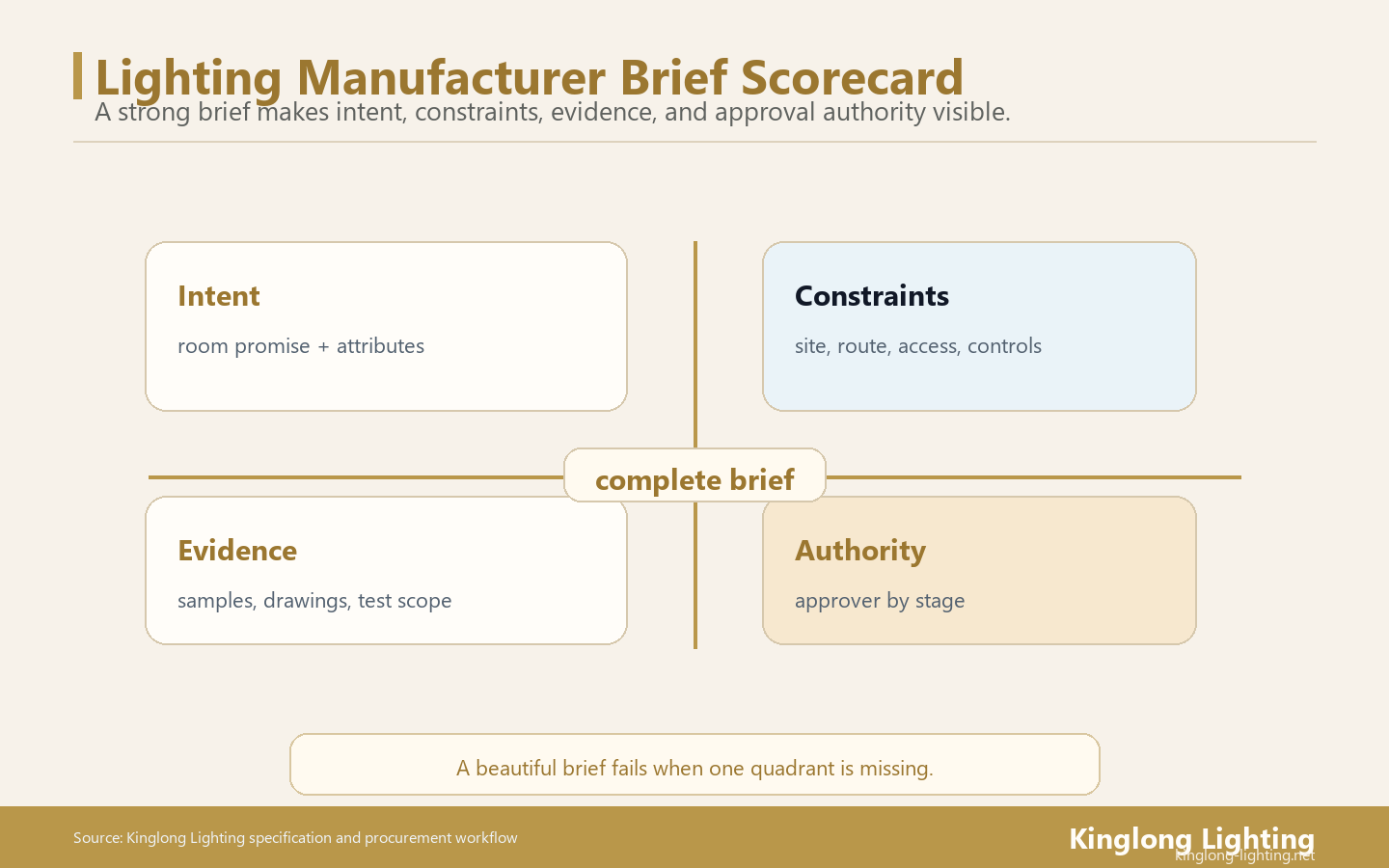
Before sending the brief, designers can score four areas from one to five: intent clarity, site constraint clarity, evidence request clarity, and approval authority clarity. A score below three in any area predicts a clarification loop. A score above four usually produces a more useful first supplier response.
Designers can then send the improved packet through Kinglong Lighting’s custom chandelier manufacturing path with fewer gaps. The goal is not to overwhelm the manufacturer; it is to remove the preventable questions that delay creative work.
Designer project spec template
Use this compact template as a pre-send checklist. The full brief can be longer, but these fields should not be missing.
| Decision area | Owner risk if vague | Evidence to request | Acceptance action |
|---|---|---|---|
| Room intent | Supplier copies style but misses purpose | One-sentence room promise, references annotated by attribute | Approve direction before technical quotation |
| Site constraints | Design cannot be routed, supported, serviced, or controlled | Dimensions, ceiling, route, access, wiring, control assumptions | Quote only after constraints are visible |
| Material inputs | Samples do not answer what the designer needs | Finish family, sample request, acceptable variation, cleaning note | Freeze master reference before production |
| Evidence format | Answers arrive as vague messages | Drawing, sample, photo set, component note, inspection checklist | Require evidence format for key claims |
| Approval authority | Owner, designer, engineer, and procurement approvals conflict | Approver by stage and decision deadline | Move forward only when stage owner is named |
Brief completeness scoring before supplier review
Before sending the brief, the designer can run a simple four-part score. Intent clarity asks whether the manufacturer can describe the room promise back in one sentence. Constraint clarity asks whether ceiling, route, access, controls, and service limits are visible. Evidence clarity asks whether the supplier knows what format to return. Authority clarity asks whether each approval stage has a named decision owner.
A score of five in every category is not required. Early-stage design briefs are allowed to have unknowns. The important distinction is between a named unknown and a missing field. A named unknown tells the manufacturer to price or design with a condition. A missing field invites an assumption that may be expensive to correct later.
Designers should also use the score to protect creative time. If the brief is weak on constraints, the first supplier reply will probably ask for drawings, ceiling height, route, and control information. If the brief is weak on evidence format, the reply may arrive as attractive images without the drawings or samples needed for client approval. The score shows where to strengthen the packet before the project loses momentum.
How Kinglong Lighting reads a stronger designer brief
Kinglong Lighting can respond faster when the brief shows what the design team wants protected and what the factory is allowed to solve. A clear villa brief helps the manufacturer propose scale, materials, structure, sampling, packing, and handover support through the villa lighting project path.
If the design team already has drawings, room photos, finish boards, references, and unresolved questions, the practical next step is to send the villa lighting brief template. Kinglong Lighting can then identify which details are ready for quotation, which need sample proof, and which require local professional review.
Before sending the brief to a manufacturer
Use this short action list before the next approval meeting. It is intentionally practical, because vague approval language is the usual source of later rework.
- Rewrite mood references into attributes the manufacturer can act on.
- Put non-negotiable constraints before nice-to-have preferences.
- Include site, route, access, control, and service assumptions before asking for price.
- Request evidence formats for drawings, samples, tests, packing, and inspection.
- Name who approves concept, sample, engineering, production, and shipment.
FAQ
What should a lighting manufacturer brief include?
It should include room intent, dimensions, constraints, materials, finish targets, controls, evidence requests, approval authority, delivery context, and open questions.
Can designers send only renderings to a manufacturer?
Renderings are useful for concept, but they are not enough for quotation or production. Manufacturers also need constraints, samples, engineering assumptions, and evidence formats.
How detailed should a villa lighting brief be?
It should be detailed enough to prevent wrong assumptions, but not so rigid that the manufacturer cannot solve the project. Fixed and open items should be clearly separated.
Who should approve the final lighting brief?
The designer should coordinate approval with the owner and relevant project professionals. Engineering, electrical, safety, and authority-controlled items should remain with qualified local reviewers.