
Villa chandelier installation failure usually begins before anyone arrives on site. The visible problem may appear on installation day, but the root cause is often an open gate: unclear ceiling support, unrealistic access, incompatible controls, poor packing logic, or missing commissioning criteria.
The best prevention is to treat installation as part of the chandelier specification. A beautiful fixture is not ready because the rendering is approved. It is ready when the structure, access, electrical, packing, and final scene gates are closed.
Kinglong Lighting can help villa owners and designers turn installation risk into a release checklist before the chandelier is manufactured, packed, and shipped.
Key Takeaways
- Failure starts early: installation problems often come from decisions skipped during design and quotation.
- Structure must be local: the factory provides weight and suspension information; local professionals confirm the building.
- Access is design: lift route, unpacking area, module size, and floor protection should shape the chandelier.
- Controls need proof: drivers, dimmers, circuits, and scenes should be tested before production assumptions freeze.
- Commissioning closes the promise: the installation is not finished until level, dimming, glare, and service are checked.
Failure 1: ceiling support is assumed, not verified
A chandelier should never be heavier than the evidence supporting it.
The first failure is structural assumption. The owner chooses a large chandelier, the designer approves the look, the factory prepares a quote, and only later does the project team ask whether the ceiling can support the weight and suspension points. At that point, redesign becomes expensive.
The ASCE Hazard Tool is a useful reminder that structural design depends on site-specific parameters and professional review. A chandelier manufacturer should not replace the local engineer. The manufacturer should provide fixture weight, suspension point layout, canopy assumptions, and module information so the local team can verify support.
How to avoid it
Ask for weight and suspension information before production release. Mark the ceiling support path on the drawing. Confirm whether backing, anchors, slab, beam, or custom frame will carry the fixture. If the building answer is unknown, hold the release rather than hoping the installer can solve it later.
Failure 2: access route is planned after shipment
A chandelier can be correct on paper and impossible in the building. Elevator dimensions, stair turns, corridor width, door height, floor protection, lift placement, and unpacking area all affect the installation. When access is planned after shipment, the project may need on-site disassembly, re-crating, or redesign.
The OSHA aerial lift page reinforces that elevated work needs planning and qualified operation. In a villa, access planning also protects marble floors, finished walls, furniture, art, and ceiling details.
How to avoid it
Define the route before module design is frozen. Measure elevator, stair, corridor, door, ceiling, and lift path. Decide whether the chandelier ships as a frame, ring, branches, strands, or smaller modules. The packing list should match the building route, not only the factory’s convenience.
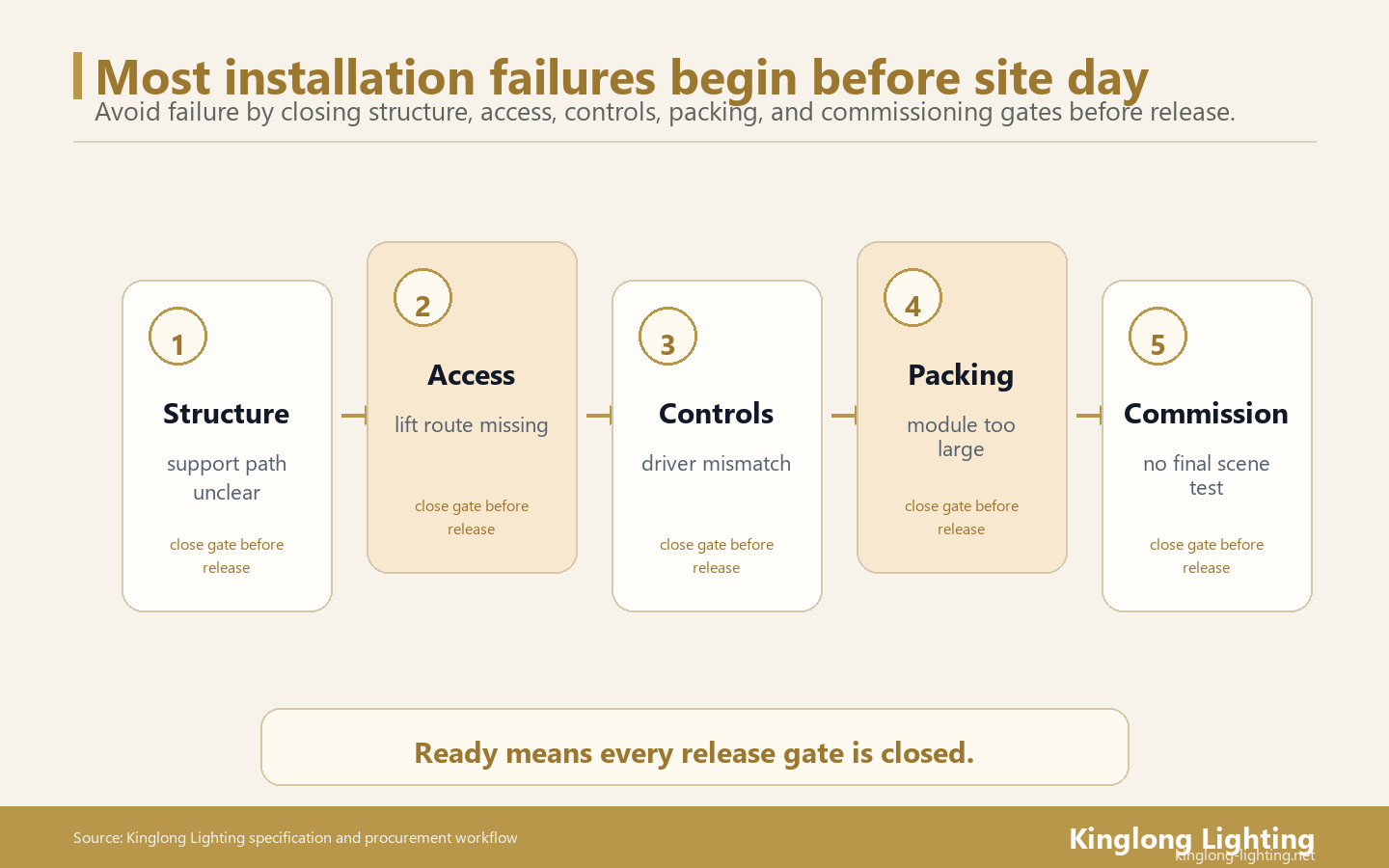
Failure 3: controls are treated as an electrician problem only
Controls fail when the chandelier design, driver selection, dimming expectation, circuit plan, and wall control system are not aligned. The owner may see flicker, poor low-end dimming, uneven zones, driver noise, or scenes that do not match the room mood.
The NFPA 70 National Electrical Code page is relevant because electrical installation belongs with qualified local professionals. For the chandelier supplier, the responsibility is to provide clear product and driver information so the local team can make code-aware decisions.
How to avoid it
List driver type, control expectation, circuit count, dimming protocol, and scene requirement before production. If the room uses a whole-home control system, involve the controls vendor early. A chandelier should not arrive with unknown driver behavior and a hope that the electrician can make it feel luxurious.
Failure 4: packing ignores installation sequence
Packing failure does not always mean breakage. It can mean the parts arrive unlabeled, modules are too large, boxes open in the wrong order, spares are mixed with main parts, or fragile pieces are unpacked before the lift and floor protection are ready. The installer then loses time and the owner sees chaos.
The UL 1598 standard page is a reminder that the chandelier is a luminaire, not only a decorative object. Product evidence, labels, components, and installation information should travel with the fixture.
How to avoid it
Request a packing list, box labels, installation sequence, piece map, spare kit, and pre-shipment photos. Large villa chandeliers should be packed around the site sequence. If the first box needed on site is buried under decorative pieces, the packing logic is working against installation.
Failure 5: commissioning is skipped after the chandelier lights up
Many teams stop when the chandelier turns on. That is not commissioning. A villa chandelier should be checked for level, alignment, dimming, glare, reflection, driver noise, finish condition, missing pieces, cleaning access, and owner scene acceptance.
The DOE lighting design page frames lighting as part of whole-space quality and efficiency. In a villa, the final question is not simply whether the chandelier works. It is whether the room works with the chandelier in place.
How to avoid it
Create a commissioning checklist before installation day. Include daytime and evening views, dimming scenes, seated eye level, stair views, reflection in glass, cleaning handover, spare kit, and any punch-list items. The owner should accept the installed effect, not merely the electrical connection.
Installation failure matrix
| Failure | Visible symptom | Root cause | Preventive proof |
|---|---|---|---|
| Support assumption | anchor or canopy changes late | weight path not verified | engineering review with fixture data |
| Access miss | fixture cannot reach room | route not measured | module and route plan |
| Control mismatch | flicker or poor scenes | driver and control not aligned | dimming and circuit notes |
| Packing confusion | site delay and part loss | boxes not sequenced | packing list and labels |
| No commissioning | owner dislikes final room | turn-on treated as finish | scene and service checklist |
How Kinglong reduces installation risk before production
Kinglong Lighting’s custom chandelier workflow can support installation planning through drawings, module logic, finish proof, packing notes, and documentation. The Mofun Design Platform can help test scale before physical production, but installation proof still needs site data.
The right handoff connects factory and site: the factory provides weight, drawings, module size, packing, and product evidence; the local engineer, electrician, contractor, and installer confirm building conditions. That division protects the owner because no party is guessing beyond its role.
Pre-installation release packet
The safest installation process has a release packet before the chandelier ships. This packet is not a thick manual for show. It is a practical evidence set that lets the owner, designer, installer, electrician, contractor, and factory read the same project. If one party cannot find the answer, the release is not ready.
Include a one-page owner summary
The owner summary should state the fixture size, weight, drop, room location, approved finish, major materials, control expectation, shipment status, and installation assumptions. Owners do not need every technical detail, but they should see the core commitments. This helps prevent late preference changes from being mistaken for factory mistakes.
Include a site responsibility page
The site page should name who owns ceiling support, lift access, floor protection, electrical connection, unpacking area, and commissioning. Kinglong Lighting can provide factory-side documentation, but the local project team must own building conditions. The villa lighting project support path works best when that division is explicit.
Include a parts and sequence page
The parts page should show box labels, module numbers, decorative piece maps, spare parts, and the installation sequence. This is where many site-day failures are prevented. If the installer knows which box opens first and which pieces must stay wrapped until final alignment, fragile parts are less likely to be lost or damaged.
Include a change-control page
Villa projects change. A ceiling may shift, the owner may request a lower drop, or the control vendor may change the dimming plan. The release packet should show how changes are approved and which drawing is current. Without change control, the team may install against an old assumption and discover the error only when the chandelier is already in the air.
Installation handoff meeting agenda
Before installation week, hold one short handoff meeting with the designer, owner representative, local contractor, electrician, installer, and factory contact. The meeting should not reopen design preferences. It should close practical risks that can still stop the installation. A 30-minute meeting can prevent a full day of site confusion.
Confirm what has changed since quotation
Ask whether the ceiling, power point, room finish, furniture layout, lift access, or installation date changed after the quote. Villa projects often evolve quietly. If the chandelier was designed around old assumptions, even a small site change can affect module route, drop height, or control behavior.
Confirm who can approve site decisions
On installation day, the team may need quick approval for height adjustment, cable trim, canopy position, or scene settings. If the decision maker is unavailable, installers may guess or stop work. The handoff meeting should name the person who can approve each site decision.
Confirm the punch-list standard
The punch list should distinguish critical issues from minor adjustments. A missing safety document, unstable support, or failed dimming scene is different from a small alignment tweak. Clear standards help the owner accept the installation without ignoring real defects or delaying over cosmetic items that can be adjusted later.
What to document after installation
Installation evidence should be kept with the owner file, not scattered across phone messages. The final package protects maintenance, warranty discussion, future replacement, and later interior renovation. It also shows whether the chandelier was installed as released or changed on site.
Keep final photos from practical angles
Beauty photos are useful, but service photos are just as important. Capture the canopy, suspension points that remain visible, driver access location, module labels, spare kit, final drop height, and any areas that need future cleaning care. These photos help a future technician understand the fixture without dismantling it blindly.
Keep the commissioning note with the drawing set
The commissioning note should state who checked level, dimming, glare, scene behavior, visible damage, and owner acceptance. If the fixture uses multiple zones or a control system, record the scene names and basic behavior. A short note can prevent later confusion when someone asks whether a dimming issue is new, expected, or caused by a later site change.
Keep a spare and replacement map
The spare kit should be mapped to the fixture. A bag of unlabeled parts is not a maintenance plan. The owner should know which glass, crystal, clip, fastener, lamp, or driver belongs to which area. When a part is replaced, the record should be updated so the remaining spare count is visible.
Soft next step before release
If your villa chandelier is already selected, pause before production release and prepare an installation risk checklist. Include ceiling condition, support path, access route, lift plan, control system, driver expectation, packing sequence, and commissioning views. Kinglong Lighting can help you send the installation risk checklist so preventable site failures are handled before the fixture leaves the factory.
FAQ
Who is responsible for chandelier ceiling support?
The local project team and qualified professionals are responsible for verifying ceiling support. The manufacturer should provide fixture weight, suspension points, canopy information, and module details. The building-specific structural answer should not be guessed by the owner or factory alone.
Can a villa chandelier be installed after furniture arrives?
It can be possible, but it becomes harder and riskier. Furniture, flooring, art, and finished surfaces limit lift access and protection options. If installation happens late, the route, floor protection, unpacking area, and work sequence must be planned carefully.
Why does a chandelier need commissioning?
Commissioning confirms that the installed chandelier matches the room promise. It checks level, dimming, glare, reflection, alignment, driver behavior, finish condition, cleaning access, and owner acceptance. A fixture that only turns on is not fully commissioned.
What should be checked before shipment?
Before shipment, check drawings, approved finish, product evidence, packing list, labels, module size, spare kit, installation sequence, and destination requirements. The goal is to make the site day predictable before the crates leave the factory.