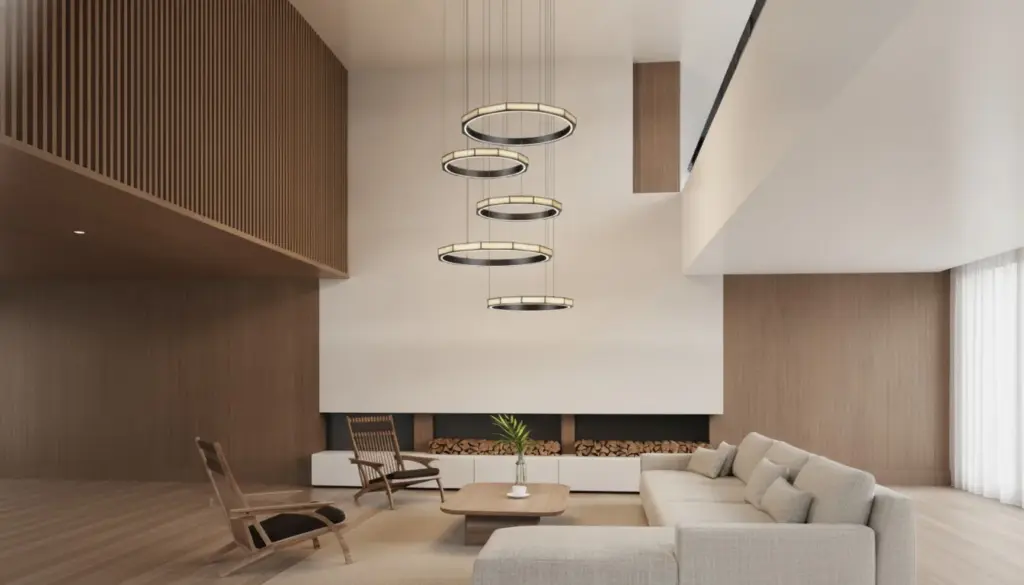
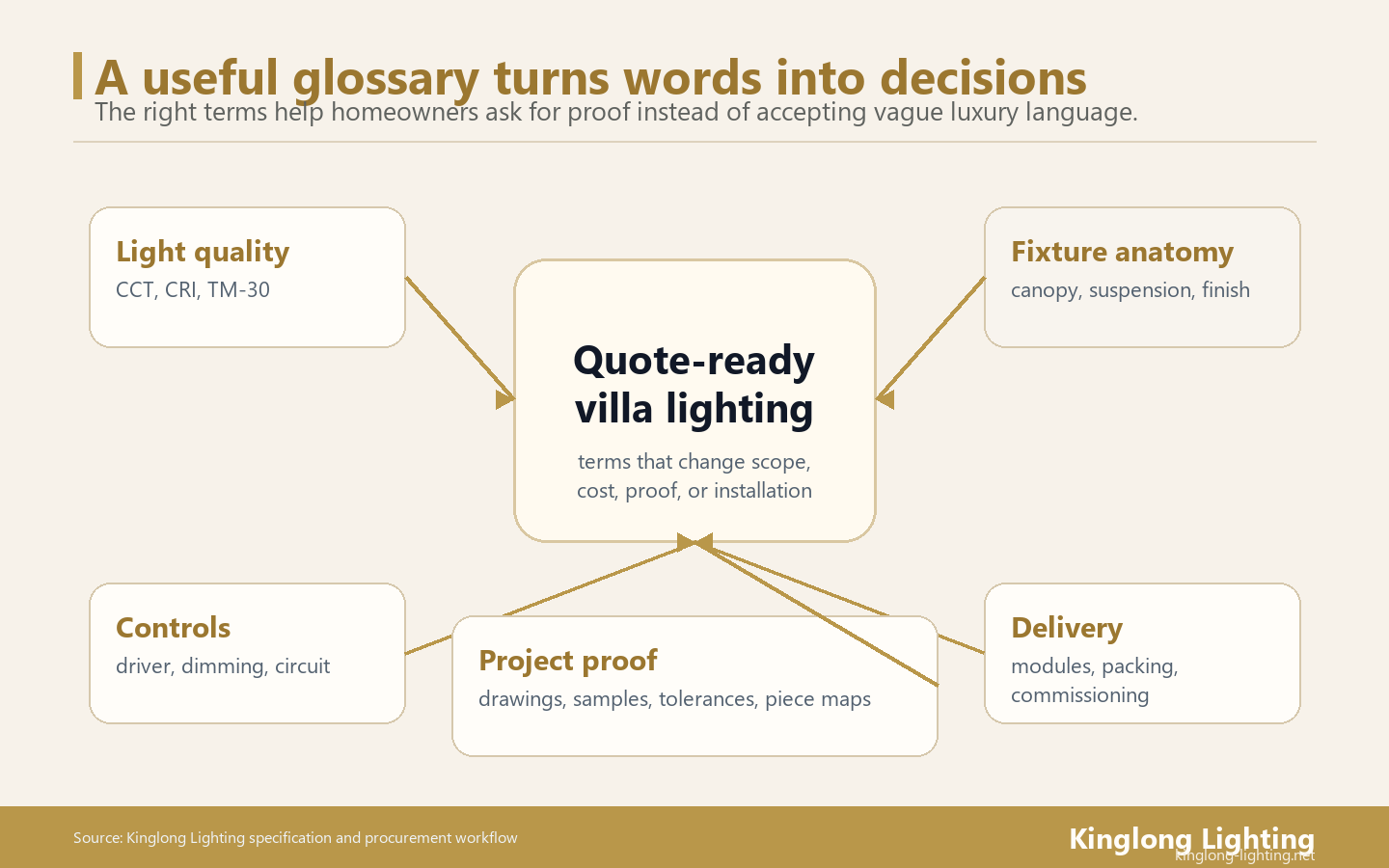
A villa chandelier glossary is useful only when it helps homeowners and designers make better decisions. Terms such as CCT, canopy, driver, finish master, mock-up, and commissioning should not become decorative jargon. They should help the project team define scope, compare quotes, prevent site surprises, and protect the installed result.
The most expensive misunderstanding in villa lighting is often a small word. One person says “warm.” Another hears “2700K.” The owner imagines candlelight. The electrician thinks about dimming. The factory needs a driver specification. If those meanings are not aligned, the chandelier can be beautiful and still wrong.
Kinglong Lighting uses terms as a control tool during custom chandelier development: each term should connect to a drawing, sample, product decision, site condition, or approval boundary.
Key Takeaways
- Terms should change decisions: a good glossary tells the buyer what to ask for next.
- Light quality terms are not interchangeable: CCT, CRI, and TM-30 describe different parts of color experience.
- Fixture anatomy affects installation: canopy, suspension, module size, and driver location belong in the quote.
- Project proof prevents drift: samples, tolerances, piece maps, and mock-ups reduce subjective disputes.
- Delivery terms matter: packing, Incoterms, site readiness, and commissioning determine whether a chandelier can be installed cleanly.
Use the glossary as a procurement control tool
A term earns its place when it changes scope, cost, proof, or installation risk.
The DOE lighting design page is a useful reference point because lighting decisions should improve both quality and efficiency, not vocabulary alone. A villa stair chandelier, dining chandelier, foyer chandelier, and bedroom pendant can use the same words but require different evidence.
This glossary therefore avoids dictionary-only definitions. Each term explains what a homeowner or designer should do with the word. If a term does not help the team approve a drawing, compare a quote, inspect a sample, or plan installation, it is not doing enough work.
Light quality terms
1. Lumen
A lumen describes light output from a source. In a villa chandelier, lumen count is useful only when matched to room function, ceiling height, shade or crystal density, dimming, and other light layers. A high-lumen chandelier can still feel poor if it creates glare or leaves task areas unsupported.
2. Lux
Lux describes light arriving on a surface. It helps designers think about dining tables, stair treads, artwork, vanity surfaces, or circulation paths. Homeowners should not ask for a chandelier to solve every lux requirement alone. A layered villa plan usually combines decorative light, architectural light, task light, and accent light.
3. CCT
CCT, or correlated color temperature, describes whether light appears warm or cool. A 2700K source may feel intimate in a dining room, while 3000K may feel cleaner in a dressing area. The decision should be reviewed against stone, timber, wall color, fabric, metal finish, and dimming level, not selected by habit.
4. CRI
CRI is a traditional color rendering metric. It can help screen light sources, but it does not tell the whole color story. A villa with art, skin tones, colored glass, warm finishes, or premium textiles may need more careful color evaluation than one CRI number can provide.
5. TM-30
The DOE TM-30 FAQ is useful because it explains a more detailed method for evaluating color rendition. Homeowners do not need to calculate TM-30 themselves, but designers can use it to discuss fidelity, gamut, and color preference more precisely when a chandelier affects art, finishes, or guest impression.
Fixture anatomy and material terms
6. Canopy
The canopy is the visible or concealed ceiling interface. It can hide suspension hardware, wiring, drivers, or access points. In a villa, canopy size and shape can affect plaster details, ceiling medallions, lift access, and future service. Ask for canopy drawings before approving a large custom chandelier.
7. Suspension
Suspension describes how the chandelier is supported: rods, cables, aircraft wire, chains, brackets, or custom frames. It is not a styling detail only. Suspension controls weight transfer, leveling, movement, ceiling coordination, and safety. Large chandeliers should have a clear suspension note for the local installer and engineer.
8. K9 Crystal
K9 Crystal is a commonly used term for optical crystal glass in decorative lighting. The label alone is not enough. Buyers should ask about clarity, cut, edge quality, quantity, replacement pieces, and how crystal density affects weight, glare, cleaning, and packing.
9. Hand-blown glass
Hand-blown glass can create organic variation, softness, and artisan character. The same variation can also create tolerance questions. A custom order should define acceptable size range, color variation, bubble tolerance, replacement matching, and how the glass will be packed and installed.
10. Finish master
A finish master is the approved physical reference for metal, plating, paint, patina, or coating. It prevents “warm brass” or “champagne gold” from becoming a subjective argument. For a custom villa chandelier, keep the finish master attached to purchase approval, production release, and final inspection.
Controls and electrical terms
11. Driver
A driver regulates power for LED components. Driver location affects heat, noise, dimming compatibility, access, and future replacement. A beautiful chandelier can become frustrating if the driver is sealed behind finished plaster or incompatible with the control system.
12. Dimming protocol
Dimming protocol describes how lights communicate with the control system. Common requirements may include phase dimming, 0-10V, DALI, or smart control interfaces, depending on the project. The owner should confirm dimming behavior before production because flicker, low-end instability, and scene mismatch are difficult to fix later.
13. Circuit load
Circuit load tells the electrical team how much power the fixture draws and how it should be distributed. Large chandeliers may need more than one circuit or separated control zones. The quote should not only list decorative dimensions; it should also provide electrical information for the local electrician.
14. Luminaire
A luminaire is the complete lighting unit, including source, housing, optical parts, wiring, and support components. The UL 1598 standard page uses luminaire as the product category. That matters because a chandelier is not merely an ornament; it is an installed electrical product.
15. Junction box
The junction box is the electrical connection point in the ceiling or wall. For villa chandeliers, the box location, load support, access, and relationship to the canopy must be coordinated early. Do not assume a decorative canopy can solve a misplaced or undersized electrical point.
Project proof terms
16. Shop drawing
A shop drawing translates the design into dimensions, parts, suspension points, canopy details, modules, wiring notes, and installation logic. It is the bridge between concept and production. Homeowners should review shop drawings with the designer, installer, and factory before paying for final release.
17. Mock-up
A mock-up is a physical or digital test of scale, material, light effect, or assembly. It may be a sample branch, finish board, partial module, or full-size ceiling test. Mock-ups are most valuable when they answer a real risk: glare, finish match, drop, access, or room proportion.
18. Sample
A sample is a physical proof of material, finish, crystal, glass, color temperature, or structure. A photo is not a sample. For luxury villa projects, samples should be reviewed under the intended light scene and near actual room finishes whenever possible.
19. Tolerance
Tolerance defines acceptable variation. Hand-made glass, metal finishing, crystal strings, and custom assembly all need tolerances. Without them, a natural variation can become a dispute. A good tolerance note says what is acceptable, what requires replacement, and who approves the boundary.
20. Piece map
A piece map records where decorative components belong. It protects cleaning, maintenance, replacement, and reinstallation. A chandelier with many glass drops, crystal strands, or custom modules should not depend on memory after parts are removed for service.
Delivery and installation terms
21. Modularization
Modularization divides the chandelier into factory-built sections that can be packed, transported, carried, lifted, and assembled. It affects seams, weight, access route, installation time, and maintenance. A large chandelier should be designed around the real building route, not only the final installed shape.
22. Packing list
A packing list records boxes, parts, quantities, fragile items, tools, spares, and labels. It is a site-control document, not an office formality. A clear packing list helps the installer verify that the chandelier arrived complete before the lift is booked.
23. Incoterms
The ICC Incoterms 2020 page is relevant because delivery terms define buyer and seller responsibilities for shipping, cost, risk, and documents. A villa owner does not need to memorize every rule, but the purchase order should make the delivery boundary explicit.
24. Site readiness
Site readiness means the room can receive the chandelier. Ceiling support, power, lift access, floor protection, dust control, furniture clearance, and installer scheduling should be prepared. A finished chandelier can still be delayed if the site is not ready.
25. Commissioning
Commissioning is the final check that the installed chandelier works as intended. It can include leveling, dimming scenes, flicker review, glare views, control response, part alignment, owner sign-off, and maintenance handover. It is where the design promise becomes the room reality.
How Kinglong uses these terms in a custom villa brief
Kinglong Lighting connects glossary terms to deliverables inside its custom chandelier manufacturing workflow. A homeowner’s word such as warm, floating, dramatic, or easy to clean should become a technical package: CCT range, material choice, suspension method, finish master, sample schedule, driver location, and installation note.
The villa lighting solution page is the best internal starting point when the buyer has a room type but not yet a technical brief. The decorative lighting collections can then help the team discuss style families without locking the project into a vague product name.
For elevated work, the OSHA aerial lift page is a reminder that access is a safety and planning issue. It is not a chandelier style term, but it directly affects installation and maintenance in double-height rooms.
How to use the glossary during handoff
The glossary is most useful when it becomes a handoff checklist. After the owner and designer choose a direction, mark which terms belong to the designer, which belong to the factory, which belong to the electrician, and which belong to the installer. This prevents the same word from being silently passed between parties without an owner.
Designer-owned terms
The designer should own room intent, visual hierarchy, finish palette, desired warmth, acceptable sparkle, viewing angles, and how the chandelier relates to furniture and architecture. These terms describe the desired experience. They should be specific enough for the factory to interpret, but they should not pretend to replace electrical or structural review.
Factory-owned terms
The factory should own shop drawing, sample, finish master, tolerance, module logic, packing list, piece map, and product documentation. These terms turn the design into a buildable object. When a custom chandelier is complex, the factory should also explain which details need owner approval before production can begin.
Site-team-owned terms
The electrician, installer, and local professionals should own junction box condition, circuit load, dimming compatibility, ceiling support, lift access, site readiness, and commissioning. If those terms are not answered locally, the factory can ship a correct chandelier that still becomes difficult to install. A strong brief names the unresolved site terms before the purchase order, not after the crates arrive.
Soft next step before quotation
If your villa chandelier brief still uses words such as warm, luxury, big, modern, or easy maintenance without a supporting term, the next step is to translate those words into a quote-ready checklist. Send Kinglong Lighting the room drawings, ceiling height, preferred style direction, finish samples, control system, destination, and installation constraints. The team can help you submit a chandelier brief with the right terms so the quote compares scope rather than vocabulary.
FAQ
Which chandelier terms matter most for homeowners?
The most important homeowner terms are CCT, dimming, canopy, suspension, finish master, sample, site readiness, and commissioning. These words affect appearance, comfort, installation, and future maintenance. Style terms matter too, but they should be translated into technical decisions before quotation.
Is CRI enough for luxury villa lighting?
CRI is useful, but it is not enough for every luxury villa decision. Color experience also depends on spectrum, material reflectance, dimming level, finishes, and what the chandelier illuminates. Designers may use TM-30, samples, and mock-ups when color quality is central to the room.
What should be included in a chandelier shop drawing?
A chandelier shop drawing should include dimensions, drop, canopy, suspension points, module breakdown, material notes, wiring notes, driver location, weight assumptions, and installation references. For custom work, it should also connect to approved samples and finish masters.
Why does site readiness belong in a glossary?
Site readiness belongs in the glossary because a chandelier is installed in a real room, not only purchased as an object. Ceiling support, access, power, lift route, floor protection, and installation timing can decide whether the fixture arrives smoothly or creates delays.