
Leather belongs in a chandelier when its job, interface, and service boundary are explicit. It works best as a serviceable module, not a material label. Its visible face can add warmth, touch, and contrast; its hidden construction still needs a defined interface, removal route, and care boundary. A leather sleeve should not quietly become a load-bearing strap, an optical control, or a substitute for the fixture’s thermal design. That division is especially important on a custom fixture with an LED zone close to a visible suspension stem. A flat swatch can approve a colour direction. It cannot approve the seam, mounting clearance, or service result of the installed part.
What to Approve Before a Leather Sleeve Repeats
- Give leather one visible or tactile job; keep support, light control, and electrical design with their own components.
- Approve the sleeve on its real metal support, with the seam, retention point, and service route visible.
- Bind the selected leather, mounted sample, care boundary, and drawing revision in one component record.
Leather Needs a Job, Not a Label
Start by assigning leather one visible job and recording what surrounds it. For example, a wrapped stem sleeve may soften a brass-and-metal composition without taking any structural duty. Kinglong Lighting’s Jiangnan collection is a useful decorative reference for discussing how a material direction sits beside metalwork; it is not proof that a particular leather construction has been approved. ISO 16131 specifies sampling and test methods for upholstery leather for furniture. Its scope also includes recommended values. It is not a chandelier standard, but it is a useful reminder: a leather choice becomes dependable only when the selected material, sample method, and intended use are stated together.
Four Jobs That Should Stay Separate
Do not let one leather callout carry four different component jobs. The cleanest material integration gives each job a named owner, then asks the mounted prototype to show that those owners do not conflict.
| Component job | What should own it | What the approval must show |
|---|---|---|
| Visible and tactile character | Leather sleeve, wrap, or trim | Colour range, grain direction, edge finish, and acceptable natural variation |
| Support and alignment | Metal support behind the sleeve and suspension stem | How the fixture is held and how the sleeve stays positioned without carrying the load |
| Light control | Optics, diffuser, shade, or louver | Where light is directed and which part controls glare or diffusion |
| Electrical and heat management | Luminaire engineering around the LED zone | The designed clearance and component arrangement, assessed for the specific fixture |
That role map also makes a future revision easier to discuss. A buyer can ask to change the leather colour or sleeve profile without accidentally reopening the chandelier’s structural or optical decisions. The result is not a less expressive fixture; it is a material role that can be sampled, described, and maintained with less ambiguity.
Specify the Leather Module Before You Approve It
A component record turns a leather reference into a part that a workshop and project team can recognise in the same way. Record the leather identity, colour reference, cut direction, surface, edge treatment, seam position, supporting metal interface, and removal method. Thickness belongs in that record too. ISO 2589 specifies a method for determining leather thickness. The cited 2016 edition applies to all leather types. That does not create a universal thickness for chandelier sleeves; it means the chosen thickness can be identified as a measured property rather than inferred from the feel of a showroom swatch.
For a sleeve that has to wrap around a suspension stem, the drawing or approved component sheet should also show the intended mounted radius. A leather piece that lies quietly on a board may tighten, shift, or place its seam in a different visual line once it closes around metal. The record should therefore connect the material sample to the actual support detail, not to a generic “leather chandelier” description.
| Record field | Question to settle before release |
|---|---|
| Leather identity and surface | Which hide, finish, colour reference, and grain or cut direction are approved? |
| Module geometry | What are the sleeve length, thickness reference, mounted radius, edge detail, and seam zone? |
| Support interface | Which metal part holds the sleeve, and how is it retained without relying on leather for support? |
| Service route | Which fastener is reached, which tool is needed, and can the sleeve be removed without disturbing the fixture body? |
| Care boundary | Which cleaning exposure is allowed, prohibited, or still subject to project confirmation? |
| Revision control | Which mounted sample, photograph, drawing revision, and material batch reference govern repeat build? |
Match the Evidence to the Surface You Actually Chose
The evidence has to match the surface and exposure, not the adjective used to sell the leather. ISO 11640 addresses surface rubbing, while ISO 11644 measures finish adhesion with explicit applicability limits. Colour fastness asks whether the leather’s hue changes after the stated rubbing or cleaning exposure; it matters when a sleeve may be touched, handled during installation, or cleaned within a defined method. Finish adhesion is how well a surface finish stays attached between a finish and leather or between finish layers. Its stated scope has limits for some leather surfaces, so a report is meaningful only after the selected surface has been identified.
Neither test name should become a blanket durability promise. The project still has to decide which exposure matters, how the sleeve is mounted, and what result is acceptable for that component. Ask for evidence that names the relevant leather and condition, then place that evidence beside the mounted sample. A generic report attached to an unmatched surface is less useful than a narrower record that tells the buyer exactly what was assessed.
The Metal Interface Is Where the Design Becomes Serviceable
The metal carrier is the hidden metal part that holds the leather sleeve. It should locate the leather, preserve the fixture’s intended support path, and give the sleeve a planned removal route. Once the sleeve has a sewn or closed seam, that seam is more than decoration. ISO 23910 specifies a method for measurement of stitch tear resistance of leather. The cited method notes particular suitability for leather over 1.2 mm thick, but it does not choose a project acceptance value for you. It does show why the seam construction, leather thickness range, and mounted tension should be written down rather than left to visual preference.
Care needs an equally clear boundary. ISO 11642 specifies a method for determining leather colour fastness to water. That supports treating water exposure as its own leather question, not as something answered by the colour chip. A hospitality lobby, a private residence, and a protected decorative zone may have different cleaning expectations. The component record should state the intended wipe or cleaning condition and who confirms any departure from it; it should not imply that all leather on lighting can be cleaned in the same way.
Place the Seam Where It Can Be Seen, Checked, and Reached
Place the seam where it can be seen, checked, and reached on the mounted component. The review should show where the seam lands in the primary view, whether the edges remain even around the real stem radius, and whether the retention point is reachable after installation. If a removable sleeve is part of the brief, the team should demonstrate the sequence: reach the fastener, release the sleeve, protect the surrounding finish, and refit a replacement without changing the alignment of the suspension stem. This is a serviceability rule, not a claim that every leather detail must be removable. When removal is not required, the record should say so and explain how the installed seam will be inspected and cared for.
A metal-support-and-sleeve arrangement also gives the designer a useful visual choice. The seam can be intentionally quiet, aligned with a shadow line, or placed where it remains inspectable rather than drifting into the focal face of the chandelier. The important point is that the chosen placement survives the actual radius and the actual access route.
A Flat Swatch Cannot Approve a Repeated Mounted Detail
A flat sample cannot show where a seam lands on the production stem or whether the fastener remains reachable. That gap matters most when one mounted sleeve becomes a repeat build across a larger pendant. The following illustrative scenario does not describe a customer project. It simply shows the decision chain: a mounted sleeve reveals the seam access and carrier conditions that a flat swatch hides, so one corrected representative detail is inspected before the same unresolved interface is copied across the fixture.
The Flat Swatch That Could Not Approve 28 Mounted Sleeves
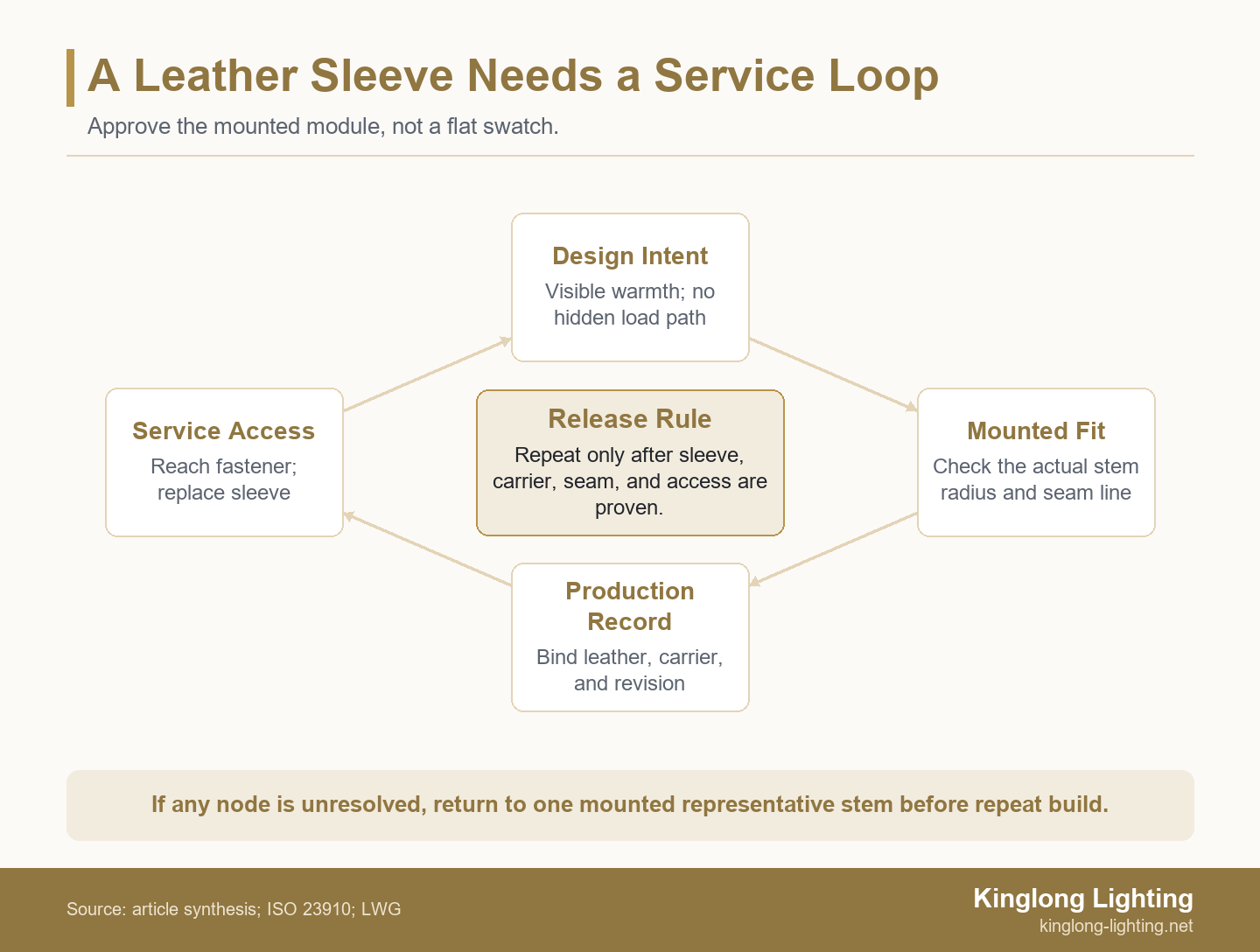
One unverified seam-and-carrier choice repeats 28 times across the illustrative pendant. The useful unit of approval is therefore one mounted representative stem: leather sleeve, metal carrier, seam zone, retention point, and the hand needed to reach it. It is a small prototype, but it controls a large amount of repeated decision-making.
Illustrative context. A hospitality design team wants a warm leather accent on a repeated metal suspension stem in a lobby pendant. The material direction is clear: the leather is intended to soften the metal composition while preserving a clean, tailored appearance.
The notional fixture has 28 drops and 28 visible leather sleeves, one around each suspension stem. Because the sleeve profile is repeated, a single unreviewed detail would be reproduced 28 times rather than appearing once as an isolated accent.
The leather colour and grain reference have been accepted, but only as a flat swatch. No mounted sample has yet shown the intended stem radius, seam line, carrier clearance, or removal route.
When the sample is wrapped around the intended radius, the seam rotates into the primary viewing line. The leather has not changed; the visual result changed because the flat piece did not represent the mounted geometry.
The first closure concept also blocks access to the concealed fastener behind the sleeve. A technician could see the finished surface but could not reach the retention point without disturbing adjacent parts.
The issue is not a new colour preference or a generic objection to leather. The sample failed to represent the interface the production component must handle: mounted radius, seam zone, metal carrier, and the service task. Approving the flat swatch would allow a known seam-access gap to move into every repeat build.
The decision is to rework one representative sleeve as a removable module on its metal carrier, then reinspect it while mounted before authorising the other 27 sleeves. The change is limited to the leather interface, so it does not reopen the entire chandelier design.
The revised record fixes the seam zone, identifies the carrier interface, shows the retention method, and states the removal sequence and care boundary. The mounted sample is photographed against the approved drawing revision so that the visible leather part and its hidden support are bound to the same record.
The reinspection checks five things in one place: seam location, visual alignment, fastener access, sleeve removal, and the stated cleaning condition. Only after those conditions are confirmed on the representative stem does the sleeve become ready for repeat production.
This is an illustrative scenario only. It does not report an actual Kinglong Lighting project, a defect rate, or a tested leather-performance result; project geometry, service constraints, and final fixture engineering remain specific to the commissioned design.
Release the Leather Detail Only With a Bound Record
A release record has two separate jobs: identify what was supplied and prove what was approved on the fixture. Leather supply-chain traceability is a separate documented manufacturing context from component performance. The Leather Working Group audit scope includes incoming and outgoing material traceability. That is useful for recording material identity and movement through the supply chain. It does not, on its own, prove that a particular chandelier sleeve fits its metal support, holds its seam position, or can be serviced after installation. Keep those proofs separate, then bind them in the same component release packet. When a material reference needs to become a mounted prototype, the custom lighting development process can connect the drawing, material role, sample, and release decision.
A release packet should join the source record to the mounted approval so a production team can identify both what was selected and how it was meant to be installed. At minimum, it should include:
- the selected leather identity, colour reference, surface description, and permitted variation;
- the metal-support drawing and revision, with the mounted sleeve geometry and seam zone;
- photographs or a sign-off record from the representative mounted sample, including the retention and access point;
- the stated care boundary, replacement expectation, and the change path if leather, support detail, seam, or edge treatment changes.
That packet gives a design team a controlled way to change one element without losing the approval history for the others. It also gives the workshop a single reference when the leather, support detail, seam, or edge treatment is revised.
Give the Custom Lighting Team a Prototype-Ready Brief
A leather inquiry becomes prototype-ready when it names the part, conditions, and service access rather than a material mood alone. A supplier can work much more precisely from a fixture drawing that marks the component location, an actual leather reference, the intended view, and the mounted conditions. That brief also lets the team decide early whether the leather should be a fixed wrap, a removable sleeve, or a protected accent kept away from the service route.
- Fixture drawing or elevation, with the leather component location marked.
- Leather reference, colour direction, and any surface or grain preference.
- Approximate sleeve dimensions and the actual stem or carrier geometry.
- Expected contact, cleaning, and maintenance conditions for the installed location.
- Any service-access constraint, such as ceiling height, installed clearance, or a required replacement method.
With those five inputs, a project team can ask for a component-level leather integration brief and a representative prototype review plan instead of another loose material sample. When the fixture drawing and leather reference are ready, request a leather-integration review from Kinglong Lighting.
FAQs
Leather selection remains conditional on its component role, surface, interface, and service boundary. These answers keep the decision tied to the mounted part rather than to a general style label.
Can leather sit near an LED source in a chandelier?
Leather can sit near an LED source only after the specific fixture’s clearance and engineering arrangement have been reviewed. Do not treat it as an automatic LED-zone material or infer a heat approval from appearance. Give the sleeve a decorative role, identify the metal carrier, and have the final fixture design assess its actual location, components, and intended use.
Is a loose leather swatch enough to approve a chandelier sleeve?
A loose leather swatch is not enough because it cannot show how the sleeve behaves once it is wrapped and closed. It can help approve colour, grain, and general feel, but it cannot prove the mounted radius, seam line, retention point, or service access. Ask for one representative sleeve installed on the intended carrier before the detail is repeated across multiple drops or arms.
Should a leather sleeve always be removable?
A leather sleeve does not always need to be removable; the right choice depends on the expected service route and replacement expectation. If the sleeve is fixed, the record should still show how its seam will be inspected and what care is appropriate. If it is removable, demonstrate access and refitting on the mounted fixture, including how the visual alignment is restored.
What should change if the leather colour is revised after the prototype?
A revised leather colour requires a mounted comparison because surface, thickness, and seam appearance may change even when the design intent stays constant. Finish behaviour and edge treatment can also affect the mounted module. Record the new material reference and compare it on the same carrier and radius; do not assume a colour substitution preserves the earlier approval.