
What to Look for in K9 Crystal
A K9 Crystal label is a starting point for a specification, not a complete quality verdict. It does not reveal how a pendant will look once it is repeated across a fixture. Buyers still need to consider clarity, cutting, shape consistency, and colour cast under the intended light, alongside any material designation the supplier provides.
In a chandelier with dozens or hundreds of pendants, a small difference in a single component becomes a visible difference in the whole composition. Compare the K9 label with the visual details that can be inspected, then connect the approved reference to the components used in production.
Key Takeaways
A K9 quality review keeps the label, approved sample, and production record separate until they can be checked together. That approach makes a buyer’s questions more specific before design intent becomes an acceptance dispute.
- Ask what the K9 Crystal label covers: a component, a material statement, or only a product description.
- Treat optical evidence such as refractive-index and dispersion language as useful only when the named material and measurement context are supplied.
- Use a sample review to compare visible condition and cut quality, not to certify composition by appearance alone.
- Before acceptance, connect the claimed component to an approved sample and a defined production lot or carton record.
What the K9 Crystal Label Can—and Cannot—Tell You
In the cited EU crystal-glass framework, commercial descriptions are linked to defined composition, manufacturing characteristics, and labelling rules. Article 2 of Council Directive 69/493/EEC supplies that terminology context. The framework does not define K9 Crystal as a universal chandelier category. It does illustrate the buyer-side principle: a material term gains precision from the rule, record, or test condition attached to it. If a quotation says only “K9 Crystal,” ask whether the claim applies to every pendant, one visible trim element, or a general product family description.
Soda-lime glass is a broad family whose usual composition ranges include silica, soda, and lime. The Corning Museum of Glass reference places silica at about 60–75 percent, soda at 12–18 percent, and lime at 5–12 percent. Those ranges are useful context, not a pendant specification. They show why a broad family name cannot predict every formed part’s clarity, cut, thickness, edge treatment, color, or behavior under the intended light source.
The label should open a documentation question: which component does it cover, and what record makes that claim comparable?
That question is more useful than a generic K5-versus-K9 ranking. Public descriptions of K9 vary widely, while the buyer’s actual decision concerns the supplied component. When comparing alternatives, use the same component name, size, finish context, and approval reference in each request. For a broader view of how crystal elements appear across fixtures, buyers can compare chandelier product families.
Which Optical Details Can Be Verified
Refractive index is stated at a wavelength, while the Abbe number describes how refractive index varies with wavelength. The cited reference gives nd at 587.6 nm and uses 486.1 nm and 656.3 nm in its Abbe-number definition. In plain language, refractive index tells you how a material bends light at a stated wavelength; the Abbe number indicates how that bending changes across wavelengths. Neither term is a visual grade by itself. Their value for a buyer is that they force a more precise question: which named material, which measurement condition, and which component does this number describe?
A named optical-glass data sheet can identify refractive index, Abbe number, and wavelength-specific transmission values for a particular material. For example, SCHOTT’s N-BK7 sheet lists nd 1.51680 and Vd 64.17, alongside wavelength-specific information. That is not evidence that N-BK7 and K9 are interchangeable. It is a useful example of the kind of named, bounded record that gives technical language a clear scope.
Optical-glass property records can identify the measured material and wavelength range rather than relying on a generic trade word. A National Bureau of Standards study, now hosted by NIST, reported selected optical-glass measurements from 0.35 to 2.32 microns and associated results with particular samples, including a borosilicate crown example with n 1.517 and V 64.5. For chandelier procurement, the lesson is modest but important: do not ask a supplier to produce an impressive number. Ask what material, component, and measurement context the number belongs to. For related fixture-selection context, buyers can consult Kinglong Lighting’s broader lighting resources.
Inspect the Component, Not Just the Wording
A visual review can compare visible condition and consistency, but it cannot by itself certify a component’s material composition. Use the same light direction, background, and viewing distance for the approval reference and the proposed pieces. Then record what can actually be observed: obvious inclusions, edge chips, facet alignment, visible haze, color shift, or a mismatch between nominally identical parts. The goal is not to “prove K9 by eye.” It is to agree on the appearance the buyer is accepting and make later comparison possible.
Surface cloudiness or fine marks can be a material-and-care question, because acrylic may scratch or craze under unsuitable cleaning conditions. The Canadian Conservation Institute notes that abrasives can scratch acrylic and some solvents can cause fine surface cracking. That does not make a chandelier pendant acrylic, and it is not a test for K9. It is a boundary: surface condition can be informative, but it must be read alongside the identified material and care history.
For a product-specific visual starting point, buyers can review the Crystal Tube series after they have written the observation criteria they expect a reference component to meet. A showroom image or product image can clarify scale and style; it cannot replace a component record.
Make the Label, Sample, and Lot Agree
A K9 component claim is acceptance-ready only when the label, approved sample, and production-lot connection can be checked together. A K9 Crystal label is one of those three records, and together they create the acceptance evidence for the buyer decision process. The label answers what is being claimed. The approved sample answers what appearance and workmanship the buyer accepted. The production record answers which delivered components are governed by those first two references. If one link is missing, the evidence is incomplete in a different way: a document may have no visible reference, a sample may have no lot identity, or a carton list may say nothing about the material claim.
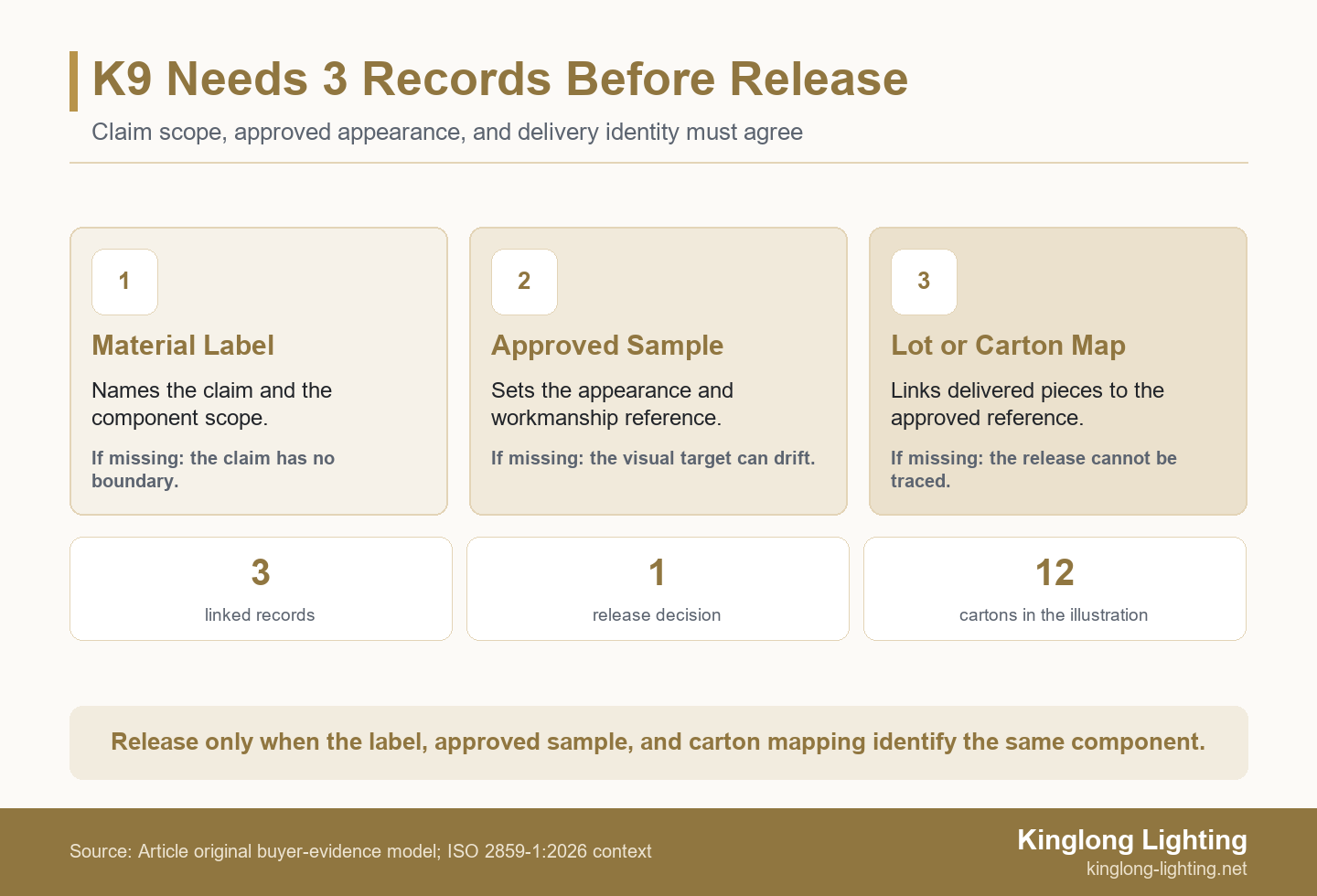
ISO 2859-1:2026 describes AQL-indexed acceptance sampling plans for lot-by-lot inspection by attributes. The standard’s relevance here is not a universal inspection percentage. It is the discipline of defining the lot, sample-size logic, and acceptance or rejection threshold before results are interpreted. A buyer can apply the same discipline to decorative components by deciding which component code, cartons, and approval reference the review covers. When that evidence needs to be translated into a custom fixture request, Kinglong Lighting’s map the evidence into a custom fixture brief.
Illustrative Scenario: The Statement and Cartons Do Not Connect
This illustrative example concerns an interior procurement team comparing pendant components for a public-area chandelier. It is not a verified Kinglong Lighting project.
The order lists 24 fixtures and 360 faceted pendants. The supplier provides one photo and a statement that uses the words “K9 Crystal.”
The team is ready to approve the pendant schedule, but the photo has no sample identifier and the statement does not name a component code.
First, the packing list groups the 360 parts into 12 cartons without connecting a carton to the photographed reference.
Second, the statement applies the K9 wording generally, while the schedule does not show which pendant line it governs.
The wording is not necessarily wrong. The problem is document identity: the buyer cannot tell whether the claimed material, the approved visual reference, and the pendants in the cartons are the same acceptance population.
When a material statement cannot be connected to the approval reference and the cartons in an illustrative order, do not release a carton for acceptance unless the current, component-coded schedule reconciles those records.
The team asks for a revised schedule with a pendant code, reference-sample identifier, carton or lot identifier, and agreed viewing condition for the comparison.
Before release, the buyer selects 24 pendants across the identified cartons and compares them with the named reference while confirming that every selected carton maps to the same component record.
Result: the review adds one documentation step before acceptance, but it avoids approving a claim whose scope cannot be traced to the 360 delivered components.
This is an illustrative procurement scenario, not a universal sampling prescription or a substitute for structural, electrical, or project-specific compliance review. Its document-version boundary is the current component-coded schedule; the earlier general statement cannot govern a release.
Write a Brief Suppliers Can Answer
A component brief with a label, reference sample, viewing condition, and production identifier makes supplier responses comparable. It also makes disagreement easier to resolve because the buyer can point to a named component instead of arguing from a broad visual impression. Kinglong Lighting can be part of that comparison, but the evidence request should remain the same for every supplier. Buyers considering the wider fixture context can view decorative lighting project references.
| Brief field | What it clarifies | Buyer evidence to request |
|---|---|---|
| Component scope | Which pendant, prism, or trim piece carries the claim | Component code, drawing reference, and quantity |
| Approval reference | Which visual and workmanship target governs comparison | Sample identifier, image set, and agreed viewing condition |
| Material record | What the supplier means by the label | Material statement and any named technical data |
| Production identity | Which delivered population the approval covers | Lot, carton, or packing reference linked to the component code |
Based on this comparison, the useful supplier response is not “our K9 is high quality.” It is a response that lets the buyer compare four fields against the same component. That brief can then travel from early product selection to a custom fixture discussion without losing the approval reference.
Prepare a K9 Crystal Review Request
A project-specific review becomes more useful when a buyer provides the component schedule and approval reference before asking for a quotation or customization discussion. Prepare the following items before the conversation so the supplier can answer the evidence question, not merely restate the label.
- Name each component that carries the K9 Crystal claim.
- Attach the sample image or physical-reference identifier that governs appearance.
- State the viewing condition for clarity, color, edge, and facet comparison.
- Request the record that ties the approved reference to cartons or lots.
When the fixture concept is ready but those links are still missing, prepare the component schedule, the approval reference, the project quantity, and the required delivery stage, then request a review of your crystal component brief.
Questions to Resolve Before Acceptance
Frequently Asked Questions
Is K9 Crystal the Same as Lead Crystal?
No. A K9 Crystal label should not be treated as a claim that the component meets a particular lead-crystal category. The relevant EU framework shows why defined crystal descriptions need stated composition and category conditions. For a chandelier buyer, the next question is not simply whether lead is present; it is which material description applies to the named component and what evidence supports the claimed optical result.
Can a Light Test Prove That a Pendant Is K9 Crystal?
No. A light test can reveal visible condition and cut behavior, but it cannot replace a material statement or lot-linked record. Use the test to compare the proposed component with the approved reference under an agreed viewing condition. If the supplier cannot identify the sample or the production population, more sparkle in one photo does not close that gap.
Which Supplier Documents Matter for K9 Crystal Components?
Ask for a material statement, an approval-sample identifier, and a production-lot or component reference that can be compared with the shipment. The useful documents are the ones that connect to one another: a statement that identifies the component, a sample record that names the visual target, and a carton or lot record that shows which delivered parts the approval covers.
Should Every Crystal Pendant Be Inspected Before Acceptance?
Care choices and inspection scope should follow the identified component and agreed acceptance plan, not a generic K9 label. Not every order needs a fixed universal percentage of pieces reviewed. The scope should reflect the component role, lot structure, visual risk, and agreed sampling method. What matters is that the buyer can explain which parts were selected and which approval reference governed the comparison.