One of the costliest glass-approval mistakes is approving a process claim from a single visual cue that production cannot reproduce. A bubble, a soft rim, or a mold seam may help describe the character a designer wants, yet none can independently prove how the part was formed. For a decorative-lighting buyer, the safer comparison separates two decisions: the look to protect and the manufacturing method the supplier must document.
What Buyers Can—and Cannot—See at a Glance
Forming route is the documented way hot glass was shaped into the part, not a verdict on whether it is the right part for the project. Hand-blown and machine-pressed glass can each be appropriate when the purchase brief states the intended character, the acceptable variation, and the replacement requirement. The risk begins when an aesthetic preference is treated as proof of a manufacturing claim.
- A seam is a question: it may show that a mold played a role, not that pressing occurred.
- Variation is a requirement: record the range the project accepts instead of calling every difference “handmade.”
- A process name needs a record: ask whether the component was pressed or blown into a mold.
- One sample is a reference, not a lot rule: approve a small group before releasing installed pieces and spares.
The practical goal is not to make a collector-style identification from a photograph. It is to give the supplier language that can be quoted, sampled, inspected, and carried into replacement stock. That is especially important for repeated shades in a chandelier or lobby feature, where small visual differences can become obvious only after many pieces are installed together.
Start by Separating the Forming Routes
A buyer should name the forming route before using a visual feature to compare glass components. Glass Alliance Europe distinguishes press, press-blow, and blow-blow as separate forming techniques. That distinction matters because a broadly described “machine-made” part may still involve different actions, tooling, and visual outcomes.
Use the supplier’s words precisely. Ask for the route used on the quoted part, whether a mold is involved, and which features are expected to vary from piece to piece. Then compare those statements with the approved reference rather than trying to turn a visible mark into a universal test. For Kinglong Lighting, the distinction matters because a decorative fixture brief has to carry the selected glass character into a repeatable component decision. Buyers can review the Crystal Tube series as a material-reference context; the product context does not replace a project-specific forming declaration.
Machine-Pressed Means a Plunger Shapes Hot Glass in a Mold
Machine-pressed glass is shaped by a plunger acting with a mold, not merely by the fact that the finished part looks regular. The Getty Art & Architecture Thesaurus definition of pressed glass identifies the mold-and-plunger mechanism. That gives buyers a useful specification term when the design depends on a documented pressed route, repeated molded geometry, or relief that must be consistent across a set.
It does not create a quality ranking. A well-made pressed shade may be the sensible choice where replacement matching and repeated form are critical. Equally, a supplier should not sell a component as hand-blown merely because a pressed part has minor variation. The purchase requirement should describe the desired form, the permitted visual range, and the evidence needed to confirm the route.
Hand-Blown Is Not the Same as Every Molded Glass Part
A mold can be part of a blown route, so buyers need to ask whether the glass was pressed or inflated into that mold. Free-blown means glass inflated through a blowpipe and shaped with tools, as the Getty glossary defines it; the V&A’s technique overview explains how the blown glass bubble is shaped with movement and tools. Mold-blown means glass inflated inside a mold so it takes that mold’s shape.
Mold-blowing is the important boundary. A partly expanded gather can be blown into a mold and take its form or decoration, then receive further work while hot. A molded-looking detail therefore does not automatically place a component in the pressed category. When a brief says “hand-blown,” ask whether it means free-blown, mold-blown, hand-finished after a molded step, or simply a desired artisanal appearance. Those are different requirements, and a supplier needs the chosen one before sampling.
Read Five Visual Clues as Prompts, Not Proof
The same visible feature can be useful for describing a sample while remaining insufficient to certify its route. A buyer can photograph the feature, state whether it is welcome or unacceptable, and ask the supplier to connect it to a process statement. That turns appearance into a procurement requirement instead of a guess about provenance.
| What you notice | What it can help describe | What it cannot prove alone | Better supplier question |
|---|---|---|---|
| Mold seam or repeated relief | Where a mold may have influenced the surface | That the part was machine-pressed | Was the glass pressed, or blown into a mold? |
| Soft or varied rim | The edge character the design team wants | A specific blowing route or level of hand work | How is the rim formed and what range is acceptable? |
| Wall variation | The visual weight and light transmission of the sample | That every production piece will vary in the same way | Which variation band will the pilot demonstrate? |
| Bubbles or small inclusions | A feature the buyer may accept, limit, or reject | Hand-blown origin or a quality level | Which visible inclusions are within the approved range? |
| Highly repeated shape | The degree of geometric consistency needed | That a component cannot include hand operations | Which dimensions and visual traits must repeat? |
Treat a visual clue as the first line of a specification question, not as the last line of a process conclusion. A pontil mark is a ring-like trace left when a blown vessel is detached from a holding rod; it is another observation that needs context. The table is most useful during sample review: circle the feature, define its acceptance boundary, and request the route declaration and a small production set for review. It is not a field test for labelling finished glass from a single photograph.
Why a Single Clue Fails in a Real Approval
A seam or relief can justify a process question, but it cannot by itself prove machine pressing. The Getty definition of mold-blown glass describes glass blown into a mold, and Getty’s account of mold-blowing in practice makes the same separation visible. The buyer should therefore treat a mold-related mark as evidence that a process question is needed, not evidence that the question has been answered.
A pontil mark, when present, also needs context. It can be a useful observation on a blown vessel, but it may be finished away, and a component’s overall production history can include more than one operation. Avoid broad rules about bubbles, weight, thinness, or seams. A clear requirement is stronger: “Match the approved rim character; declare the forming route; show the agreed range on a pilot group.”
Choose the Route by the Character You Need to Control
Choose the route for the visual character and level of repeatability the fixture must control. This is a design-and-procurement choice, not a contest between an artisan label and a factory label. Start with the question that affects the installed fixture: does the project need controlled individual variation, tightly repeated geometry, or a combination with specific limits?
For controlled variation, define what should vary: perhaps a gentle shoulder change, a softer edge, or a slight difference in wall character. Then define what must not vary: shade diameter, fitter interface, suspension alignment, colour family, or fit with a replacement piece. For repeated geometry, describe the reference form and the dimensions or relief that must remain consistent. Neither approach removes the need for engineering, safety review, or supplier capability confirmation.
“Hand-blown look” is therefore not yet a production requirement. It becomes one only when the buyer states the intended effect, the excluded effects, and the proof needed before release. That wording gives the supplier room to explain the feasible route instead of guessing which visual irregularities will be praised on a hero sample and rejected across an installation. Buyers can browse related lighting-material resources before turning that choice into a final brief.
Use a Three-Level Proof Before You Approve the Glass
Approve the glass only when the visual reference, documented route, and production-representative pilot agree. These are three different kinds of proof: the reference describes the desired appearance; the route statement says how the supplier intends to form the part; and a grouped pilot is a small set of production-representative pieces reviewed together against the approved reference to show whether the appearance survives repetition. One layer cannot do another layer’s job.
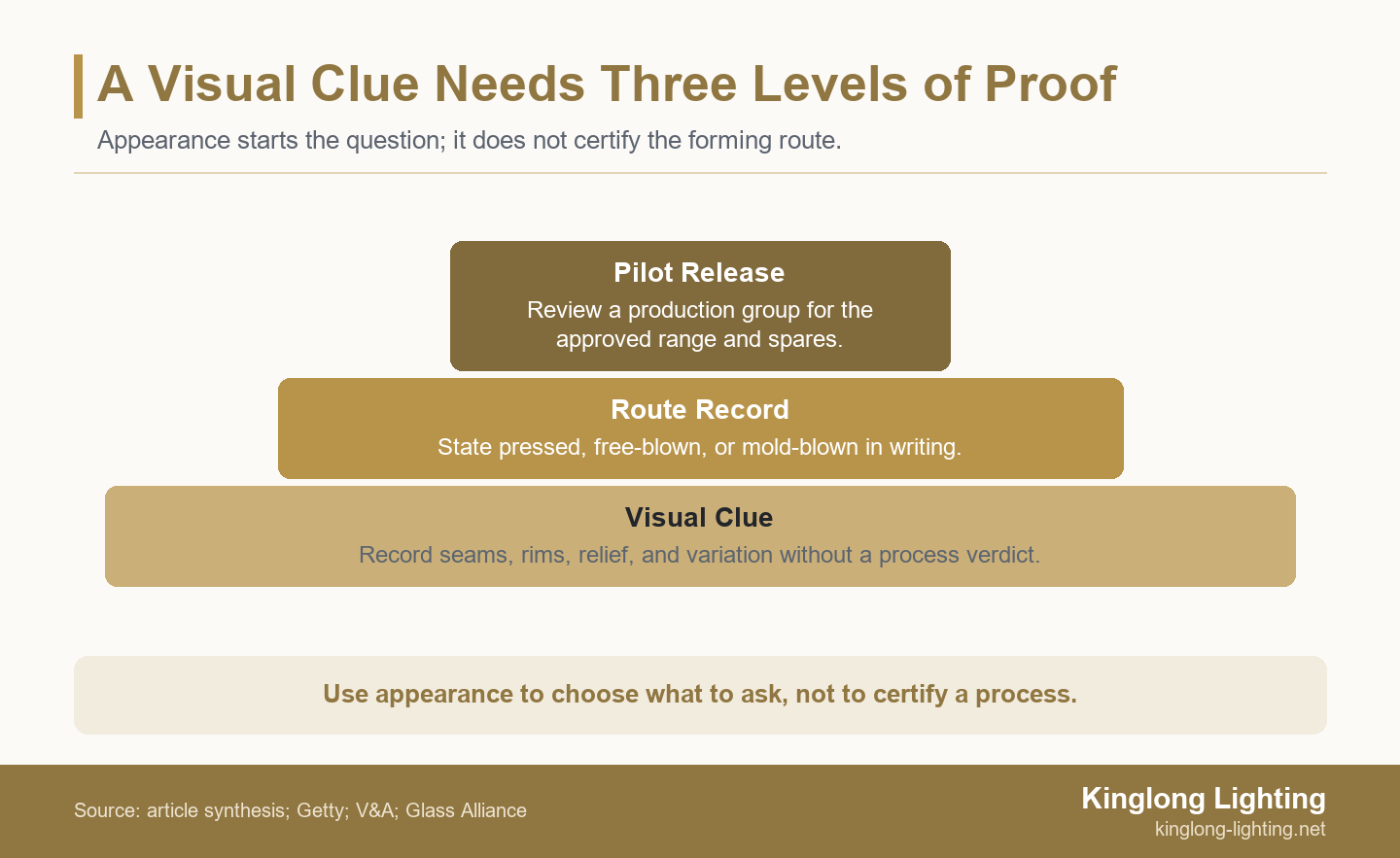
- Visual reference: retain photographs and, where possible, a labelled physical master sample. Mark the rim, shoulder, relief, transparency, and any accepted variation.
- Forming declaration: name pressed, free-blown, mold-blown, or another agreed route in the supplier’s wording. If the route contains more than one operation, record the relevant sequence instead of relying on a sales label.
- Grouped pilot: review several production-representative pieces together. Record the accepted range, the rejected differences, and whether installed pieces and service spares must stay within it.
The third level prevents a common mismatch: a single beautiful shade receives approval, while later pieces are judged against an unstated idea of what “similar” means. For custom decorative lighting, teams can map the requirement into a custom lighting brief once those three records exist. The useful handoff is the visual reference plus route and pilot evidence, not a promise that every piece will be identical or individually unique.
An Approved Hero Sample Does Not Approve 204 Pieces
The illustrative scope is 48 × 4 + 12 = 204 glass shades requiring a defined visual acceptance range. The arithmetic is not a universal order rule; it shows why a hero sample has a different job from a production approval. A buyer can like one shade and still have no shared basis for accepting the remaining installed pieces or later service spares.
Consider the scenario as a project-control example rather than a published case. It follows the same question as the comparison: can a desired visual character be carried into a documented route and an approved production range? The following quantities and decisions are deliberately illustrative.
A Three-Fixture Pilot Creates the Release Boundary
For this illustration, compare a 12-shade pilot from three fixtures with the master sample before staged release. The result is not a pass label for hand-blown glass; it is a written range that lets the buyer decide whether the visual character can be repeated across the affected scope.
A hotel-lobby design team is approving smoked glass shades for a custom decorative-lighting installation. The desired reference has gentle shoulder variation and a soft rim, so the team wants visible character without losing the ability to replace a damaged shade later.
The illustration uses 48 fixtures with four shades each, creating 192 installed shades, plus 12 service spares. The visual approval therefore affects 204 parts rather than the one sample first shown to the designer.
The hero sample is visually accepted, but the purchase order says “hand-blown” and the supplier’s plan says only “formed glass.” The plan does not name free-blown, mold-blown, or pressed, and it does not state an acceptance range for the group.
The sample’s shoulder is slightly varied and its rim is softer than the design team’s rigid reference. Those are useful visual observations because they tell the supplier which character needs protection.
The production record gives no route declaration, no grouped sample size, and no rule for the spares. The team would have no reliable way to judge whether a later shade belongs with the approved set or merely resembles the hero piece in isolation.
The phrase “formed glass” does not identify the mechanism, while one hero sample does not establish the amount of allowed variation. The open risk is not that all variation is wrong; it is that the project has no shared boundary between intended character and an unexpected production difference.
Place a controlled hold on final glass approval and release only work that is independent of this open material decision. The design intent remains valid, but the process-dependent quantity cannot be approved until the supplier closes the evidence gap.
Replace the ambiguous label with the agreed forming route, reference photographs, allowed and excluded visual differences, and a three-fixture pilot. Require the supplier to state how the 12 service spares will be compared with the same approved range.
Review 12 pilot shades from three fixtures beside the master sample, record the accepted variation range, and bind that record to the 192 installed shades and 12 spares. If the group cannot meet the agreed character, revise the route, reference, or acceptance boundary before staged release.
The 48 fixtures, four shades per fixture, three-fixture pilot, and 12 spares are illustrative assumptions, not a universal sampling rule. A real project should set its own pilot scope according to component risk, grouping, service needs, and supplier capability. For application context beyond this illustration, teams can view Kinglong Lighting project references.
Send a Better Glass-Sample Request
Send the visual and process request with quantity and spare scope so the sample can be planned for production rather than display only. A supplier can give a more useful response when the request names the reference image or sample, intended forming route or open question, component drawing, installed quantity, and spare quantity together.
- Attach the reference and identify the rim, wall character, relief, or variation that matters.
- State whether the requirement is a named route, a visual effect, or both.
- List the dimensions and interfaces that must repeat even when visual variation is permitted.
- Ask for a written route declaration and a grouped pilot proposal before final production approval.
- Include the installed count and service-spare count so the approval record covers both.
Attach one marked-up image or physical reference rather than a broad style label. A few arrows can identify the shoulder, rim, relief, transparency, or acceptable small inclusions that the supplier needs to interpret. State the viewing condition if the glass will be judged under a particular lamp temperature, background, or grouping. If a component must fit a fixed holder or share a visible line with neighbouring shades, make that non-negotiable constraint explicit. The supplier can then separate what is an appearance preference from what is a dimension, assembly, or service requirement.
Before release, ask the supplier to return the request as a checkable record: the proposed route, sample scope, visual range, production reference, and spare treatment. That response gives the buyer a defined point to revise, approve, or hold. It also creates a clear handoff for the design team, procurement lead, and production reviewer: each can see the same version of the requested character, process evidence, and service scope. When the fixture drawing, reference, route preference, quantities, and spare requirement are ready, request a glass-sample review for your fixture to turn them into a supplier-ready sample and production-proof checklist.
FAQs
These answers keep the route-versus-appearance boundary intact. They can tighten a buyer’s request, but they do not replace the reference, written process statement, and production-representative review used for release.
Can a mold seam prove that glass is machine-pressed?
No. A seam can show that a mold was involved, but it cannot establish whether the hot glass was pressed into the mold or blown into it. Use the seam to ask for the forming declaration and to compare the feature with the approved reference. If the route matters to the project, require it in writing and review a grouped pilot rather than relying on the seam as a stand-alone test. A seam may also be positioned or finished differently across designs, so it should be described as an observed feature, not used as a shortcut for judging quality.
Is hand-blown glass always thinner than pressed glass?
No. Thickness can vary with the component design, forming method, finishing, and the supplier’s process controls. It is more useful to state the visual or dimensional range that the fixture accepts than to treat thinness as proof of a route. Compare the relevant areas against the approved sample and confirm whether those differences need a measured limit, a visual boundary, or both. A shade may need a stable fitter interface while allowing a different visual impression in the body, so the brief should separate those two decisions rather than applying one broad thickness rule.
What should a hand-blown glass specification include?
Name the intended forming route or the open route question, a reference sample or image, acceptable and excluded variation, component dimensions and interfaces, grouped-pilot scope, installed quantity, and spare requirement. Also state whether spares must match the same approved range. The specification should make clear which appearance details are design priorities and which production records must accompany the pilot before the order is released. If free-blown, mold-blown, or a mixed operation is acceptable, say so explicitly; otherwise the phrase “hand-blown” may leave the supplier and buyer approving different expectations during sampling and production.
When is machine-pressed glass the better choice for lighting?
Machine-pressed glass can be the better choice when the design depends on tightly repeated form, relief, dimensions, or replacement matching and the specification does not require controlled artisanal variation. The decision should still follow the component’s engineering needs, visual reference, and supplier evidence. A pressed route is a mechanism, not a lower-quality label; choose it when it matches the documented character and continuity the fixture needs. Where the brief asks for a particular handmade-looking effect, test that effect on the pilot instead of assuming it is incompatible with every molded or mechanically assisted operation.