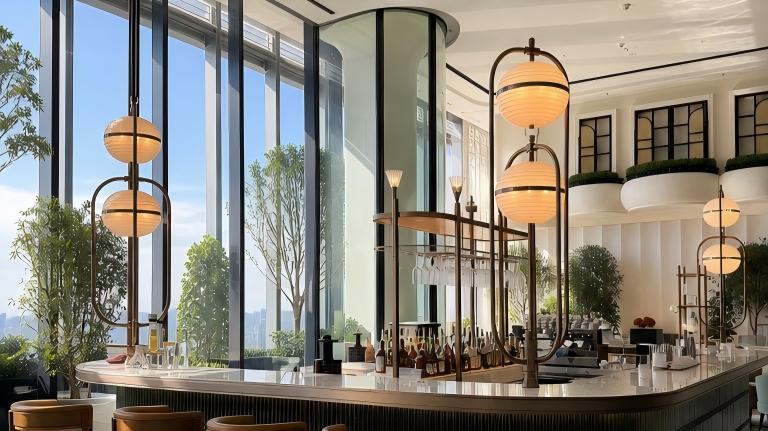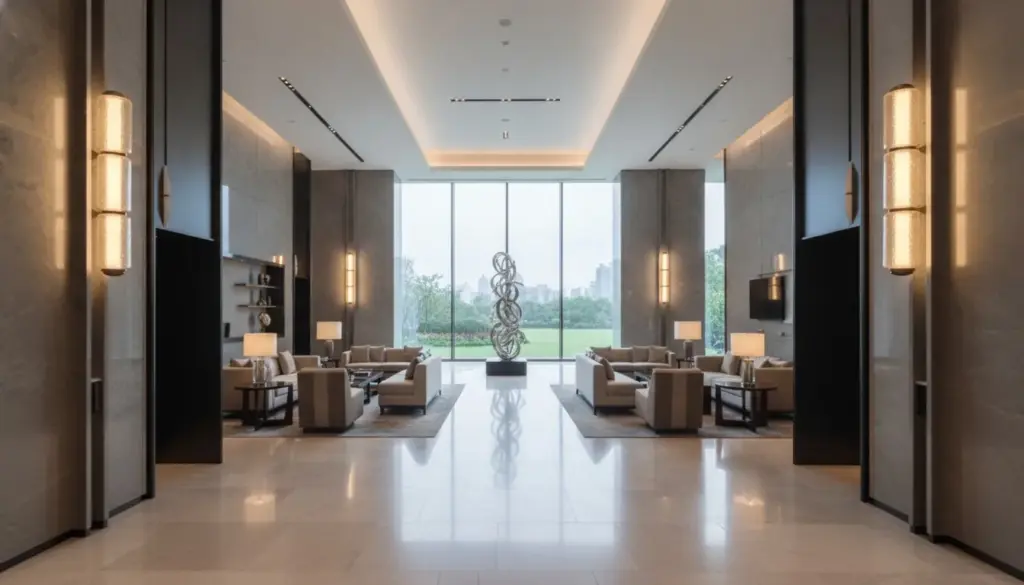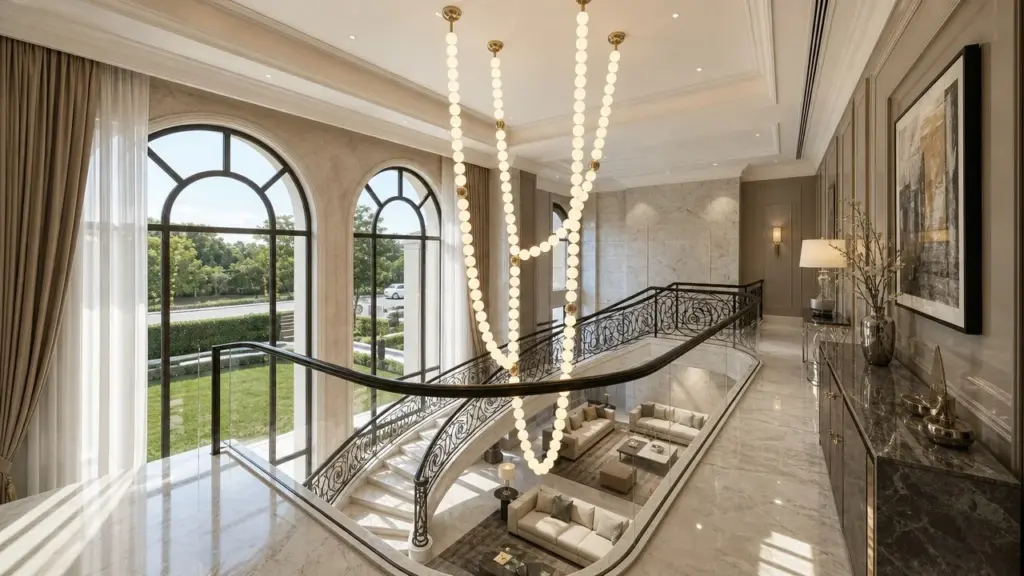
St. Regis resort lighting works when tropical ease and crystal tradition support each other because resort luxury is judged in motion: morning sea light, shaded afternoon lounges, sunset rituals, evening dining, and private villa calm. A chandelier that feels magnificent in a ballroom can feel heavy in a beach setting. A fixture that feels relaxed can lose the St. Regis sense of ceremony if it has no sparkle, structure, or ritual moment.
Public St. Regis and resort information can guide design context, but it is not an official St. Regis lighting standard and does not imply endorsement of Kinglong Lighting. The practical question is how to translate St. Regis glamour into tropical conditions without losing comfort, durability, maintenance logic, or manufacturing control.
Key Takeaways
- Two forces: St. Regis resort lighting must balance ceremony and relaxed tropical context.
- Crystal restraint: Crystal can work in resorts when sparkle is controlled, serviceable, and climate-aware.
- Tropical proof: Humidity, salt air, cleaning access, glare, and villa privacy should be part of the chandelier file.
- Resort rhythm: Lighting scenes should support morning softness, sunset ritual, evening dining, and nighttime wayfinding.
- Kinglong fit: Kinglong Lighting can support custom resort fixtures by separating visual tradition from production evidence.
Read St. Regis tradition through a resort lens
In a tropical St. Regis-style resort, crystal should feel like refined light on water, not a city ballroom imported to the beach.
The official St. Regis brand site uses public cues around exquisite experiences, butler service, rituals, fashion, glamour, and iconic gatherings. The official St. Regis Maldives Vommuli Resort page places that tradition in a private island setting with Indian Ocean context. These signals create a design tension: the brand can support sparkle and ritual, while the resort setting asks for air, ease, salt resistance, privacy, and indoor-outdoor calm.
Crystal tradition should be translated, not copied
Crystal tradition does not always require a formal chandelier silhouette. In a resort, it can become suspended drops that echo water, polished accents that catch sunset, hand-blown glass that softens sparkle, or low-density crystal tubes that create movement without weight. The approval question is whether the fixture carries St. Regis ceremony while respecting bare feet, ocean views, open terraces, and relaxed guest posture.
The most convincing resort interpretation often uses less crystal but makes each point of light more intentional. A dense city chandelier may rely on mass and repetition. A tropical version may rely on reflection, spacing, and the way each element catches natural light. The mock-up should therefore include daylight views, not only evening glamour views. If the crystal looks heavy at noon, it will not become lighter because the night scene works.
Tropical setting changes material risk
Resort environments make small material choices more important. Salt air can affect metal finish expectations. Humidity can influence driver location and service access. Sand and dust can change cleaning frequency. Strong sunlight can shift how warm metals and glass read during the day. A chandelier package should therefore name finish process, protective coating, spare crystal or glass components, cleaning method, crate protection, and local maintenance responsibility.
Specifiers should also ask where the fixture sits on the indoor-outdoor spectrum. A fully conditioned ballroom, an open-air arrival pavilion, a covered restaurant, and a beachfront villa terrace do not share the same risk profile. The same polished finish or crystal component may be appropriate in one zone and unwise in another. A resort lighting schedule should label exposure level so the factory does not treat every decorative fixture as if it lived in the same climate.
Design scenes around resort time, not only rooms
St. Regis resort lighting should be reviewed across time blocks. Morning scenes may need very soft decorative contribution because daylight carries the space. Afternoon scenes should avoid glare from reflective surfaces. Sunset scenes can allow sparkle and ritual. Evening scenes may support dining, lounge, arrival, or wedding moments. Night scenes need wayfinding and safety without breaking privacy. The fixture should have a temporal role, not only a spatial position.
| Resort moment | Lighting role | Fixture risk | Evidence to request |
|---|---|---|---|
| Morning arrival | Soft welcome with daylight support | Decorative light feels unnecessary | Daylight photo and scene level |
| Afternoon lounge | Shade, comfort, and low glare | Crystal creates harsh reflection | Guest-eye glare review |
| Sunset ritual | Controlled sparkle and ceremony | Fixture becomes too theatrical | Mock-up video and dimming curve |
| Evening dining | Warm table atmosphere | Color quality weakens food and skin tone | CCT and color evidence |
| Night wayfinding | Low-level orientation and privacy | Overlighting paths or villas | Scene schedule and shielding plan |
The conclusion is that St. Regis resort lighting needs a time-based approval file. A fixture can be approved for evening glamour but still fail afternoon comfort if the scene review is incomplete.
Use color quality and comfort as luxury controls
The DOE TM-30 FAQ helps explain why color rendition should be discussed with richer vocabulary when materials include crystal, brass, timber, stone, food, fabric, and skin tone. The WELL v2 Light concept reinforces visual comfort and human experience. In resort lighting, those two topics are inseparable: color quality protects the romance, and comfort protects the stay.
Calculated from a 5-moment resort lighting review: if a chandelier is tested only at sunset and evening dining, 2 reviewed moments / 5 total moments = 40 percent coverage. That may be enough for a mood presentation, but it is weak for production approval. The other 60 percent can hold the problems that guests experience daily.
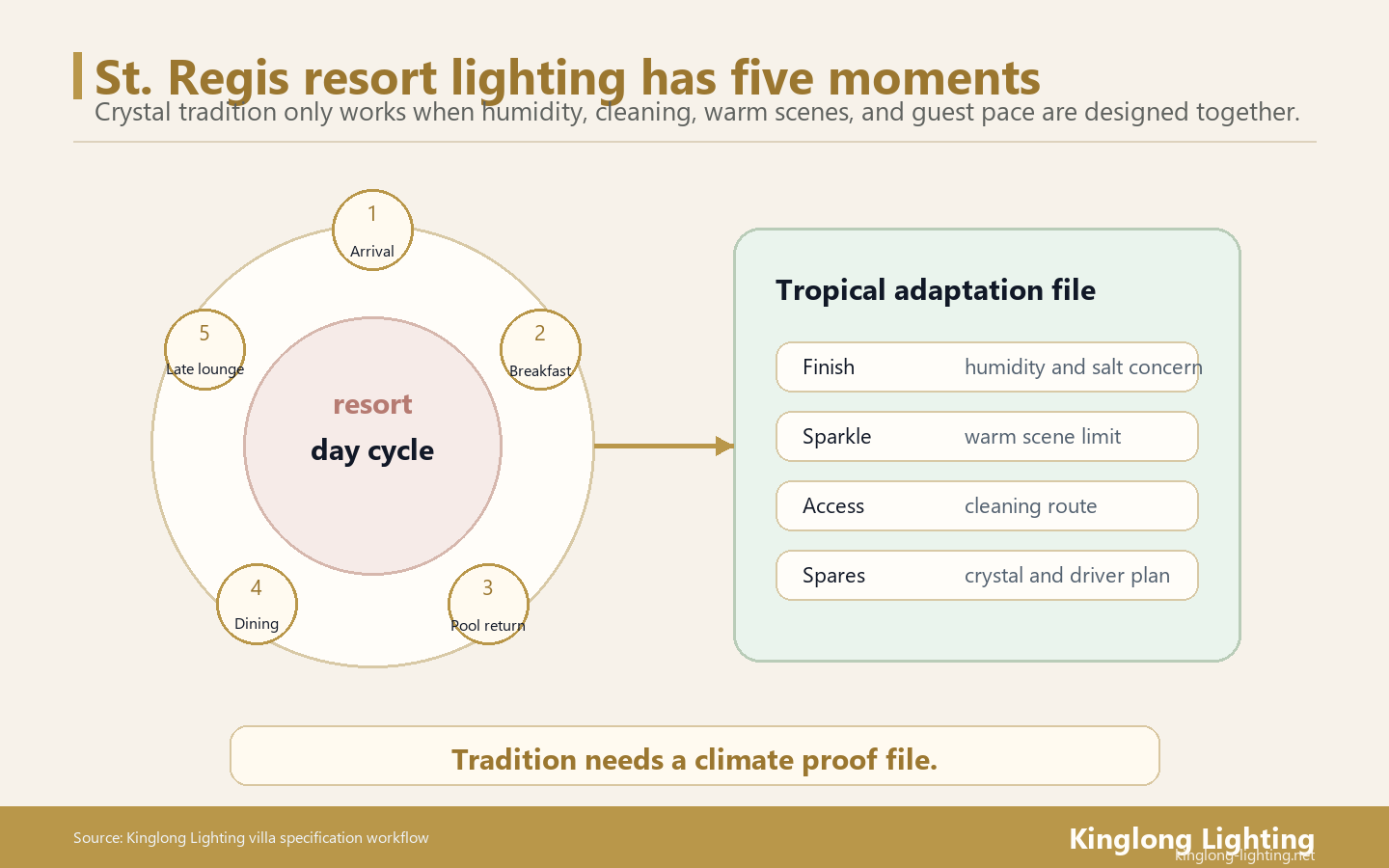
That time-based review is also a maintenance tool. Morning staff may clean after breakfast, engineering may access drivers during low-occupancy hours, and events may reset the same space by evening. A resort chandelier that is easy to admire but hard to reset can become an operating burden. The approval file should show who can clean it, how often, with what equipment, and whether spare elements can be replaced without disturbing guests.
Protect tradition with modern manufacturing proof
Official luminaire references such as UL luminaire testing and certification and the IEC 60598 luminaire standard family show why product evidence must remain connected to the final fixture configuration. For a resort chandelier, this means testing route, driver selection, enclosure assumptions, suspension method, finish process, and replacement parts should match the actual version sent to site.
The hidden trade-off is that resort informality can weaken documentation. Teams may accept a relaxed sample because the setting feels easy. Then the same fixture has to survive salt air, guest proximity, daily cleaning, and event use. A better brief keeps the mood relaxed but the file strict: drawing, finish master, color data, control scene, safety evidence, packing plan, installation sequence, and maintenance instructions.
How Kinglong Lighting can support St. Regis-style resort briefs
Kinglong Lighting can help by presenting resort fixtures in three layers. The first layer is tradition: crystal, polished metal, ceremonial rhythm, and refined sparkle. The second layer is tropical translation: lighter density, softer glass, warmer diffusion, corrosion-aware finishes, and lower-glare viewing angles. The third layer is production proof: drawings, samples, testing route, packing, installation, and maintenance access.
The customization workflow, hospitality lighting page, and project inquiry route can support this type of evidence-based brief. Send the resort location, salt-air exposure, indoor-outdoor boundary, guest-view positions, scene schedule, material palette, and preferred St. Regis-style ritual moments. Ask for a concept that shows both crystal tradition and climate-aware production logic.
Kinglong Lighting should present options with a clear climate note. One option may use more crystal in a conditioned lobby. Another may use treated metal and glass in a semi-open restaurant. A third may use low-density sparkle in a villa or spa arrival sequence. With that structure, the owner can preserve St. Regis ceremony where it matters and avoid forcing fragile glamour into every tropical condition.
A final resort check should cover replacement logistics. Island properties may not have immediate access to specialized parts, lifts, or factory technicians. The chandelier file should therefore include spare quantities, module labeling, crate repacking instructions, and a simple service sequence. That operational detail can protect the sense of effortless luxury long after opening night.
Related Guides
- Marriott Luxury Brand Lighting
- Hotel Lighting Glossary
- CNAS-Accredited Testing for Hotel Chandeliers
St. Regis Resort Lighting Action Card
- Define which ritual moment the chandelier supports.
- Test crystal sparkle during morning, afternoon, sunset, evening, and night scenes.
- Request salt-air, humidity, cleaning, spare-part, and driver-access assumptions.
- Protect color quality for food, skin tone, timber, stone, glass, and metal.
- Send the resort condition brief to Kinglong Lighting for custom review.
A St. Regis resort chandelier file should protect tradition from the climate
A St. Regis resort chandelier brief often starts with heritage, ceremony, and crystal language. In a tropical setting, that language has to pass a second test: humidity, salt air, open-air transitions, cleaning access, warm evening scenes, and guest clothing patterns all change how sparkle and finish behave. The right file does not reduce tradition. It protects tradition from the conditions that can make it feel heavy, hard to maintain, or out of place.
Map the chandelier to resort time
The same chandelier may be seen during breakfast, after pool use, at sunset arrival, during formal dinner, and late at night. A single evening render cannot prove all of those moments. The approval file should define which scenes matter most and how the fixture is allowed to change between them. If the chandelier needs ceremonial sparkle at dinner, it may still need softer reflections near morning circulation or lounge seating. This is a control decision as much as a decorative decision.
Adapt crystal and metal to humidity and service
Tropical resort conditions make maintenance part of the design language. Crystal size, hanging density, metal coating, cable exposure, and spare strategy should be reviewed before production, not after the operator asks how the fixture will be cleaned. The supplier file should show which parts can be removed, which finishes need special handling, where drivers sit, and how the maintenance route avoids damage. A chandelier can be luxurious and still be designed for regular service.
Keep warmth from becoming visual fatigue
Warm resort palettes can make crystal feel generous, but too much amber light or uncontrolled sparkle can flatten the room. The brief should test the chandelier against timber, stone, water reflection, fabric, and table lighting. If Kinglong Lighting prepares samples or visualizations, the useful question is not only whether the piece is beautiful; it is whether the evening atmosphere remains comfortable after guests spend an hour in the space. That is where a St. Regis-style resort project often wins or loses.
Use the release file to separate romance from risk
The final release file should list the romantic intent and the operational risk side by side. Ceremony, sparkle, and arrival memory belong in the design column. Humidity, cleaning, corrosion concern, spare parts, access, and scene control belong in the evidence column. When both columns are visible, the project can keep the St. Regis feeling while making production, installation, and maintenance decisions with less guesswork.
Confirm the parts guests will notice after opening
The resort team should also decide which details must remain perfect after months of service. That may include the clarity of a crystal drop near eye level, the warmth of metal against timber, the way the chandelier reflects in water or glass, and the ease of replacing a damaged visible piece. Those details are small in a procurement spreadsheet but large in the guest memory. Naming them before sampling lets Kinglong Lighting focus proof, packing, and spare planning on the parts that carry the St. Regis promise.
That same note should identify the resort conditions that will be checked again after installation. A short post-installation review of scene levels, cleaning access, visible corrosion points, and spare readiness helps the chandelier remain aligned with the original design promise after the opening rush has passed.
Frequently Asked Questions
Can a tropical resort use crystal chandeliers?
Yes, if sparkle, density, finish protection, cleaning access, glare, and replacement parts are controlled for the resort setting.
What is the biggest lighting risk in a St. Regis-style resort?
The common risk is copying formal crystal tradition without translating it for daylight, salt air, privacy, maintenance, and relaxed guest behavior.
What should a resort chandelier mock-up include?
Include day and night photos, guest-eye glare checks, color evidence, finish samples, dimming tests, cleaning access, and a maintenance plan.