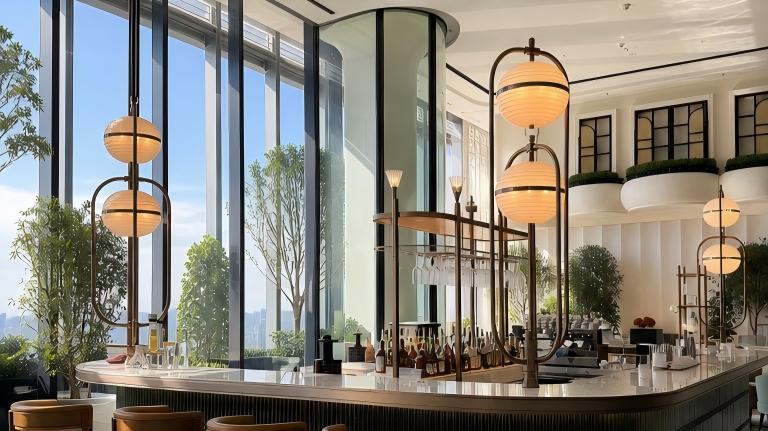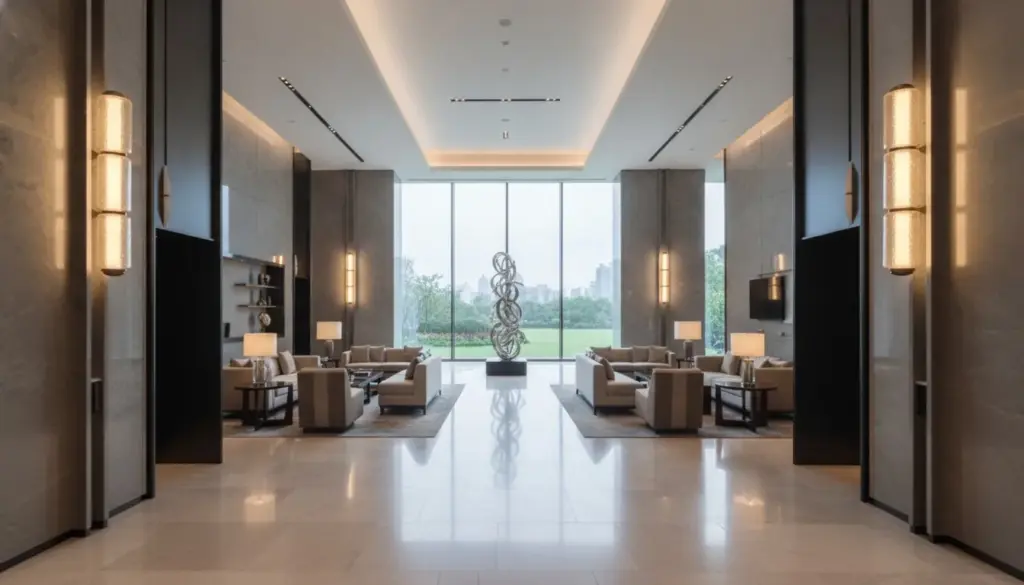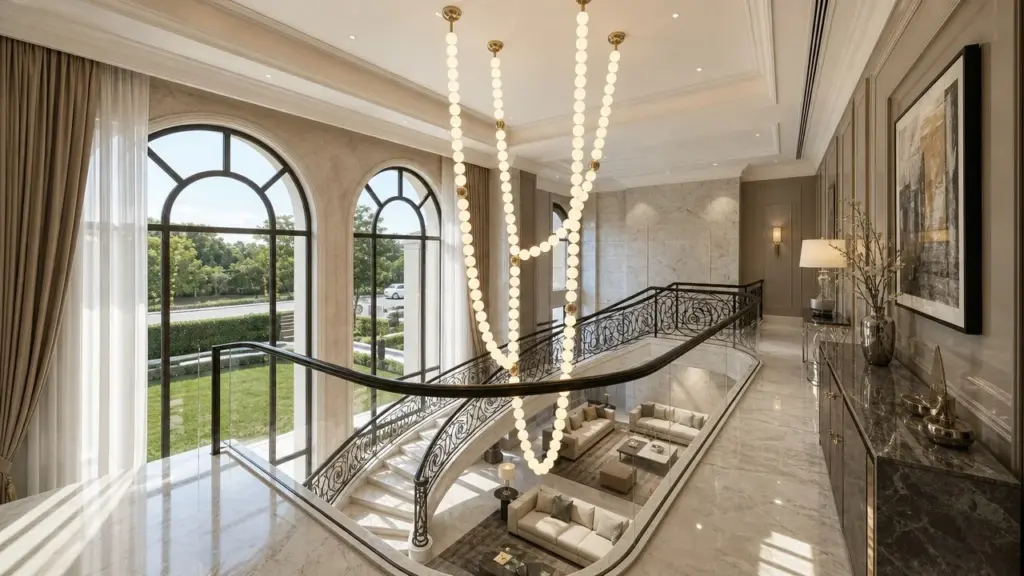
Shangri-La lighting design cannot be reduced to adding Asian motifs because the identity depends on translating heritage, calm hospitality, local culture, material restraint, and modern manufacturing control into one guest experience. A chandelier that looks obviously themed may feel shallow. A fixture that is too neutral may lose the emotional memory the property needs. The better question is how to make heritage buildable without turning it into decoration pasted onto a standard product.
This discussion uses public Shangri-La brand context, Kinglong Lighting’s public project and product information, and general lighting design sources. It is not an official Shangri-La specification and does not imply endorsement by Shangri-La. The goal is to help designers and procurement teams brief custom lighting that respects Eastern heritage while still meeting modern hotel manufacturing, testing, installation, and maintenance needs.
Key Takeaways
- Identity balance: Shangri-La-style lighting should feel culturally grounded, calm, and hospitable without becoming literal stage scenery.
- Material translation: Heritage can appear through rhythm, proportion, craft, texture, warm metal, glass, and spatial calm, not only through symbols.
- Modern control: Custom heritage lighting still needs drawings, mock-ups, color evidence, drivers, testing route, packing, and service access.
- Manufacturing value: A factory must convert story into repeatable modules, finish standards, tolerances, and installation logic.
- Kinglong fit: Kinglong Lighting can support this balance through custom design, product families, 3D visualization, and hospitality manufacturing experience.
Start with hospitality philosophy, not ornament
Eastern heritage in hotel lighting is strongest when guests feel the pace, proportion, and material intelligence before they notice a motif.
Shangri-La’s official brand page describes five-star hotels in premier addresses, tranquil surroundings, inspirational architecture and design, and hospitality from the heart. Its 50-year story page frames the brand through Asia and the evolution of hospitality. The Kuok Group’s Shangri-La profile references Asian heritage, more than 100 hotels, and over 75 destinations. For lighting, the useful signal is not to copy a single historical pattern. It is to create a sense of welcome, quiet luxury, and place.
The most durable briefs usually begin with behavior words before visual references. Should the arrival feel ceremonial, restorative, residential, garden-like, or urban and polished? Should guests slow down, gather, look upward, or move naturally toward reception? Those answers guide scale, diffusion, contrast, and sparkle. They also protect the design team from choosing a motif before deciding what the lighting should make guests do and feel.
Heritage can be spatial before it is decorative
A guest may experience Eastern heritage through layered thresholds, lower glare, warm material transitions, soft reflections, symmetry, asymmetry, or a rhythm that recalls screens, lanterns, courtyards, water, silk, or landscape. None of these require a literal emblem. In many luxury properties, the most confident cultural gesture is restraint. The lighting supports an atmosphere that feels rooted rather than announced.
Literal symbols create approval risk
The risk is not culture. The risk is shallow translation. A dragon, cloud, lotus, fan, or lattice motif can be beautiful when it belongs to the project story and material logic. It can also look generic if it is simply placed on a chandelier. The decision rule is to ask whether the motif affects form, light behavior, craft method, or guest experience. If it only decorates the surface, it may be weaker than a more abstract material strategy.
Translate heritage into manufacturing language
Custom lighting factories need more than a mood description. They need a controlled translation from story to product. If the story is “silk road warmth,” the manufacturing file should identify material tone, translucency, texture, module rhythm, edge detail, light source, and cleaning method. If the story is “courtyard calm,” the file should identify scale, spacing, shadow softness, visual hierarchy, and reflection control. If the story is “landscape and water,” the file should clarify glass treatment, suspension movement, glare risk, and maintenance access.
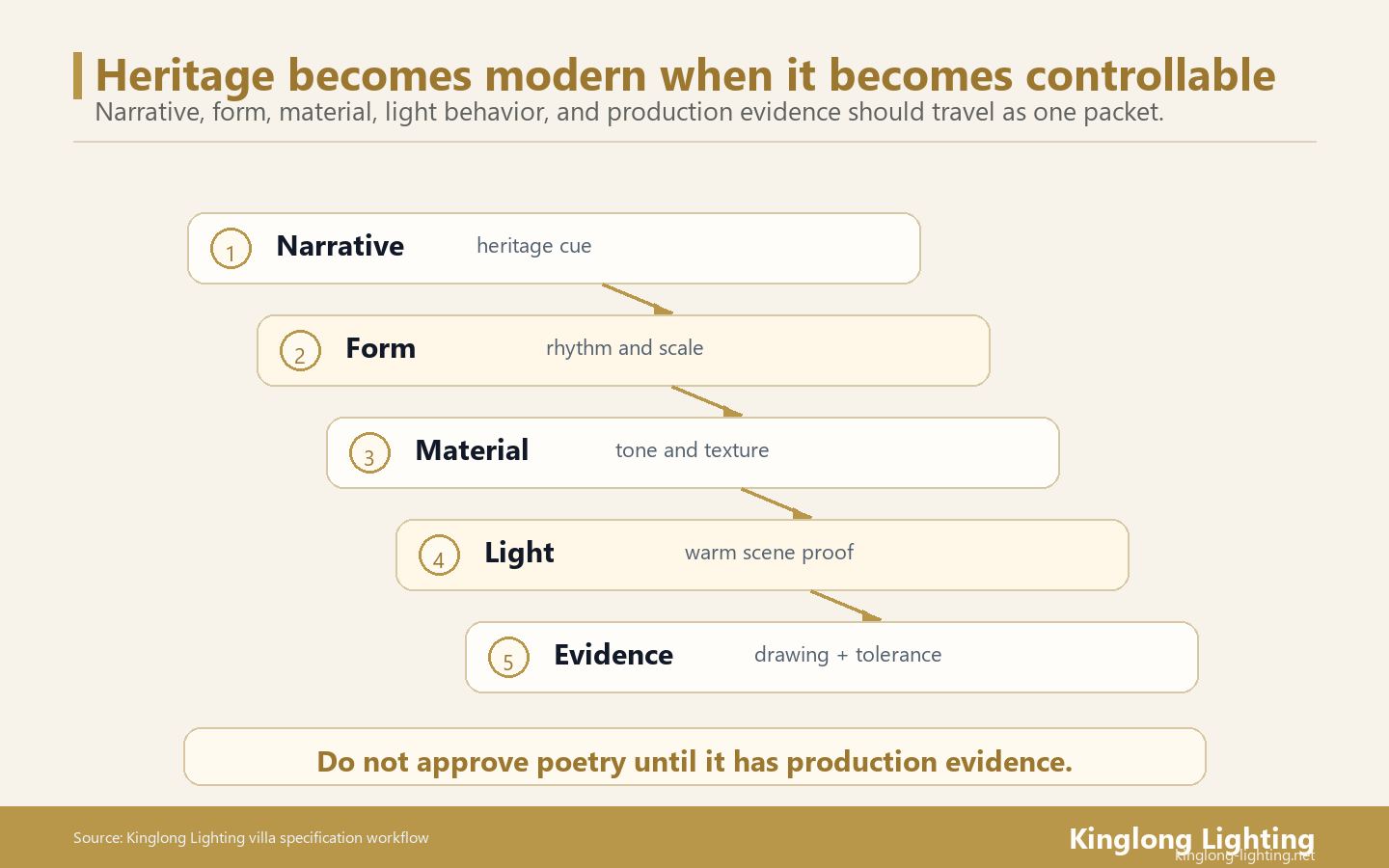
Based on our analysis, a heritage lighting brief becomes buildable when it has 5 translation layers: narrative, form logic, material system, light behavior, and production evidence. Missing one layer does not always stop design, but it pushes decisions into later project stages where changes cost more. The mechanism is timing asymmetry: poetic language is cheap early, but unclear production language becomes expensive after samples, tooling, or site coordination.
| Heritage cue | Better translation | Manufacturing proof | Risk if vague |
|---|---|---|---|
| Lantern warmth | Diffused glow, warm metal, soft edge | Material sample and CCT target | Fixture becomes too yellow or dim |
| Screen rhythm | Repeated vertical or lattice-like spacing | Module drawing and tolerance check | Pattern looks uneven at scale |
| Water reflection | Layered glass, polished accents, controlled sparkle | Mock-up video and glare review | Guest-facing glare or messy reflections |
| Landscape calm | Long horizontal proportion and low contrast | Rendered scene and dimming test | Space feels flat or underlit |
| Craft heritage | Hand-finished detail with repeatable standard | Finish master and QC sample | Irregularity reads as defect, not craft |
The conclusion is that heritage must become a specification. The designer protects meaning. The factory protects repeatability. The owner protects time, budget, and future maintenance.
Use color quality and comfort to create calm luxury
The DOE TM-30 FAQ is useful here because Shangri-La-style material palettes often depend on subtle color differences: warm metal, jade-like glass, amber tones, pale stone, dark timber, textile, and skin tone. A simple “warm white” note is not enough. The mock-up should show how the proposed source renders the materials that carry the identity.
The WELL v2 Light concept reinforces visual comfort and human experience. That fits a calm luxury brief. A chandelier can be culturally expressive but still fail if it creates high-contrast glare over lounge seating, reception, or dining. Calculated from a 5-layer brief: 2 affected layers / 5 total layers = 40 percent of the translation stack tied to material system and light behavior. That makes color quality and comfort core identity decisions, not engineering afterthoughts.
Kinglong product language that can support Eastern heritage
Kinglong Lighting’s public product families provide useful vocabulary for this type of brief. The Jiangnan Series directly signals Eastern inspiration through material and cultural direction. The Crystal Tube Series can support more geometric, luminous interpretations. The Crystal Cloud Series can support suspended, atmospheric compositions when the design intent leans toward softness and movement.
Those product references should be treated as starting languages, not fixed answers. A Shangri-La property in Xi’an may need a different cultural rhythm from a coastal resort, a business district property, or a renovated heritage building. The supplier should therefore present options by meaning and manufacturing logic: one option may emphasize warm brass and screen rhythm, another may emphasize glass layers and water reflection, another may emphasize cloud-like suspension and quiet sparkle.
Make the design modern by making it controllable
Modern manufacturing does not make heritage less authentic. It protects the guest experience from inconsistency. A custom chandelier needs a bill of materials, finish master, drawing version, module tolerance, driver specification, control scene, test route, crate plan, and maintenance method. Official references such as UL luminaire testing and certification and the IEC 60598 luminaire standard family show why luminaire evidence must stay connected to the final product configuration.
The trade-off is useful. Pure symbolism may be easy to explain but can age quickly. Pure minimalism may be safe but can feel anonymous. A controlled custom approach lets the property hold cultural memory through proportion, material, light, and craft while still giving procurement the evidence needed for approval.
How Kinglong Lighting can brief the next Shangri-La-style project
Kinglong Lighting’s public materials note 33 years of craft, more than 300 hotel clients, service across 60+ countries, and a 200,000 m2 integrated manufacturing base. For a Shangri-La-style brief, those capabilities should be organized around identity translation. The customization workflow can connect narrative, sample, drawing, and production release. The Mofun Design Platform can help test scale and composition before physical sampling.
The soft next step is to send Kinglong Lighting a heritage brief through the contact page. Include the property location, cultural references, forbidden clichés, desired guest emotion, ceiling data, material palette, CCT target, control scenes, maintenance constraints, and approval deadline. Ask for 2 or 3 concept routes that show narrative, form logic, material system, light behavior, and production evidence. That request gives the project team creative range without losing manufacturing control.
Related Guides
Shangri-La-Style Lighting Action Card
- Define the heritage story in guest-experience terms, not only visual motifs.
- Translate each story cue into form, material, light behavior, and production proof.
- Review color quality on the actual material palette.
- Protect calm luxury by checking glare and dimming scenes from guest eye level.
- Send the heritage-to-production brief to Kinglong Lighting for custom concept review.
A Shangri-La-style manufacturing packet should translate heritage into controls
Heritage language becomes useful for manufacturing only when it is translated into decisions a factory, installer, and operator can share. A brief can begin with warmth, calm, landscape, water, courtyard, craft, or Asian hospitality, but it should not stop there. The manufacturing packet should define form logic, material system, light behavior, production tolerance, cleaning method, and release drawing. That is how a culturally sensitive idea becomes a modern chandelier that can be built without losing the atmosphere.
Separate cultural cue from literal decoration
A heritage cue does not have to become a literal symbol. It may become rhythm, proportion, shadow softness, layered translucency, warm reflection, or a material transition. The approval file should state what the cue is doing in the room and what would make it feel heavy or theatrical. This protects the project from approving ornament that photographs as culture but fails as hospitality. A controlled cue can feel more respectful than an obvious motif because it supports the guest experience without turning the room into a theme.
Protect warmth with material and color proof
Warm luxury depends on small differences in metal tone, glass tint, stone reflection, wood response, textile color, and skin tone. The packet should include finish samples and scene tests that show those materials together. If a source makes brass too yellow, glass too green, or timber too flat, the heritage atmosphere weakens. Kinglong Lighting can support this by pairing material samples with control assumptions and by showing how the chosen source behaves in the actual room palette.
Make fabrication tolerance part of the story
Modern manufacturing does not erase craft; it gives craft a repeatable boundary. Module spacing, etched texture, translucent panels, metal curves, suspension points, and visible joints all need tolerances. If the design relies on calm rhythm, uneven spacing can break the effect. If it relies on a soft lantern-like glow, inconsistent material thickness can change the scene. The release packet should therefore treat tolerance as part of the design story rather than a hidden factory detail.
Plan maintenance so identity lasts
A Shangri-La-style lighting identity should still feel calm after cleaning, replacement, and service. The packet should explain which parts can be removed, how finishes should be handled, where drivers and spares sit, and which visible details need careful protection. Maintenance planning is not separate from identity. It is what keeps the identity from fading into mismatched parts, damaged finishes, or improvised repairs.
The final decision file should let the buyer say exactly how the design moves from heritage cue to product evidence. That clarity protects both atmosphere and manufacturing discipline.
Keep the evidence file readable for non-design teams
Procurement, operations, and installation teams may not speak in the same language as the design concept. The release packet should translate the design into plain evidence: approved sample, drawing revision, scene target, module map, cleaning method, and owner of each decision. That helps the heritage story survive handoff, because every team can see what must be preserved.
A concise evidence table can do more than a long design narrative at this stage. It should show what the cultural cue means, what product decision carries it, what sample proves it, and what would trigger revision before production.
Frequently Asked Questions
What makes Shangri-La lighting design feel distinctive?
Public brand context points toward heartfelt hospitality, calm luxury, architecture, design, and Asian heritage. Lighting should translate those ideas through proportion, material, warmth, comfort, and local story.
Should Eastern heritage lighting use literal motifs?
Sometimes, but not automatically. Literal motifs work best when they shape form, material, or light behavior. Abstract rhythm, texture, and proportion often age better than surface decoration.
How can a factory protect a heritage lighting concept?
The factory protects the concept through drawings, samples, finish masters, module tolerances, color evidence, testing route, packing, installation planning, and service access.