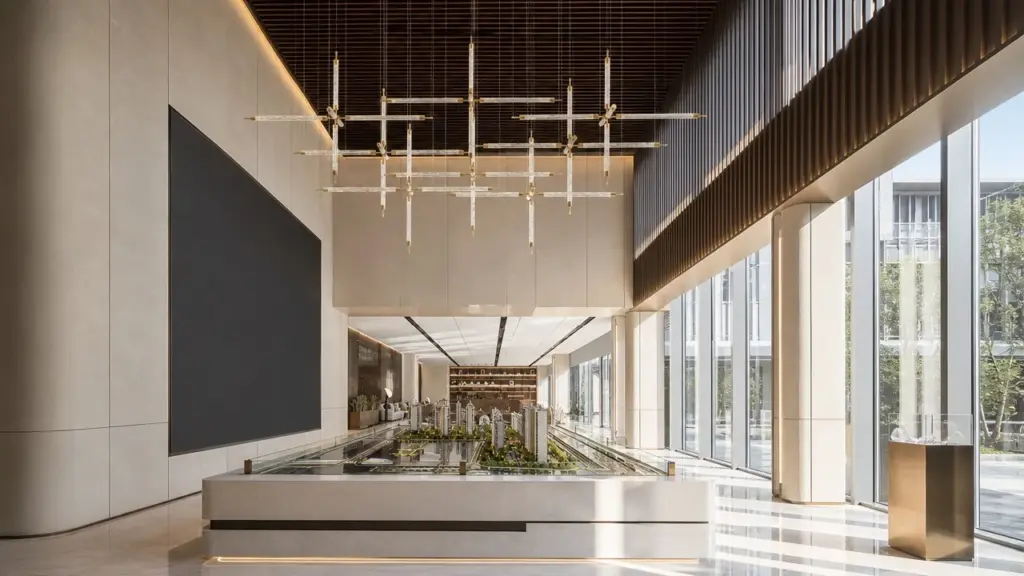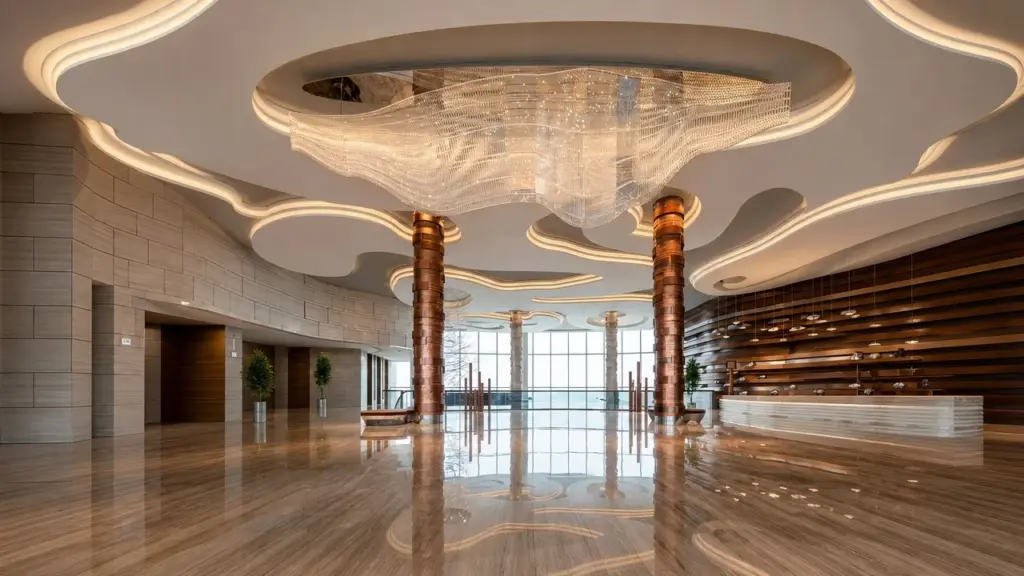
Choose a candidate against the lobby brief
For a hotel lobby, start with cut crystal-glass samples when the brief prioritizes defined sparkle, formed glass when shape or a softer luminous surface leads the design, and acrylic when the proposed geometry or handling constraints justify evaluating a polymer option. Select the actual fixture after comparing its samples, assembled weight, operating conditions and maintenance plan. The material name alone cannot establish which proposal is best.
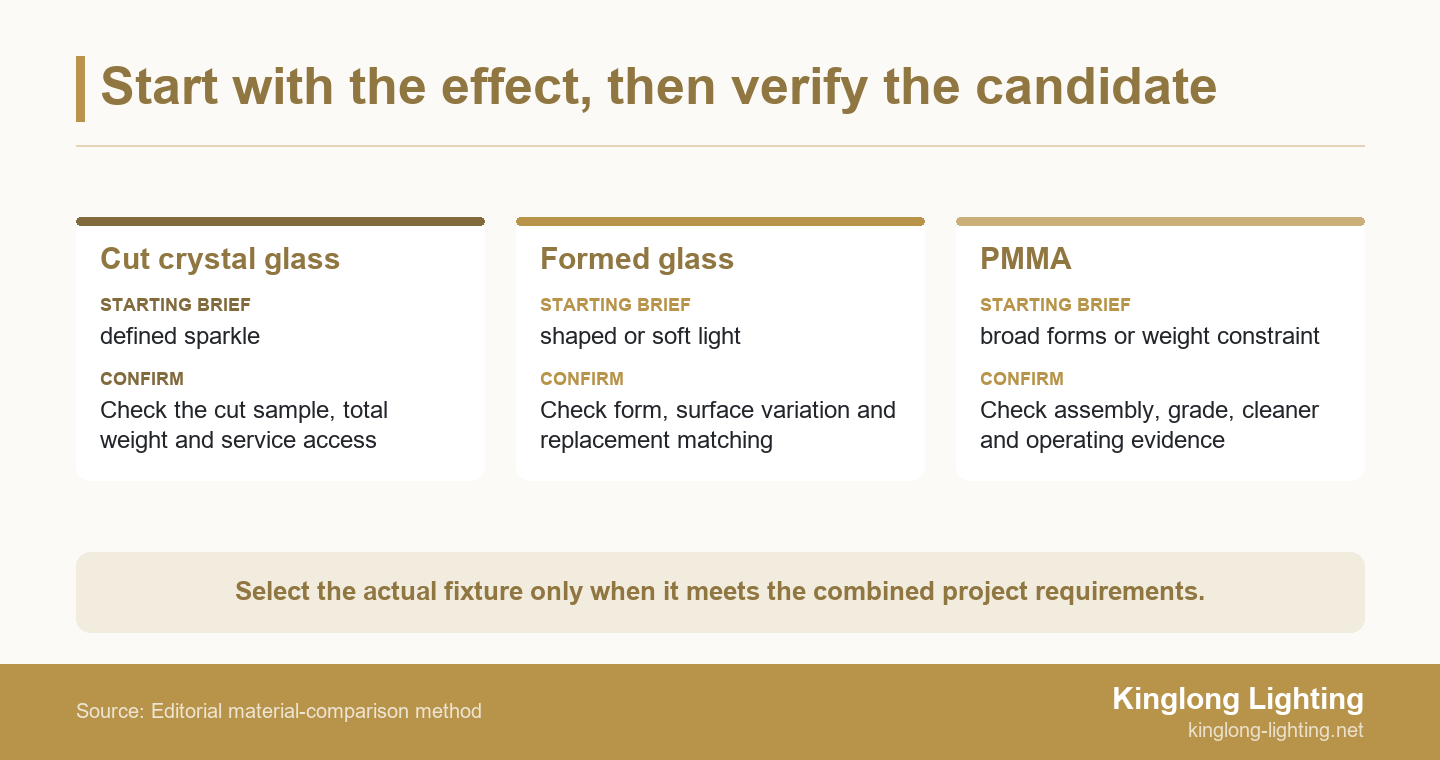
These are starting directions for sample selection. A faceted glass element and a smooth glass globe can create different effects despite sharing a broad material family. An acrylic part can also be clear, textured, coloured or diffusing. Compare the actual surface, geometry and lighting arrangement offered for the project.
- Ask what “crystal,” “glass” or “acrylic” means in the specific offer, including material identification and processing.
- Review the visual samples under a common lighting setup and compare the complete proposed fixtures on the same scope.
- Keep cleaning compatibility, heat exposure, replacement parts and unresolved product evidence visible in the selection record.
Use the comparison below to choose what to request and how to evaluate it. Any structural, electrical or fire-performance requirement remains a project-specific review of the applicable product and installation. A material data sheet and a completed luminaire’s evidence serve different purposes.
Clarify crystal glass, formed glass and acrylic in the offer
The Corning Museum of Glass explains that “crystal” historically described high-quality clear glass and discusses lead crystal as a glass composition. Corning Museum explanation of crystal and glass
For this comparison, “crystal” refers to the decorative crystal-glass elements proposed by the supplier, while “glass” refers to the other proposed glass elements, such as formed shades or tubes. These commercial headings are useful for organizing offers, but they do not identify three equivalent or mutually exclusive chemical categories. Request the actual material description rather than assuming every crystal offer has the same composition.
Ask whether a proposed element is cut, pressed, moulded, blown or otherwise formed, and whether it has a coating, colour treatment, backing or bonded component. If an offer uses a label such as K9 Crystal, obtain the supplier’s identifiable glass specification and sample reference. Do not infer lead content, optical performance or an acceptance grade from the label alone. If composition matters to the destination or specification, obtain the relevant declaration or product evidence.
PLEXIGLAS documentation identifies its semi-finished acrylic products as polymethyl methacrylate, or PMMA. PLEXIGLAS material terminology
For an acrylic proposal, ask for the actual polymer, manufacturer and grade, together with whether the part is cast, extruded, moulded or fabricated from sheet. Record the finish and any coating separately. A trade name mentioned in an article does not establish that the chandelier offered to you uses that manufacturer’s material. The Kinglong lighting resource library can support the questions accompanying a material-specific request.
Compare visual quality under the same conditions
Use a representative element or sample assembly from each candidate, and record its identity before comparing appearance. Keep the light source, dimming condition, background and viewing positions consistent for the first comparison. Then check each candidate in the lighting arrangement proposed for the lobby.
For cut crystal-glass elements, examine the intended facet pattern, edge finish, clarity, colour tint and consistency across the supplied pieces. Observe whether the sparkle and reflections achieve the brief from normal guest viewpoints. A close-up photograph of one illuminated drop cannot show how the complete arrangement will read against glazing or a distant ceiling.
For formed glass, review the shape, surface texture, visible joins, edge finish and the appearance of the lit wall or body. Ask which variations the supplier intends as part of the design and which it treats as defects. A hand-formed appearance should be judged against a documented reference for acceptable variation, including the replacements the hotel may need later.
For acrylic, inspect the proposed thickness, edge treatment, surface finish, visible fabrication lines and the distribution of light in the actual sample. Check the intended clear or diffusing effect. Do not use “high transmission” as a substitute for the desired visual result, because the fixture’s source position, optical treatment and geometry also need evaluation.
Record specific observations such as an unwanted visible source image, a colour mismatch between adjacent elements or an edge that catches attention from the reception desk. Give the designer a decision to make about that observation. If photography is used for remote approval, identify the physical sample retained and the conditions under which the images were made.
Use the same comparison questions for all three candidates
Compare candidate fixtures that meet the same spatial brief, quantities and intended lighting role. Record differences in their element geometry, frame, light source, driver and included services. If those items differ, identify the consequence before ranking the offers by material or price.
| Buyer question | Cut crystal-glass candidate | Other glass candidate | Acrylic candidate |
|---|---|---|---|
| Does the appearance fit the brief? | Review facet effect, clarity, tint and consistency in the proposed arrangement | Review shape, texture, lit appearance and agreed variation | Review surface and edge finish, clear or diffusing effect and visible fabrication |
| What will the complete fixture weigh? | Obtain assembled weight including elements, frame and suspension | Obtain assembled weight for the actual wall thickness and construction | Obtain assembled weight including frame, fixings and electrical components |
| Can the hotel maintain it? | Review cleaning access, element removal and spare-part identification | Review cleaning, handling and replacement of the actual formed element | Confirm cleaner compatibility for the exact grade, finish and fabrication |
| Does the environment suit the product? | Obtain the relevant proposed-product evidence and operating instructions | Identify the actual glass specification, coatings and operating limits | Identify the polymer grade and assess heat, light exposure and product requirements |
| Will replacements match? | Retain a reference for cut, dimensions, tint and attachment | Define acceptable shape, colour and surface variation | Retain grade, colour, finish, thickness and component references |
A collection page such as Kinglong’s Diamond Orb series can help communicate an initial visual direction. Ask for the actual proposed variant and its material specification when using a collection reference in the comparison.
Check complete-fixture weight and service access together
Material density describes a material under stated conditions. The weight the building must support depends on the quantities and geometry of the decorative parts, frame, suspension and other components in the actual fixture. Ask the supplier for the assembled fixture weight and relevant component information for project review.
Do not turn a comparison of equal-sized material samples into a prediction for two differently designed chandeliers. An acrylic proposal with a different frame and component count needs its own weight information. The project’s structural professional assesses the building-side support arrangement using the actual proposed fixture data.
Handling and access are separate selection questions. Find out how an element is removed, how it is protected during cleaning, how a replacement is attached and whether its removal exposes electrical components. The light-source and driver service route may differ from the decorative-element cleaning route. Ask the facilities team to review both.
Compare the required labour and access arrangement using the hotel’s actual operating constraints. Keep the assumptions visible if a quotation includes an estimate for cleaning or replacement work. Material names cannot establish the hotel’s future maintenance cost without that scope.
Confirm a cleaning method for the exact component
PLEXIGLAS cleaning guidance recommends a moistened soft cloth for routine cleaning and warns against rubbing the surface completely dry. The same page lists isopropanol for some tasks alongside broader warnings about alcohol-containing cleaners. PLEXIGLAS cleaning instructions
That wording does not settle the compatibility of the hotel’s chosen cleaner with a different acrylic grade, coating, adhesive or finished chandelier. Ask the supplier to confirm the exact formulation, dilution and method for the proposed component in writing. Have the hotel review that instruction against its cleaning practice. Resolve conflicting instructions before accepting the maintenance method.
For glass and crystal-glass parts, also request instructions for the actual finishes, attachments and any bonded or coated surfaces. A cleaner suitable for a plain material sample may be unsuitable for another part of the assembly. Ask the supplier whether elements should be cleaned in place or removed and what precautions apply near electrical components.
Where a cleaning trial is required, have the supplier define an appropriate trial on a designated sample and agree how to assess the result. Record the agent and procedure used, followed by the observed surface or appearance changes. A successful trial supports that specific procedure and sample. Keep the approved instructions with the maintenance record.
When reviewing a supplier’s experience, use Kinglong’s published project portfolio for project context. Obtain the proposed component’s maintenance instructions separately, since a portfolio image cannot demonstrate cleaning compatibility.
Review heat, exposure and evidence at the right level
PLEXIGLAS publishes different temperature-use information for its GS and XT product families and describes expansion with changing temperature and humidity. PLEXIGLAS temperature behaviour
Ask the supplier to identify the actual acrylic grade and assess its use in the proposed fixture, including the light-source arrangement and local operating environment. Do not convert a temperature statement for branded semi-finished sheet into a universal chandelier service limit. Claims about fire behaviour, resistance to yellowing or a warranty also need the named product, conditions and applicable evidence.
SCHOTT’s BOROFLOAT technical information describes thermal, optical, chemical and mechanical properties for that named glass product. SCHOTT BOROFLOAT technical details
Use this as an example of product-specific documentation. It does not establish that a chandelier’s glass or crystal-glass element is BOROFLOAT or shares its properties. Request the specification for the material actually offered, and identify any coating, adhesive or other component relevant to its environment.
For the complete luminaire, ask for the evidence required by the project and destination, tied to the relevant model or assembly. A material test classification cannot establish every requirement for a finished fixture. Have the appointed professionals review outstanding product and installation requirements before procurement treats the technical proposal as accepted.
Copy this material and sample decision record
Use one record per candidate, with each sample identified against the current quotation and drawing. Write the requirement or agreed reference before recording observations. Use Accepted, Revision required or Pending evidence as working dispositions, and identify which decision remains open rather than assigning an unsupported overall material score.
| Record field | Buyer entry |
|---|---|
| Candidate and traceability | [Supplier / fixture reference / quotation and drawing revision / sample ID] |
| Material and processing | [Declared material / manufacturer and grade if relevant / process / colour / coating / finish] |
| Comparison conditions | [Source / dimming condition / background / viewing positions / retained reference] |
| Appearance requirement and observation | [Agreed visual reference / observed clarity, shape, colour, surface or lit effect / reviewer] |
| Weight and service information | [Complete-fixture weight / removal and replacement method / missing input] |
| Cleaning and operating evidence | [Approved cleaner and method / grade-specific information / relevant product evidence] |
| Replacement agreement | [Reference sample / tolerances or variation agreed / spare quantity and identifiers / future matching arrangement] |
| Disposition and action | [Accepted, Revision required or Pending evidence / reason / responsible person / next action / date] |
Ask how a replacement ordered later will be matched to the retained reference and what variation is possible. Agree any spare parts with the actual fixture specification and quotation. Keep the approved sample identification and decision accessible to the hotel team after handover.
See how the preferred candidate changes with the brief
In this fictional example, a hotel compares a cut crystal-glass assembly, a formed-glass assembly and a PMMA assembly for the same lobby feature. The designer first specifies visible point sparkle from the entrance. Under the agreed comparison setup, the cut sample meets that appearance reference. Its record can show appearance accepted while complete-fixture weight and cleaning information remain pending.
The brief then changes to a broad, softly luminous form above reception. The earlier appearance decision no longer answers that task. The designer reviews the formed-glass and diffusing PMMA candidates against the revised reference. Suppose the formed-glass sample meets the new appearance requirement, while the PMMA supplier has not confirmed compatibility with the hotel’s cleaner. Record the formed-glass appearance result and the PMMA cleaning question separately. The new selection depends on closing the remaining requirements for the chosen fixture.
If the building subsequently imposes a fixture-weight constraint, request revised complete-fixture information for the viable candidates. A compliant PMMA assembly could become preferable if it meets the visual, cleaning and operating requirements while an alternative cannot meet that constraint. If none can satisfy the combined brief, revise the composition or request a different proposal. Each change alters a decision condition that the record can show.
Request proposals on a comparable material brief
Kinglong Lighting supplies custom decorative lighting for hotel projects. Send the lobby design reference, proposed dimensions, intended light effect, destination and material or sample questions through its hotel lighting project service page to discuss the proposed fixture and manufacturing scope.
Ask for an identified material proposal, representative sample and the supporting weight, maintenance and product information needed for your comparison. Keep any alternative’s changed geometry, frame and included services visible in the quotation so the designer and buyer can review the same proposal.
Hotel lobby chandelier material questions
Is crystal always better quality than glass?
Quality depends on the specified material, processing and agreed sample criteria. Crystal-glass wording cannot establish the clarity, cut consistency, colour or construction of a proposed chandelier. Compare the actual candidates against the intended effect and recorded acceptance reference, then resolve their product and maintenance requirements.
Can acrylic replace glass without redesigning the fixture?
A proposed substitution needs review of the actual part geometry, connections, finish, source arrangement and operating conditions. Ask the supplier which details change and have the relevant project reviewers assess them. Update the material and sample record, quotation and drawing references before accepting the substituted configuration.
Which material is cheapest over the hotel’s operating life?
There is no reliable ranking from the material name alone. Compare quotations on the same fixture and service scope, then add the hotel’s specific cleaning, access, replacement and spare-part assumptions. Where a cost is unknown, retain it as an unresolved input and obtain the missing information before claiming a lifetime-cost advantage.
Planning guides for your project
Use these guides to compare materials, prepare specifications and coordinate the next approval.
- Hand-Blown Glass vs Crystal Tubes for Hotel Lobbies: Material Selection Framework
- The Hidden 18-25%: Why Hotel Chandelier Total Cost Surprises Procurement
- Atrium and Double-Height Lobby Chandelier Design Guide
Explore matching collections: Crystal Tube · Ice Flower · Diamond Orb