
A villa lighting selection book should let the owner review a coordinated proposal without searching through chats, PDFs and mood boards. Put the current room and fixture index first, then give each proposed variant an identified page linking its images, dimensions, finish, quantity, light source, ceiling notes and price status. End each item with the decision requested, the person responsible and any unresolved exceptions. A clear package can contain both approved design choices and open questions; its status should show the difference.
What the Owner Should Be Able to Decide
- Which exact fixture and revision are proposed for each location, supported by identifiable evidence.
- Which appearance, technical and commercial questions are ready for a decision, and which still need an answer.
- What has been approved, by whom and for which scope, without mistaking selection approval for permission to manufacture or install.
Start With One Current Index and a Defined Decision
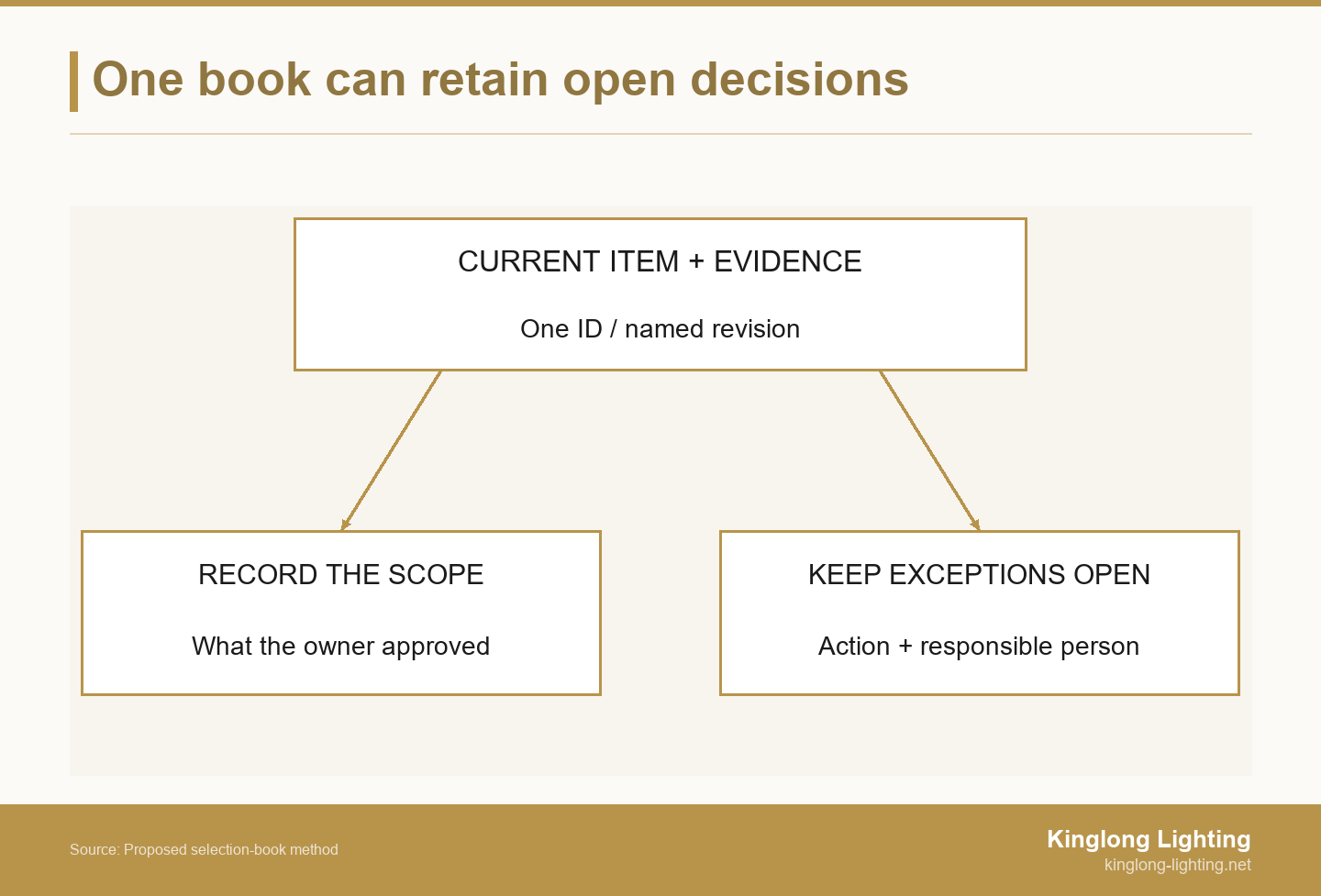
A villa lighting selection book is a coordinated record of current proposed fixtures and the decision requested for each item. Give the issue an ID and a current index linking each item to its room, revision, evidence and open exceptions. This turns a collection of attractive references into a record the owner can review and the project team can update.
Start with the actual room and fixture schedule, using the same item IDs in drawings, quotations and correspondence. Kinglong’s lighting design and procurement resources can help organize the brief. Keep the book’s issue identifier separate from each item’s revision: a new issue might update a dining pendant while carrying an unchanged bedroom fitting forward with its existing evidence.
Copy this cover record: Project [ ]; book issue/date [ ]; prepared by [ ]; current index location [ ]; rooms and item IDs covered [ ]; decision requested [ ]; decision owner [ ]; referenced documents [ ]; exceptions carried forward [ ]. In the index, give each item its room, quantity, page or file reference, current revision and decision status. Name the revision of any linked drawing or quotation rather than linking only to a folder whose contents may change.
Agree who maintains the live working file and who issues the owner-review version. Preserve the reviewed issue so later edits do not change what a previous decision referred to. A chat message can be supporting correspondence, but record the relevant decision against the identified item and scope instead of assuming everyone has read the same conversation.
Describe the decision in ordinary language: review the room composition, accept a named finish reference, confirm a stated price scope, or answer an outstanding coordination question. These are proposed recordkeeping practices, not a mandatory industry format. The book’s job is to make the actual project decision visible, including when part of it cannot yet close.
Separate Room Intent From Product and Finish Evidence
A room image explains intended atmosphere and placement; a product view identifies the actual proposed variant. Keep both distinct from the dimensioned drawing and physical finish reference. Caption what each image represents, including whether it is an inspiration image, a proposed visualization, a catalogue starting point or a photograph of an identified sample.
For the room view, show enough context to discuss the fitting’s relationship to the furniture, sightlines and ceiling. Link it to the relevant plan or elevation. For the product view, name the model reference and the proposed changes to size, finish, arrangement or light source. Where the view has not yet been updated to those changes, say so; do not let a familiar image quietly stand for a different fixture.
Finish images need their own limits. X-Rite’s guidance on visual color evaluation describes inconsistent device color and the limitations of electronically shared photographs for color decisions. Record the physical finish reference, represented material or surface, relevant viewing conditions and what remains to be checked. A screen image can support discussion without becoming proof that the proposed physical finish has been accepted.
When discussing scale and placement, Kinglong’s published lighting projects can provide installed-context references. Keep that purpose explicit: a project image is not a dimensioned drawing for the current villa, nor evidence that its proposed variant or finish has been approved. In the book, distinguish a reference used to explain the visual goal from evidence used to close a specific decision.
If the owner likes a room image but the proposed fixture has a different arrangement, ask the designer to identify the change and supply a matching view or drawing. Retain the earlier image as a clearly marked reference if useful. The reader should not have to infer which details survive from inspiration to the actual proposal.
Copy This Single-Item Selection Page
Use an item page to bring dimensions, finish, quantity, light source, ceiling notes, price status and the decision owner into one reviewable record. Link the room and product views and keep unresolved exceptions beside the requested decision. An unknown field should lead to a named action, not disappear behind a general “approved” label.
The following is a proposed fillable page, not a completed client selection book. Copy it for each distinct proposed variant and attach the referenced evidence. Where the same variant serves several rooms, keep its location and quantity breakdown traceable. Use separate pages or clearly identified variant entries when the size, finish, light source or other decision basis differs.
| Review field | Entry to complete | Open action if not confirmed |
|---|---|---|
| Identity, location and quantity | Item ID [ ]; item revision [ ]; room/location [ ]; quantity by location [ ]; index reference [ ] | Count or location discrepancy [ ]; responsible person [ ] |
| Room image and product view | Room-view file/revision [ ]; purpose [ ]; proposed product-view file/revision [ ]; starting model and changes [ ] | Missing or outdated view [ ]; replacement requested from [ ] |
| Dimensions and drawing | Dimensions and units [ ]; agreed measurement reference [ ]; drawing ID/revision [ ]; dimensions still provisional [ ] | Dimension to verify [ ]; drawing or site confirmation by [ ] |
| Finish reference | Finish/material [ ]; physical sample/reference ID [ ]; represented surfaces [ ]; viewing conditions [ ]; decision scope [ ] | Sample or comparison needed [ ]; responsible person [ ] |
| Light source and controls | Source/lamp or module [ ]; driver [ ]; requested light/control behavior [ ]; supporting document/revision [ ] | Technical evidence or interface question [ ]; confirmation by [ ] |
| Ceiling and access note | Relevant ceiling detail/revision [ ]; proposed drop/position [ ]; support/interface question [ ]; service access [ ]; confirming party [ ] | Unresolved coordination [ ]; responsible technical party [ ] |
| Price status | Unpriced/quoted/revised [ ]; quotation ID/date/currency [ ]; quantity and variant covered [ ]; inclusions/exclusions [ ]; owner budget decision [ ] | Missing price or scope [ ]; response required from [ ] |
| Decision owner and exceptions | Decision requested [ ]; authorized decision owner [ ]; evidence reviewed [ ]; exception IDs [ ]; current status [ ] | Question [ ]; required evidence [ ]; responsible person [ ]; next review [ ] |
Copy this decision line below the page: Item/revision [ ]; decision scope [ ]; accepted/not accepted/deferred [ ]; approver/date [ ]; evidence references [ ]; exceptions remaining [ ]; separate confirmations or release still required [ ]. These labels describe the proposed record. Agree how they map to the project’s actual responsibilities before collecting signatures.
Name the requested light behavior rather than relying on a broad “adjustable” label. DOE’s overview of color-tunable LED products distinguishes dim-to-warm, white-tunable and full-color-tunable products and discusses applications, control options and possible complications. If a tunable function is requested, identify it on the page; the overview does not establish a particular proposed system’s compatibility or cost.
When a starting model comes from Kinglong’s decorative-lighting collections, carry its reference onto the page and explicitly list the proposed modifications. A collection image remains a starting reference until the actual variant evidence is identified. This gives the supplier a specific design question and gives the owner a clear record of what differs from the original model.
Keep Technical Evidence Tied to the Proposed Variant
Technical evidence should identify the actual proposed variant and the question it addresses. Ask the responsible technical parties to confirm ceiling, support, access and control interfaces, with the relevant drawing references. Visual preference alone cannot settle those details. The item page records who must answer them; it does not replace engineering or installation documentation.
For dimensions, specify units and the agreed reference from which the stated drop or position is measured. Mark which dimensions come from an issued drawing and which require site confirmation. If an existing ceiling detail and a new fixture drawing disagree, carry the discrepancy as an exception for the responsible parties rather than selecting whichever value looks more convenient on the presentation page.
If DALI is specified, use the DALI Alliance product database within its actual scope: specific tested components and version conditions. It does not list luminaires. Identify the proposed component and applicable version information with the technical team. A component entry does not by itself certify the decorative luminaire or prove the performance of the complete installed system.
Different evidence answers different questions. The public description of the IES optical and electrical measurement publication concerns solid-state lighting products under standard conditions. When a report is relevant to the brief, link the actual report and identify its tested object and conditions. Such measurement evidence does not itself settle the proposed finish, ceiling arrangement or installation acceptance; the publication description is not a project-specific test result.
Keep evidence at the level at which it applies. A manufacturer’s general brochure can explain a range, while the proposed driver or drawing needs its own identity. If the light source, driver or physical arrangement changes, ask the responsible party which existing evidence remains applicable and what needs replacement. Record the answer against the affected item so the owner sees a specific pending question instead of a vague technical disclaimer.
Walk an Incomplete Selection Through the Book
Consider an illustrative selection-book trial for dining item DIN-A. Its current drawing is revision B, but the product image still shows revision A. The drop and a quotation inclusion remain unresolved. The owner likes the appearance. That preference is useful, but the item needs a matching view, coordination evidence and a pricing response before those affected questions can close.
Start by entering DIN-A, its dining-room location and current item revision in the index and page. In the image row, label the older view as a reference pending replacement; link drawing B in the dimensions row. In the ceiling row, describe the unconfirmed drop and identify the technical party who must reconcile it with the relevant ceiling detail. In the price row, name the missing inclusion and the quotation to which the question refers.
The decision line can now say that the owner accepts the stated appearance direction while the listed coordination and price exceptions remain open. Cite the actual evidence reviewed, including the image limitation. Do not describe this as acceptance of an unseen revised silhouette or as permission to manufacture the item. If the owner needs the updated view to judge the change, leave that appearance decision deferred as well.
Request the revised view against drawing B, confirmation of the relevant drop and a quotation response covering the missing inclusion. Then compare the returned documents with the page, update their references and ask the appropriate decision owners to review the affected fields. If they resolve the questions, close those exception entries with the supporting references. If the coordinated drop changes the visible composition, return that changed appearance to the owner instead of carrying the earlier preference forward automatically.
The trial shows what “complete” means for the book: every item and unresolved question is accounted for. It does not mean every design, technical or commercial decision has already been accepted. Keep that distinction visible in the package index as well as on the individual page.
Record Approval by Item, Scope and Revision
An approved selection needs the item, revision, decision scope, approver, date and remaining exceptions recorded together. An owner decision about appearance does not automatically authorize manufacture, procurement or installation. State which separate confirmations and release remain required under the project’s agreed process, rather than using one signature to imply every responsibility has been discharged.
When an alternative changes an agreed function, use Kinglong’s decorative-lighting value engineering guide as a related discussion resource. Keep that alternative tied to its affected item and evidence. A lower proposed price or a preferred photograph is not, by itself, acceptance of changes to the required function, finish or installation arrangement.
Before issuing the book, reconcile the index with the item pages: all room locations and quantities are accounted for; current revisions match their attachments; price status is explicit; and each exception has a question, required response and responsible person. Check that every decision requested is within the named person’s authority. Where a response belongs to a technical or commercial party, do not present the owner-review page as a substitute for that confirmation.
Service access also belongs in the discussion before the selection closes. CIBSE’s public LG20 overview describes guidance for facilities managers who maintain, modify and update electric lighting installations. For this proposed book, identify the question of future access and servicing and assign it to the relevant party. The overview does not prescribe this template or provide a universal maintenance requirement for the villa.
Retain a short change record alongside the index: New issue [ ]; changed item IDs/revisions [ ]; changed evidence [ ]; decisions affected [ ]; unchanged evidence carried forward [ ]; exceptions opened/closed [ ]; issued by/date [ ]. Archive the earlier reviewed issue. Explain what changed when asking for a new decision, so the owner can focus on the affected choice without re-approving unrelated, unchanged items.
An exception closes when the required answer is received, checked against the relevant item and accepted by the appropriate decision owner. Merely receiving a newer PDF is not that check. Update the index status after recording the decision, and keep any remaining conditions visible to whoever handles the next project stage.
Bring Kinglong a Coordinated Whole-Home Brief
A useful whole-home brief includes the current issue and index, room and fixture schedule, quantities, room views, proposed product references, dimensioned drawings and finish references. Add the requested light-source and control behavior, ceiling questions, price status and unresolved list. Identify which questions need a supplier response and which still require the designer or site team’s decision.
Ask for responses against the item IDs rather than another unstructured set of product images. Specify whether the next discussion concerns a starting design, a proposed customization, available sample evidence or quotation scope. That makes the requested response easier to attach to the correct page and keeps the owner’s next review focused.
You can review the whole-home villa lighting brief with Kinglong using those inputs. Its published villa service path describes design and visualization, physical sample or detail mock-up review, progress photography and installation documentation. Ask which deliverables apply, and agree availability, charges and responsibilities for the proposed scope. The useful result is a clarified brief and response on applicable evidence and open questions, rather than an assumed complete selection-book service or automatic approval.
Frequently Asked Questions
Should the selection book be a PDF or a spreadsheet?
Use a format the project can maintain and issue reliably, with the same current index, item IDs and referenced evidence available to reviewers. A spreadsheet can manage changing fields while an issued PDF preserves a review snapshot. Either way, name the issue being reviewed and keep its attachments identifiable; the file type alone does not create a traceable approval record.
Can one product page cover the same model in several rooms?
Yes, if the actual variant and decision scope match, with a clear breakdown of locations and quantities linked back to the index. A shared model name alone is insufficient when size, finish, light source or another relevant detail differs. Separate those variants or distinguish them explicitly, so approval of one cannot silently be applied to another.
Can the owner review the book before every price is confirmed?
Yes, for an explicitly limited design decision that keeps the unconfirmed price and its required response visible in the item record. Mark the price status open and identify who must supply the quotation information. The review should not imply approval to purchase or acceptance of a complete budget; return the commercial decision when its stated basis is available.
What happens when a selected fitting is substituted after issue?
Create a revised item for the substitution, identify the changed evidence and reopen the decisions whose basis is affected by the replacement. Preserve the earlier approval as history rather than applying it automatically to the new fitting. Update the index and notify the relevant decision owners, retaining genuinely unchanged evidence only where it still applies to the revised proposal.