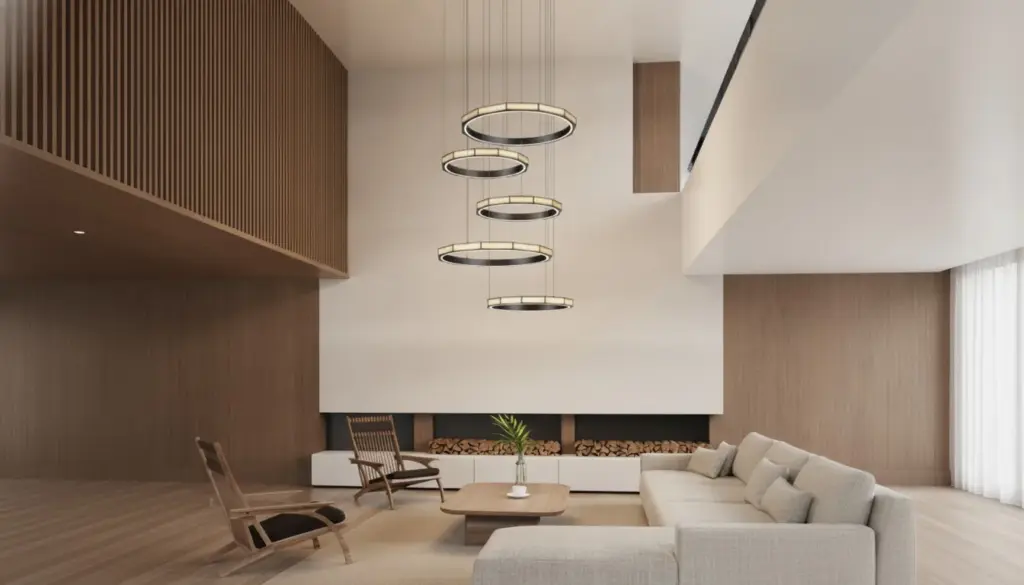
A small villa may need only a few of each decorative light, yet the quotation can contain several different minimums. The useful question is what each minimum counts: complete fixtures, identical glass pieces, a purchased component pack, a finish batch or the value of a production run. Identify that basis before increasing the fixture order or changing the design. A component commitment may explain the offer, but it does not automatically mean the owner needs more complete lights.
Ask What the Minimum Actually Counts
MOQ means minimum order quantity. The item and unit still need to be stated: a minimum number of complete fixtures is different from a minimum purchase of glass elements or a batch of finishing material. An order multiple specifies the increments in which an item is supplied. A setup charge or minimum order value is a financial condition, not another way to count fixtures. Ask the supplier to separate these conditions in the offer.
For an owner or owner representative assembling a whole-home package, the room schedule should remain the starting point. Record the required fittings and quantities first, then examine the commitments behind them. Kinglong’s lighting design and procurement resources provide background for preparing that enquiry. Keep the required installation separate from any extra purchase proposed to make it possible.
- When the offer gives a quantity, ask “of which exact item, in what unit, and per which specification?” A total across different parts may not satisfy a minimum for one part.
- When the offer gives a charge, ask what development, setup or service it covers and whether it is already included in the fixture price.
- When the offer includes excess material or components, ask who buys and owns the excess, where it goes and whether it can actually support later replacements.
A manufacturer’s pack is not always the same as a required purchase. An employee-authored DigiKey explanation of packaging types describes breaking down incoming quantities, so the original packaging is not necessarily what a customer receives. This is an electronics-distribution example, not evidence that a particular lighting driver is available in split packs. It supports asking for the actual purchasing basis rather than treating every stated pack size as the project’s minimum.
Find the Constraint Behind Each Component
For each component in a villa light, ask whether the constraint comes from a stocked item, a new tool, a purchased batch or a setup condition. Crystal elements, custom glass, cast metalwork, finishes, drivers, packaging and final assembly can raise different questions. A description such as “custom-made” does not identify which of those questions matters, or establish a universal minimum.
For crystal, specify the shape, size, holes, surface treatment and matching requirement. Ask whether the proposed element is an existing reference or a new development. For glass, identify whether an existing shape and tooling can serve the design or whether the proposal requires another forming route. The answer should identify the actual part rather than a broad material label.
Kopp Glass describes mold making and custom small-lot production within its technical-glass manufacturing capabilities. Both points matter: tooling can be part of custom development, while custom production does not inherently mean a large lot. This is not a decorative-glass minimum or a Kinglong production policy. Ask the proposed supplier which route and quantity basis apply to the selected element.
Metalwork needs a similarly specific explanation. NADCA’s discussion of tooling costs explains die-casting tooling investment and the role of production volume in managing it. That helps explain why a new tool and an existing casting reference may have different commercial implications. It does not set a numerical MOQ, and not every decorative casting uses pressure die casting. Ask which process the actual quotation assumes.
A finish minimum may also originate before the metal part is finished. KBS Coatings explains its custom-color batches as production on dispersion equipment. This specific liquid-coating example illustrates a material-production constraint; its quantities cannot be transferred to powder coating, a plating bath or Kinglong. Ask whether the quoted condition concerns buying finish material, setting up an application run, or processing a defined set of parts.
Installed images help define the visual result the owner wants to protect. Kinglong’s published lighting project portfolio can support that conversation. Photographs do not establish the component quantities purchased, the tooling arrangement or the minimum accepted for those projects. Use them as design references, then request a separate written explanation of the current offer.
Use a Component MOQ Matrix in the Enquiry
A component MOQ matrix turns a vague minimum into questions the supplier can answer. Record the part or process and its unit, identify the possible constraint, ask for the quantity or charge in writing and request a comparable alternative. The matrix below is an enquiry template, not an approved MOQ schedule. Replace the descriptions with actual references and keep unanswered quantities visibly unconfirmed.
| Part or process and unit | Possible constraint to identify | Written quantity or charge question | Alternative worth comparing |
|---|---|---|---|
| Crystal elements, counted by exact reference | Stock reference, matching requirement or custom shape | What is the purchase minimum for this exact element, and may demand be combined across the named fixtures? | Existing element that preserves the agreed appearance and connection |
| Custom glass, counted by exact glass part | Existing tooling or a new forming development | Which tooling and production quantities apply, and are samples or spare allowances separate? | Existing glass shape or tooling, with any design change identified |
| Cast metal parts, counted by part and revision | Tool development and the selected casting process | Is the tool charged separately, and what minimum applies to the actual casting rather than the complete light? | Suitable existing casting or a reviewed alternative construction |
| Finish material or application service, in the supplier’s stated unit | Material batch, finish-bath or application setup | Is this a material purchase, a part quantity or a run charge, and what does the quoted finish cover? | Accepted existing finish or compatible grouped processing |
| Drivers, counted by exact manufacturer and model | Stock availability, purchase pack or order multiple | What can be purchased for this project, and is a pack quantity mandatory or only one supply option? | Technically reviewed, suitable stocked alternative |
| Packaging, counted by carton or insert reference | Protective dimensions, custom inserts or printing setup | Which minimum belongs to the protective pack and which to optional branding or printing? | Suitable protective packaging with simpler branding |
| Assembly and setup, in the supplier’s stated basis | Preparation for a particular design or production run | Is setup separate, included in the unit price, or tied to a minimum order value? | Quote the required fixture quantity with its setup basis explicit |
Assign each row to the fixtures it affects and ask the supplier to distinguish confirmed quantities from estimates. Do not combine glass pieces merely because they look similar, or combine metal parts with different drawings under one description. For a finish service, ask for the supplier’s own unit instead of converting bath volume into a guessed number of lights. A quantity answer without its part identity or process scope remains incomplete.
Starting references from Kinglong’s decorative-lighting collections can make the standard-versus-custom discussion more specific. Mark the intended changes to each model, including material, finish and electrical requirements. The supplier can then address those differences rather than interpret “same style, small quantity” as an exact specification.
Convert Shared-Part Demand Before Comparing Minimums
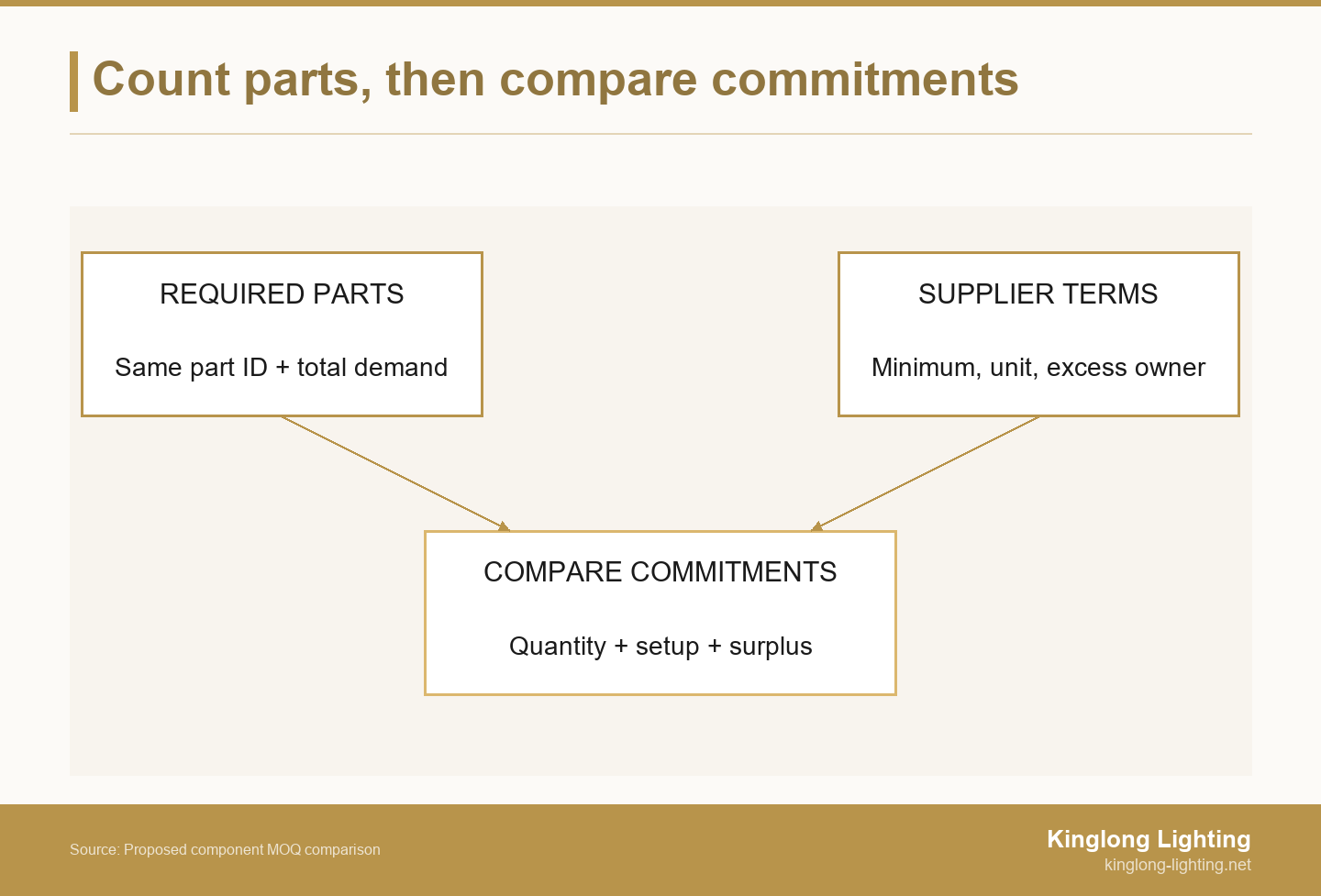
In this hypothetical glass example, 2 pendants use 12 identical glass elements each, and 4 wall lights use 3 of that same element each. Together they require 36 glass elements. If the hypothetical supplier minimum is 50 glass elements, the arithmetic excess is 14 glass elements, not 14 complete fixtures. These are invented inputs for explaining the calculation, not a Kinglong minimum, a customer quotation or a recommended spare quantity.
First establish that the element really is the same part in every application. Matching appearance alone does not confirm the material, dimensions, attachment or revision. Then multiply each fixture quantity by its consumption of that part and add the component demand. Compare that total with the supplier’s confirmed minimum in the same unit. If the supplier also specifies order multiples, ask which purchasable quantity follows from both conditions.
The hypothetical calculation excludes spares, production loss and other allowances. Ask whether the owner must purchase the excess, who owns it and whether it will be delivered, retained or available for a future order. If the minimum or shared-part identity is unconfirmed, leave the comparison open. Request the missing reference or purchasing condition before presenting a savings claim or asking the owner to authorize extra material.
A retained component is not automatically a usable spare. Confirm its identity, condition, storage arrangement and the fixtures it can serve. If it stays with the manufacturer, ask how it is recorded and what terms govern later access. If it is delivered, include identification and handling information in the handover. Those answers can change the value of an excess purchase without changing the arithmetic.
Keep the required fixture schedule intact throughout the comparison. A supplier may propose a different purchasing basis or an alternative part; the owner still needs to see whether the offer supplies the original room requirements. Any proposal for extra complete lights should therefore be explained separately from a surplus component quantity.
Compare Design Alternatives on the Same Basis
A workable small-order alternative preserves the agreed design and technical requirements while making the full commitment clear. Compare standard references, verified shared parts, existing tools, suitable finishes and packaging on the same scope. Kinglong’s decorative-lighting value engineering guide helps frame that discussion around retained functions. A lower unit price does not establish a lower project commitment if the required purchase, setup work or excess stock changes.
Ask for the requested custom version and the proposed alternative against the same room quantities. Identify any changed silhouette, material, connection, light source, control requirement or visible finish. A stocked driver is an option only after its suitability for the actual fixture and control arrangement is checked. An existing glass shape is a design alternative, not an invisible substitution. The owner should know which quality is being retained and which choice is changing.
Packaging deserves its own comparison. Packlane publishes different minimums for corrugated and cardstock product boxes, illustrating that the selected packaging format can affect the purchasing condition. Those are its own offers, not villa-lighting packaging minimums or proof of shipping protection. Ask whether simpler branding can change the commercial commitment while the actual protective packaging remains suitable for the fixture.
For each option, compare the required complete fixtures, accepted specification, development and setup basis, component or material excess, packaging and stated exclusions. Check whether charges are already included before adding them again. Where an option omits transport, installation support or another material cost, request the missing scope rather than rank it as cheaper. An unknown cost is not zero, and a reduced component minimum does not by itself establish a lower total.
Request a Written Quantity and Cost Breakdown
Before committing to the villa package, request a written answer linking complete-fixture quantities to the component and process conditions behind them. It should identify units, minimums and order multiples, the basis of development or setup charges, excess ownership, the covered specification and unresolved questions. This lets the owner decide whether to retain the design, approve a clearly described alternative or request further information.
If a supplier states a component minimum without its unit, return that specific question. If excess ownership is unanswered, keep it open in the offer comparison. The useful response is a revised quotation or schedule in which the named component quantity, associated charge and treatment of excess can be traced to the affected fixtures. A general statement that the project is “small-order friendly” does not close those questions.
Kinglong’s contact FAQ says standard-product MOQ depends on the series and welcomes single-piece commissions for hospitality and high-end residential spaces. That is an enquiry basis, not a component-minimum schedule or acceptance of a particular construction. Bring the room and fixture schedule with quantities, model and material references, completed component questions, acceptable design alternatives, destination and open unit, charge or ownership questions when you send Kinglong the villa lighting enquiry. Ask for the specific written quantities and commercial scope that apply to the proposed package.
Frequently Asked Questions
Will the same minimum apply when I reorder later?
Not necessarily. Ask for the reorder basis, current availability and any assumptions about retained tooling, material or components. An initial order may include development work that differs from a repeat purchase, while the availability of a previously used part can change. Keep the accepted references and revisions so the supplier can explain what remains applicable instead of treating “same as last time” as a complete specification.
Does paying a tooling charge mean I own the tool?
Do not assume ownership or transfer rights from a tooling charge alone. Ask the supplier to state the agreed ownership, permitted use, exclusivity if any, storage, maintenance and transfer arrangements. Distinguish paying for development work from the terms governing the physical tool. If access to that tool matters to future supply, resolve the wording in the order documents before relying on it.
Does a deposit settle all component commitments?
A deposit does not by itself explain the agreed scope of quantities, excess materials or later charges. Read it alongside the accepted quotation and order terms, and ask which commitments it funds. Identify what remains conditional on design approval or another specified step. The owner should be able to connect the payment request to the stated fixture package and component obligations rather than infer those obligations from the payment amount.
Can different villas be combined to reach a component minimum?
Only if the supplier agrees that the exact component specification, timing and commercial arrangement can be combined. Similar designs may use different glass, finishes or electrical parts, so a combined fixture total is not enough. Ask how purchasing, ownership of excess, project identification and later changes would be handled. Do not assume that a component quantity shared across projects removes separate design, assembly or delivery conditions.