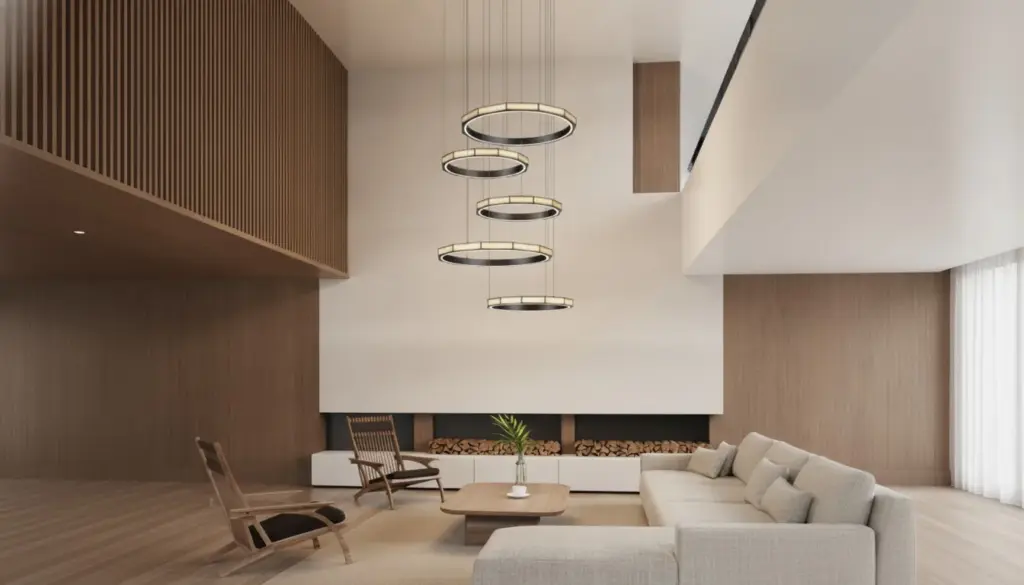
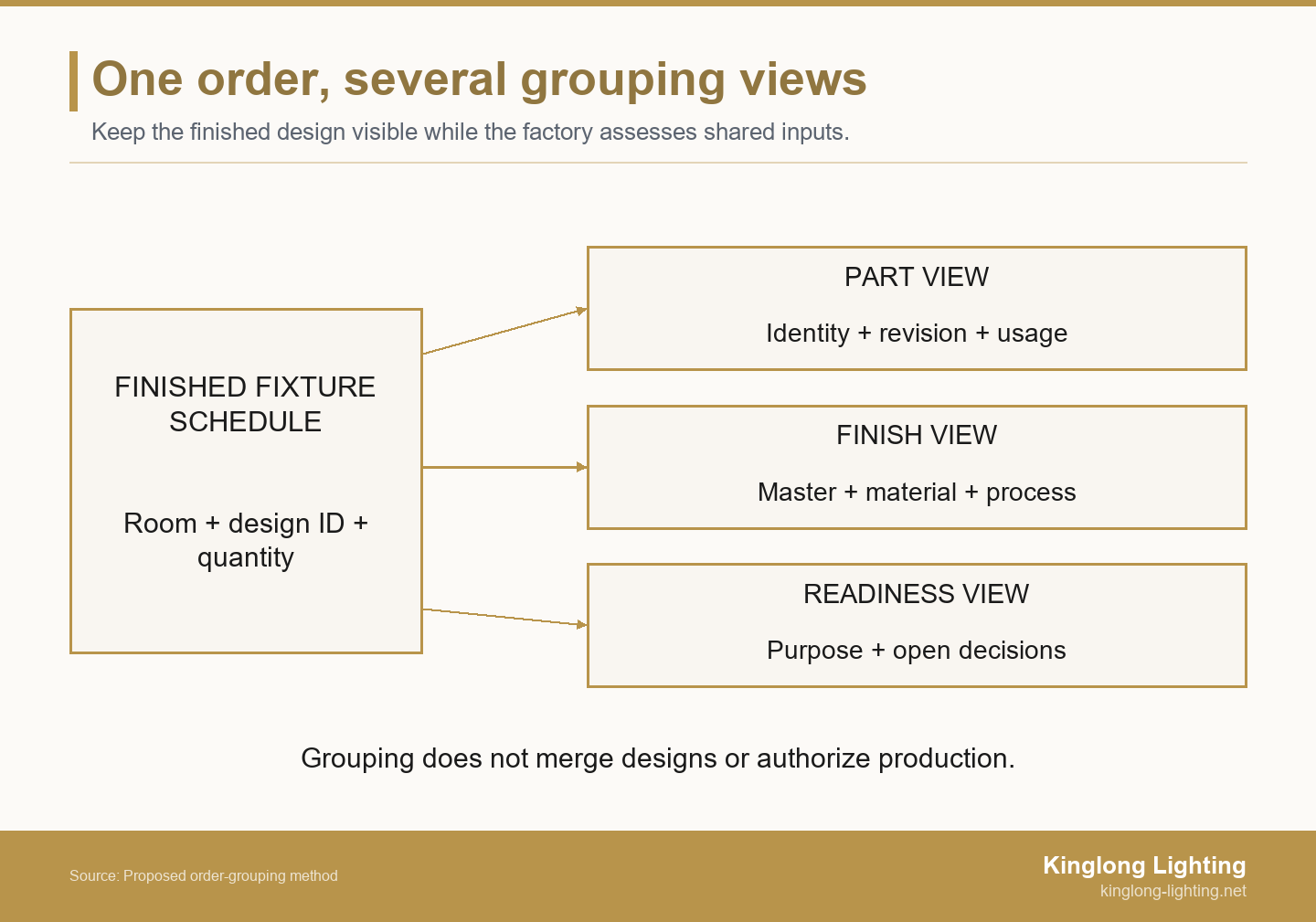
Present a varied villa lighting order as a finished-fixture schedule with linked views of the inputs the factory may be able to share. Keep every room-specific design and quantity visible, then identify candidate common parts, finish references, engineering differences and open decisions. The factory can assess those relationships and return an explicit proposal. This is more useful than a collection of unrelated images, and it preserves the designer’s choices while making the production questions easier to find. The package becomes assessable before anyone assumes it is ready to manufacture.
Keep Each Finished Design Visible
A low-quantity, high-variety villa lighting order needs one identified line for each finished design, with linked grouping views for candidate common parts, materials and finishes, engineering differences and scoped decisions. The grouping views should lead back to the original fixture schedule. They help the factory see shared inputs while retaining the room, appearance and installation requirements that distinguish the designs.
- Keep the finished fixture ID, room and quantity as the order’s reference, including items supplied in pairs or as a composition.
- Propose common inputs with a specific reference and a stated quantity basis; ask the factory to confirm their actual application.
- Record what is agreed, what remains open and which next action the available information supports.
Here, a SKU is a distinct orderable fixture variant identified in this project. A pendant with a different suspension arrangement may need its own line even if it shares a decorative component with another model. Conversely, the same finished design installed in several locations can retain its product reference while the schedule records the allocation to each room. Agree the unit of supply explicitly: an individual fitting, a matched pair and a complete composition are different counting bases.
Use the designer’s current brief to establish those distinctions. The lighting design and procurement resources can help identify missing inputs. For the actual package, keep the current drawings, visual references and room allocation attached to the identified lines.
Use One Schedule with Separate Grouping Views
An order grouping matrix keeps each finished fixture ID and quantity visible while naming its finish reference, candidate shared parts, engineering differences and current decision scope. Start with the line-level schedule, then sort or filter it for a particular discussion. A finish view helps compare appearance references; a part view asks what is genuinely common; a readiness view identifies the information still needed for the proposed next action.
The illustrative six-line villa order below contains twelve finished fixtures: one living pendant, two dining pendants, one foyer pendant, four corridor wall lights, two bedroom wall lights and two study table lamps. It is a constructed example, not a reported customer order. Part references and usage are candidates for discussion, and the status notes describe limited example decisions rather than permission to manufacture.
| Fixture ID | Room and finished design | Finished quantity | Visible-metal finish reference | Candidate decorative part | Separate engineering question | Current decision scope |
|---|---|---|---|---|---|---|
| L-P01 | Living pendant | 1 fixture | FM-B01; substrate unconfirmed | Collar CP-01; usage assumed | Canopy and load-bearing arrangement | Appearance direction agreed; mounting open |
| D-P01 | Dining pendant | 2 fixtures | FM-B01; substrate unconfirmed | Collar CP-01; usage assumed | Overall drop and control specification | Drawing comparison underway |
| F-P01 | Foyer pendant | 1 fixture | FM-B01; substrate unconfirmed | Collar CP-01; usage assumed | Cluster layout and current site inputs | Required site information missing |
| C-W01 | Corridor wall light | 4 fixtures | FM-B01; substrate unconfirmed | Plate WP-02; usage assumed | Projection and installation details | Technical review recorded; buyer instruction open |
| B-W01 | Bedroom wall light | 2 fixtures | FM-B01; substrate unconfirmed | Plate WP-02; usage assumed | Switching and control details | Sample review only; controls unresolved |
| S-T01 | Study table lamp | 2 fixtures | FM-C02; substrate unconfirmed | No shared part proposed | Destination plug and base arrangement | Sample not yet reviewed |
To use the matrix, replace each reference with the actual drawing or sample identifier and its revision. Name the person responsible for each open question in the supporting record. A label such as “sample review only” should identify the sample and features reviewed. It should not become a general approval flag when the sheet is sorted by finish or exported for quotation.
The distinction between views also appears in Onshape’s bill-of-materials documentation: a structured view shows subassemblies, while a flattened view lists parts. That is a useful information-management analogy for keeping finished designs linked to their constituent inputs. The proposed villa matrix does not require that software or establish that similar-looking components are interchangeable.
Use a published lighting project portfolio to discuss installed scale and setting when helpful. Keep those images in the visual-reference set, with the features they illustrate identified. The factory still needs the new project’s line-level information to evaluate its construction and quantities.
Confirm Common Parts Before Aggregating Demand
A candidate shared part needs a common identity and revision, a stated application to each fixture and a confirmed usage per finished assembly. Ask the factory to check those fields together. A similar name or silhouette is insufficient for a dependable roll-up. The part view should preserve the source fixture IDs so a changed design can be traced to the affected component demand.
For the illustrative calculation, assume one decorative collar CP-01 per pendant in the living, dining and foyer lines. Their quantities are 1, 2 and 1, giving a candidate demand of 4 collars. This calculation is useful as a question for the factory: does the same identified collar actually apply at the assumed usage across those designs?
Under a separate illustrative assumption of one decorative plate WP-02 per wall light, 4 corridor units and 2 bedroom units imply a candidate demand of 6 plates. The plate count and collar count refer to different components. Neither is the quantity of finished fixtures being ordered, and neither establishes the final bill of materials.
Have the factory return the applicable part reference, revision and usage against each finished line. If it confirms the assumptions, retain the supporting return with the grouped demand. If the bedroom plate differs from the corridor plate, split that part group while keeping both finished designs intact. Recalculate the affected component demand and reconcile the finished quantities back to the room schedule.
If part identity, revision or usage remains unconfirmed, leave the shared demand unresolved. Ask for the missing application information instead of entering zero or assuming that finished-fixture quantity equals component quantity. The observable result should be a revised part view showing confirmed applications and explicitly open entries. It lets the buyer distinguish a real common input from an attractive but untested grouping idea.
Group Finish Work Without Assuming Identical Appearance
A common finish reference can organize the appearance discussion. Before treating it as a shared production operation, ask the factory to identify the substrate, proposed process, affected parts and sample scope. The matrix intentionally leaves the base material unresolved: a visible-metal reference alone does not describe every metal component or establish that all those components enter the same operation.
Attach the identified finish master and state what the designer wants compared: color direction, sheen, texture, variation or the finished detail. A flat sample may inform a discussion without resolving the appearance of every curved, textured or assembled part. Record which features have been accepted and which require another sample or detail review.
The viewing conditions deserve an explicit note. X-Rite’s explanation of metamerism describes colors that appear to match under one lighting condition and differ under another. Agree the relevant lighting and comparison conditions with the designer. This is a reason to define the sample comparison, rather than a numerical acceptance tolerance for the villa package.
If you begin with models from Kinglong’s decorative-lighting collections, keep the selected product references and list each bespoke change beside them. The factory can then assess whether a common appearance reference also permits a common material or process. Any proposed simplification that changes the design remains an alternative for review.
Separate Engineering Effort from Approval Status
Classify the engineering work as unchanged, adapted or new, with the reference that supports that description. Record what a drawing or sample decision covers. A shared decorative collar may leave canopy construction, suspension, load-bearing details and controls different across the finished designs. The factory’s grouping proposal should expose those differences so the appropriate reviewers can resolve them.
Use a status that answers a specific next-action question. “Appearance direction agreed” means something different from an installation detail that has been reviewed, and both differ from a buyer’s instruction to proceed. Keep the decision reference and outstanding questions alongside the status. The factory can discuss engineering effort and quotation scope while those questions remain visible.
For a specified digital-control requirement, ask for the exact proposed device and its applicable information. The DALI Alliance’s certification overview states that DALI-2 certified products are listed in its searchable public Product Database. Check the actual listed product where that certification is relevant. Its listing does not establish that every proposed driver, finished fixture or complete project arrangement has the same status.
Installation suitability also depends on the actual equipment and context. UL Solutions’ marking and application guides support assessment of UL-certified equipment for a particular installation. Where relevant, send the specific product information to the appointed technical reviewer. The guides do not establish certification of a proposed Kinglong fixture or make UL the requirement for every destination.
Name the missing evidence rather than writing “engineering pending” without explanation. A current ceiling detail, component specification and finish decision lead to different requests and owners. Relating each question to the affected fixture and operation allows the team to see whether another item is genuinely independent.
Ask for a Quoted Package with Explicit Exceptions
Ask the factory to return the identified lines and quantities, its confirmed grouping assumptions, the scope of development or setup work, exclusions, unresolved inputs and delivery basis. A grouped enquiry does not itself establish a lower minimum quantity, price or lead time. The useful commercial result is an offer whose assumptions can be compared with the package the designer and buyer intended.
For each finished fixture ID, confirm the quoted quantity and reference revision. Identify which parts, materials or finish operations you propose to share and what evidence supports that proposal. State departures, separate development or setup scope, exclusions, information still needed and delivery assumptions. Mark which statements are confirmed and which depend on further design, sample or technical decisions.
Keep the delivery basis explicit. ICC explains that Incoterms rules clarify the tasks, costs and risks involved in delivery between seller and buyer. State the actual agreed basis when comparing offers; a factory package total alone does not describe all delivery responsibilities or installation scope.
If a supplier proposes changing a material, finish or construction to simplify the package, use a design-and-commercial review such as the decorative-lighting value engineering guide. Preserve the original requirement, proposed alternative and decision. A clean quotation should make the effect of an accepted change identifiable rather than hiding it inside a revised total.
Preserve Room Identity Through Packing and Changes
Keep the room and finished fixture IDs on packing references and change records even when the factory groups component procurement or finish work. Distinguish complete fixtures, loose installation parts and proposed spares. Someone receiving the order should be able to reconcile its contents to the room schedule without reverse-engineering the factory’s production groups.
Ask the supplier to explain how the packing list will identify each finished line, its quantity and any separately packed parts. Record the carton or package references against that allocation. If similar-looking parts differ, retain their specific identifiers and applicable fixture references. Do not label an unconfirmed spare as universally suitable for every model sharing the same visual family.
When a room’s design changes, update its finished line first and trace the consequences through the common-part, finish and readiness views. Ask the factory which grouped assumptions are affected. Review its revised quantities and scope against the unchanged room allocations, and retain the earlier issue as history. A change to one pendant may alter a shared-input proposal without requiring the other finished designs to become identical.
Before the buyer relies on a revised offer or gives a scoped instruction, confirm that the supplier is using the same schedule revision. This ties the eventual physical handoff to the accepted package rather than to an obsolete grouping spreadsheet.
Bring Kinglong the Room Schedule and Open Decisions
For a villa-package enquiry, assemble the floor plan and ceiling heights, room and fixture IDs, finished quantities, preferred product references and finish masters. Add the proposed shared inputs, engineering differences and actual decision status, together with destination and budget basis. Keep unconfirmed component usage and material information visibly open. These inputs let the supplier respond to a defined package instead of inferring it from isolated pictures.
Kinglong Lighting’s villa page requests floor plans, ceiling height, preferred mood and budget, and describes sample review. You can discuss the villa lighting package with Kinglong to explore relevant fixture options and clarify the sample or detail information needed next. Keep that response linked to the same identified lines. The discussion should make the product questions more specific; the factory still needs to confirm the proposed grouping and accepted commercial scope.
Frequently Asked Questions
Does grouping a villa package remove minimum order quantities?
A grouped package does not remove minimum quantities; ask the supplier what each minimum applies to and which project scope it will actually accept. Clarify whether the constraint concerns a finished model, component, material purchase or proposed process. Keep that answer with the quotation and any conditions. Acceptance of the overall enquiry should not be read as confirmation of every individual line or as a published general MOQ policy.
Can several factories supply different parts of the villa package?
Several factories can supply separate parts of the package if each keeps clear responsibility and the team maintains common room and reference records. Identify which supplier provides each finished line and who coordinates appearance or installation interfaces. A shared sample reference supports discussion but does not make one supplier responsible for another’s work. Compare the returned proposals against the same project requirements before treating them as a coordinated whole.
What if the factory proposes a material change for grouping?
Treat a proposed material change as an alternative requiring review, because a shared finish name does not establish equivalent appearance or construction. Ask for the changed material, affected parts and the evidence needed to compare the proposal with the original requirement. Have the appointed people assess the relevant design, technical and commercial consequences. Update the accepted line and its grouping views only after the actual decision is recorded.
Can agreed items proceed while another design remains open?
Agreed items can proceed only within an authorized scope that the factory confirms is independent of the unresolved design and its shared operations. Ask what the open decision affects and which activity is proposed to continue. Identify any dependency on common material procurement, samples or grouped processing. Record the permitted action and remaining conditions; progress on an independent item does not resolve the other design or expand the instruction.