
An overseas designer’s lighting brief needs to reach a factory as more than a translated description. Keep the original drawing, fixture identity and finish reference attached to the factory-language wording, then ask the factory to show what it intends to make. The China-based procurement lead can compare that return with the designer’s intent and route the differences to the right people. This makes a misunderstanding visible while it is still a question about a particular item, rather than an unexplained difference in the delivered villa lighting package.
Define What the China Procurement Team May Interpret
For overseas villa lighting, the China-based procurement team connects the designer’s source reference to a controlled factory-language interpretation under one stable fixture ID. Its next task is to compare the factory’s marked return with that reference and obtain the authorized decision on any change. Translating a requirement, proposing a construction and accepting that construction are different actions.
- Carry the original intent and its translated meaning together; keep model names, item codes and sample IDs consistent.
- Ask the factory to identify its proposed dimensions, materials, components and departures from the brief.
- Escalate an unresolved detail with a specific question, the affected reference and the next action that depends on it.
Begin with the actual project brief. General lighting design and procurement resources can help identify missing inputs, while the designer’s current references determine what this particular villa requires.
Build a Handover Packet Around One Stable Fixture ID
A fixture handover packet connects identity, paired language fields, drawing references, finish evidence, light-source and control requirements, destination information and open exceptions. Keep those details tied to the same source revision. The factory should be able to find the reference behind a requirement without searching a message history or guessing which photograph the buyer meant.
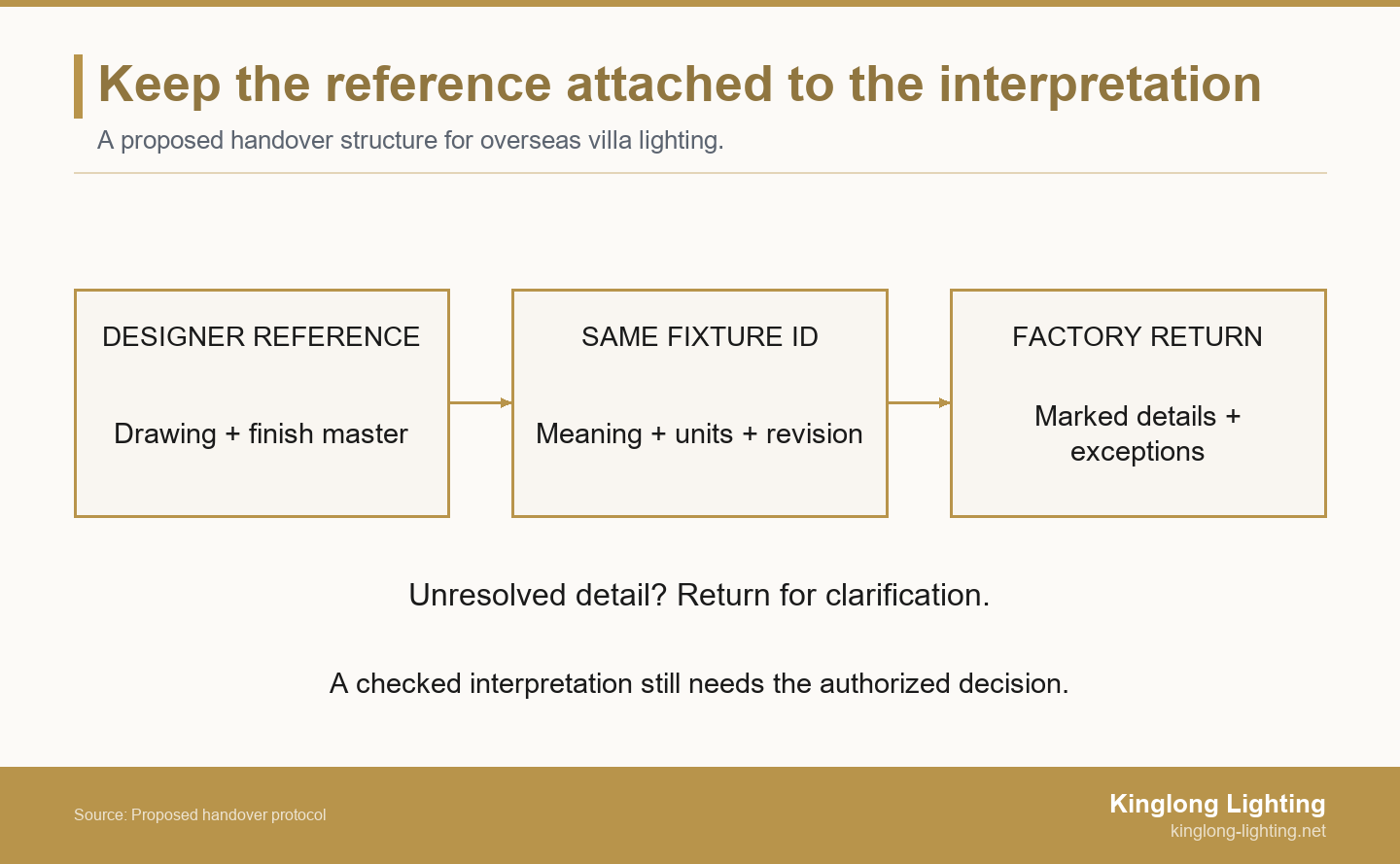
Copy the following rows into the project’s item sheet. For each fixture, retain the original-language requirement beside its reviewed factory-language rendering. Fill the return column with the factory’s actual proposal and the reviewer’s next question. An empty entry means information is missing; it should never be interpreted as permission to choose freely.
| Handover field | Keep with both language versions | Factory return or unresolved question |
|---|---|---|
| Identity and location | Unchanged fixture ID, room, quantity and source schedule revision. | Repeat the same ID on drawings, sample records, quotation and packing references. |
| Design meaning | Original wording, reviewed translation, annotated visual and the feature the designer intends to preserve. | State the proposed interpretation; list each difference instead of writing only “as requested.” |
| Geometry | Dimension, unit, measurement endpoints, orientation and referenced ceiling or furniture drawing. | Mark the corresponding dimension on the proposed drawing and identify any unconfirmed site input. |
| Finish and material | Material description, finish-master ID, sample holder and the scope of the appearance comparison. | Identify the proposed sample and process; ask which missing sample or comparison condition must be resolved. |
| Light source and controls | Requested light appearance, named control method and actual project system references. | Return proposed source and driver details for the appointed reviewer; flag any unsupported requirement. |
| Destination and installation | Project location, electrical inputs, installation conditions and the person responsible for technical review. | Provide applicable product information and identify outstanding suitability or documentation questions. |
| Exceptions and action | Source revision, translation reviewer, open differences and the exact purpose of this issue. | Name the decision needed, its owner and what can or cannot proceed on the available information. |
Make numerical meaning explicit. NIST’s guidance on expressing SI quantities pairs the number with its unit and places a space before the unit symbol. In a lighting handover, also identify what the dimension measures. Clear unit notation cannot resolve a disagreement about whether “height” means the lamp body or the complete suspended assembly.
Keep inspiration images distinct from manufacturing references. A published lighting project portfolio can help a buyer discuss scale and setting. It does not supply the mounting detail, finish standard or dimensions for the new villa. Label each selected image with its intended role so a factory does not inherit an assumption from an unrelated installation.
Make Drawings and Finish References Say the Same Thing
An annotated drawing should explain the physical detail that a short description leaves ambiguous. Show where a suspension dimension starts and ends, which face is visible, and which orientation the designer expects. Identify canopy, suspension and lamp body separately when their relationship matters. If furniture or ceiling geometry changes, return to the affected setting-out reference instead of merely updating the translated fixture name.
For appearance, identify a finish master: the physical sample used as the comparison reference. Record its code, material, holder and the features being reviewed. “Antique brass” can communicate a direction without specifying the same surface appearance as another supplier’s use of the phrase. A photograph helps explain the intention, but it does not identify a physical master or establish that a proposed sample is equivalent.
Comparison conditions also matter. X-Rite’s explanation of metamerism describes colors that appear to match under one lighting condition and differ under another. Agree which relevant lighting conditions and viewing arrangements the designer wants considered. This principle supports a more useful sample discussion; it does not provide a numerical acceptance tolerance for this project.
Separate color, sheen, texture and variation in the review notes. If the master is a flat metal coupon and the proposed component is curved or textured, state what the coupon comparison covers and what still needs a detail sample. Record whether the designer accepted the color direction, the surface treatment or the finished component, so the factory can see the scope of that decision.
When a design starts from Kinglong’s decorative-lighting collections, carry the chosen product reference into the item packet. Identify project-specific changes beside it. A collection image can establish the starting point while the revised drawing and sample record define what the factory is being asked to develop.
Require the Factory to Show Its Interpretation
A factory readback is the factory’s marked statement of how it proposes to make the item. Ask for the proposed drawing, identified materials and component references, together with an exception list. Translating the factory’s response back into the designer’s language helps communication, but comparing its physical choices with the source is what reveals a lost detail.
Read that return by requirement. For geometry, compare measurement endpoints and the current ceiling reference. For appearance, compare the proposed sample with the identified master and record remaining differences. For a departure, ask whether the factory is proposing an alternative or reporting that the original requirement cannot yet be confirmed. Those answers call for different decisions.
Preserve exact control terminology. The DALI Alliance describes DALI as a dedicated digital lighting-control protocol. A reply saying “LED, dimmable” therefore leaves a DALI requirement unanswered. Request the proposed driver and relevant control information for the appointed system reviewer. Naming a protocol clarifies the question; it does not prove that a particular fixture and the project’s controls will work together.
Keep destination evidence equally specific. UL Solutions’ marking and application guides help assess UL-certified equipment for a particular installation. Where that certification is relevant to the project, review the actual equipment and its applicable information. The guidance does not establish that every proposed fixture is certified, or that UL certification is the requirement for every destination.
Send unresolved questions with the relevant extract, rather than the entire correspondence chain. Identify the item, the requested detail, what the factory returned, and the decision needed. Ask the designer to resolve appearance, the appointed technical reviewer to resolve suitability, and the authorized buyer to address commercial consequences. Record their response against the returned reference.
Work Through a Dining Pendant Handover
Consider an illustrative dining pendant handover, rather than a reported customer case. Item V-DIN-P01 refers to drawing LT-12 revision C and antique-brass finish master FM-04. Its specified overall drop is 1200 mm, measured from the finished ceiling to the lowest fixture point. The factory returns “body height 1200 mm” and “brushed brass.” These are example inputs, not recommended installation dimensions. The body height does not establish the overall drop, and the finish wording does not establish equivalence to the master.
The procurement lead keeps the source wording beside the reviewed factory-language field and marks the two exceptions. For the drop, the question is: does the returned drawing show the complete assembly within the specified overall dimension, including the canopy and suspension arrangement? Ask the factory to mark those parts and endpoints. If it needs a current ceiling detail, identify that missing input rather than choosing a suspension length on the designer’s behalf.
For the finish, send the master reference and ask the factory to identify the sample it proposes to supply. The designer compares the relevant surface features under the agreed conditions and records what is accepted or still different. The fact that both names contain “brass” does not settle that comparison. If the factory proposes another construction for cost or availability reasons, treat it as an alternative for design and commercial review.
The observable result is a returned drawing with the correct overall-drop endpoints and an identified finish decision, each tied to the item and current references. Until those records exist, the affected details remain open. After clarification, compare the new factory return with both the source and the specific questions raised; a general “confirmed” reply would leave the same ambiguity in place.
If the finish master cannot be located, keep the finish comparison open. Ask who holds the master or which identified replacement sample the designer will adopt. A photograph can support discussion while that happens, but it cannot stand in for the missing physical comparison. Confirm which independent work, if any, is authorized to continue while the finish-dependent action waits.
For a proposed substitution, the decorative-lighting value engineering guide provides a separate design-and-commercial review path. The handover record should preserve the original requirement, the proposed change and the resulting decision, so the revised instruction remains understandable to everyone who receives it.
Keep Revision, Permitted Use and Release Separate
Record the current designer reference and factory revision, the purpose of each issue, open exceptions and the named decision. A later file is not automatically a manufacturing instruction. Plain-language purposes such as “for clarification” and “for sample review” tell the recipient what response is expected; any instruction to proceed needs its own explicit scope and authorized sender.
The archived UK BIM Framework Guidance Part C, in its discussion of metadata, distinguishes an information version from the purpose for which it can be used. That is a useful information-management lesson here. This proposed villa register does not import the guidance’s national codes or contractual workflow into every project.
Keep a short issue register with fixture ID, source revision, translation revision, factory return, permitted use, open question and decision reference. When a change is accepted, update the affected paired fields and linked drawing or sample record together. Mark the previous issue as superseded, retain it as history and tell the factory which current issue replaces it.
Finally, obtain acknowledgment of the identified issue and its intended use. Resolve any mismatch between the drawing being reviewed and the quotation or order reference before the buyer relies on it. This closes a specific handover gap without treating a language review as authorization to manufacture.
Send Kinglong a Brief That Can Be Checked
For a villa lighting discussion, assemble the floor plan and ceiling heights, room and fixture IDs, current designer drawings, preferred mood, finish-master status and budget basis. Add the destination, proposed controls, required technical-review contacts and a short list of open exceptions. Identify which details are fixed and which are proposals. A supplier can then respond to the actual question instead of reconstructing the brief from mood-board images.
Kinglong Lighting’s villa service page requests floor plans, ceiling height, preferred mood and budget, and describes sample review. You can discuss the villa lighting brief with Kinglong to explore relevant fixture options and clarify which sample or detail information should be reviewed next. Keep the resulting references in the same item packet. Product discussion can make the next review more specific; the project’s appointed people still make their respective design, technical and buying decisions.
Frequently Asked Questions
Can machine translation be used for the factory brief?
Machine translation can prepare a draft, but a technically competent reviewer should compare its meaning with the original drawings and references before reliance. Keep the source wording visible and maintain agreed terms for recurring details. Check measurements, finish descriptions and control terminology against the actual proposed item. A fluent sentence is useful communication; the factory’s marked response supplies the interpretation that still needs review.
What if the owner changes a detail in a chat message?
Capture the requested change against the fixture ID and send it to the people authorized to resolve its design and commercial consequences. Retain the message as the request, then update the controlled record after the decision. If the change affects dimensions, finishes or components already under review, identify the affected return and obtain a revised response. Do not let a translated chat silently replace the current instruction.
Can the factory proceed before every finish sample arrives?
Only separately identified work can proceed when its authorized scope does not depend on the unresolved finish, and that limit is explicit. Ask the factory what the missing sample affects and let the appointed decision-maker confirm the permitted action. Record remaining dependencies and any commercial consequences. Progress on an independent item does not establish acceptance of the unresolved finish or authorize the dependent work.
What if the destination country has not been confirmed?
Keep destination-dependent electrical and compliance decisions open, and request the project location and appointed technical reviewer before accepting those details. The team may continue discussing appearance while identifying which product choices depend on that information. Mark the electrical and documentation fields as unresolved. A statement that a supplier exports internationally does not answer the requirements for the particular project and installation.