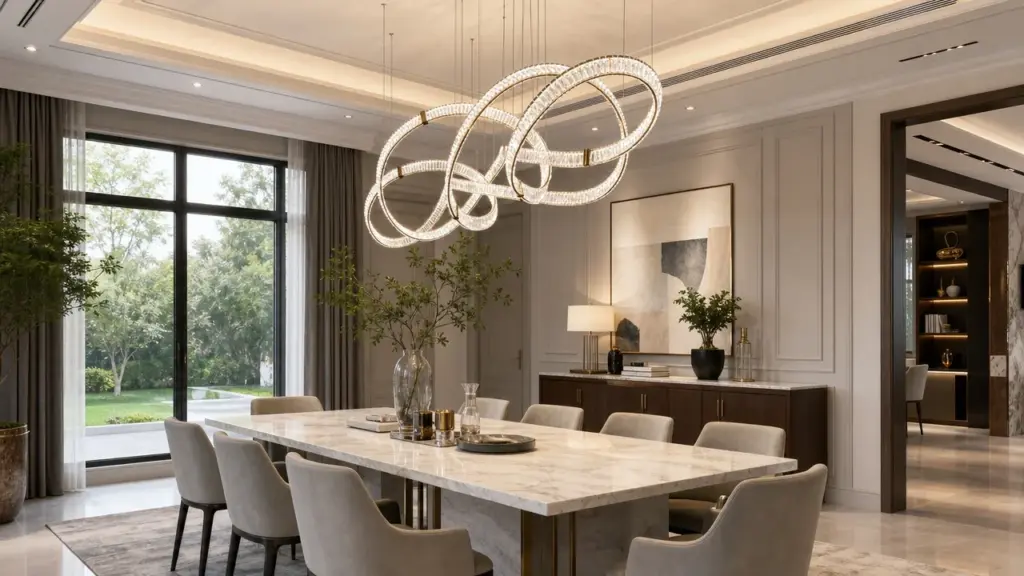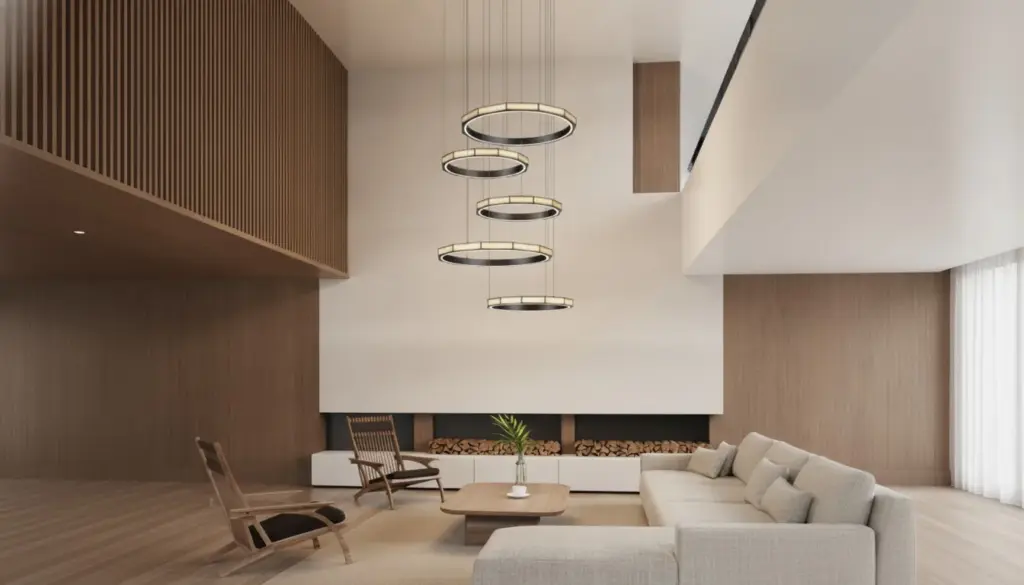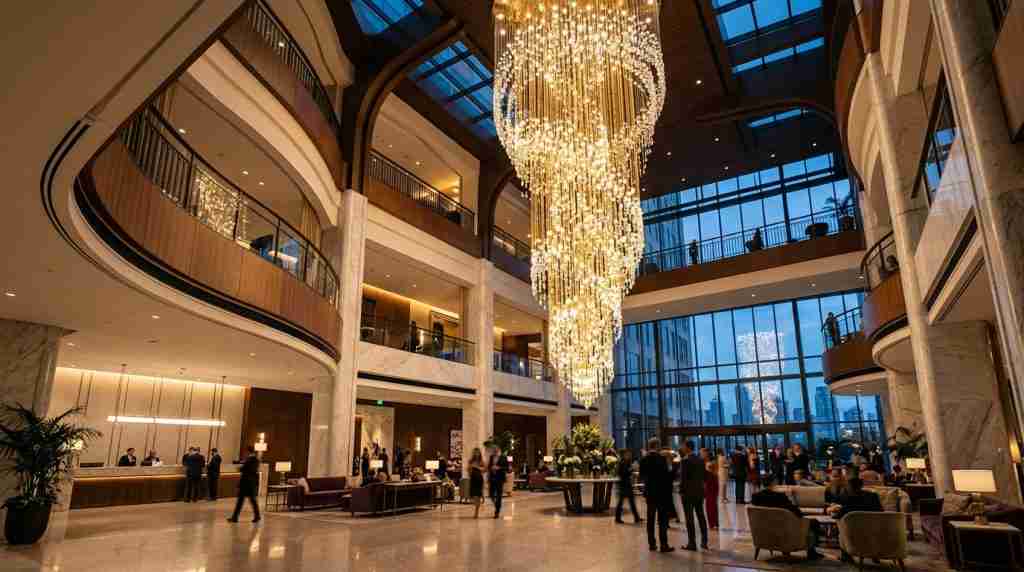
A coherent villa does not need a statement fixture in every room. Choose where decorative attention should lead, let supporting fixtures carry selected references through the house, and give quieter rooms a more restrained presence. Make those decisions from actual views, activities and architecture before allocating custom work. A hero can be memorable without being the brightest or most expensive piece. Equally, a visually quiet bedroom still needs appropriate light for reading, movement and everyday use. The useful hierarchy describes relationships, rather than ranking rooms by importance.
Give Decorative Fixtures Different Visual Jobs
A hero fixture is the main decorative focus in an intended view. Supporting fixtures connect that focus to the wider scheme through a chosen detail, material or form. Quiet rooms use less assertive decorative presence where the owner wants the architecture, furnishings or activity to take precedence. These are proposed planning roles, not product classifications. They do not specify light output, a purchasing allowance or a standard of workmanship. A supporting wall light may need demanding development because its position is difficult, while a readily available pendant may already provide the right focal point.
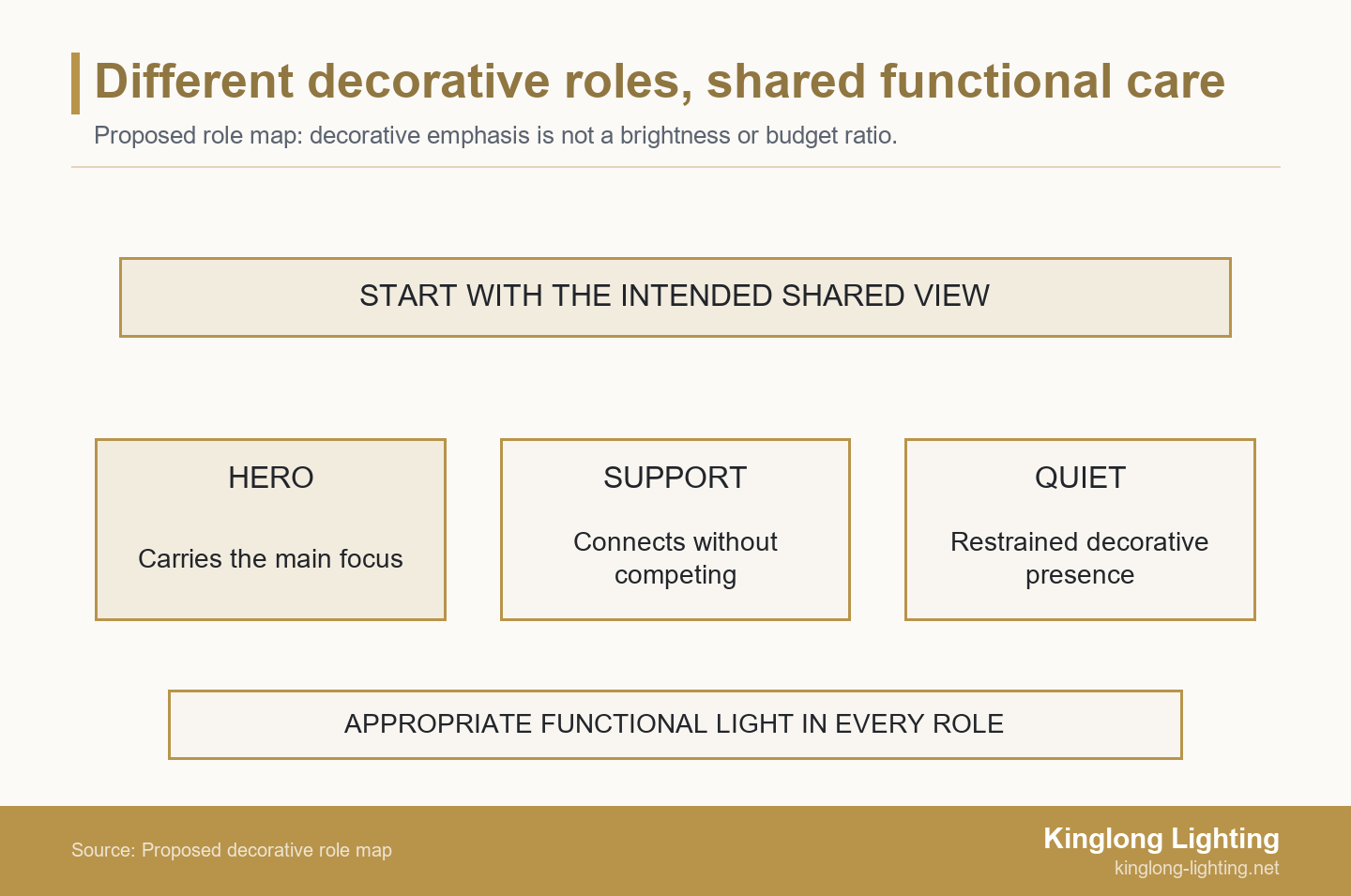
The research discussion on the IES website about lighting design objectives describes illumination hierarchy as an ordered distribution of visual emphasis. That is a useful distinction between illuminating everything and deciding what attracts attention. It is not a rule for decorative fixtures or fixed ratios. Here, the principle informs a simpler owner-facing question: what should a person notice first, and what should remain supportive?
Write the answer for a view, not merely beside a room name. An entrance chandelier may lead the arrival sequence but become a background element when seen from the dining table. A retained artwork may deserve the lead instead. Assigning roles early makes that intention discussable before the presentation fills with individually attractive products.
- Choose the lead from a particular shared view; let decorative fixtures support artwork or architecture when those provide the focus.
- Give each custom detail a purpose tied to the selected role and setting, rather than assigning spending by a fixed percentage.
- Retain appropriate functional light and the specified quality when reducing decorative emphasis in a quieter room.
Choose the Lead From the Views You Actually Share
Start with the route into the house and the places where people sit. Mark which decorative positions can be seen together, including views through open doors, across a stair void and in mirrors. Gather the current furniture plan and finish references using the lighting specification and procurement resources. The aim is to identify relationships that a separate product photograph cannot show. A view from the entrance may favor a vertical feature; a view from a low sofa may place that same feature behind a nearer pendant.
Use the following row structure for each important position. Replace the illustrative entry with the actual room and sightline. Name the intended focus before assigning the lighting role, then state what cannot be lost and the next check. If the focal object or viewpoint is undecided, mark the role provisional and resolve that input rather than ordering a fitting to settle the argument.
| Room / position | Main view and intended focus | Proposed decorative role | Protect / check next |
|---|---|---|---|
| Illustrative dining position | Seen from the living sofa; the table pendant leads | Hero in that shared view | Protect the table relationship; check the proposed drop from the seated view |
| Your room / position: ______ | Viewed from: ______; focus: ______ | Hero / supporting / quiet; reason: ______ | Protect: ______; unresolved input: ______; next check: ______ |
A useful completed row explains why the role belongs there. “Dining equals hero” does not. If two positions claim the same attention from the same viewpoint, compare them together and decide whether one should become quieter, move or be omitted. Separate rooms can each have a lead when they are experienced independently; the map is not a whole-house limit on memorable pieces.
Develop the Hero Around Its Setting
Develop the hero’s scale and visible details against the architecture and furniture it addresses. Review its body, suspension, canopy and relationship to the ceiling as a composition. A sculptural piece over a table asks different questions from a cascade in an entrance void. Show the selected proposal in the relevant view, including its unlit appearance. A dramatic catalogue close-up does not establish that the fitting has the right presence from the front door or from a dining chair.
Give custom development a specific purpose. An adjusted drop may align the composition with the intended viewpoint; a finish sample may establish its relationship with nearby metalwork. A distinctive glass arrangement may be the detail worth protecting. Record which feature carries the visual idea before requesting alternatives. Otherwise, successive revisions can preserve the product name while removing the part that made it suitable.
Do not make the hero more prominent simply by specifying more watts. Australia’s Energy Rating guide to choosing a lamp distinguishes light output in lumens from electricity consumption in watts. Those lamp measures do not establish decorative priority or the illumination delivered by a complete fitting onto a particular surface. Have the lighting designer assess useful light and the project team review the actual product geometry. Decorative prominence and technical suitability need different evidence.
Let Supporting Fixtures Connect Without Copying
Supporting fixtures should have a recognizable relationship with the lead without repeating all its gestures. Carry a metal tone, a glass treatment, a curve or a restrained level of detail where it helps the intended view. Let scale and form respond to the position. A wall light can belong with an entrance feature through a shared material while remaining much less visually assertive. An identical miniature is not automatically the best support.
Kinglong Lighting presents named decorative families in its catalogue. You can explore Kinglong’s decorative collections to identify candidates that express the chosen reference. Treat those candidates as products to check, rather than assume the family includes every needed variant. Confirm the available sizes, finish references and proposed adaptations for the actual enquiry. The selection question is what this fitting contributes to the room, not whether every room can carry the same collection name.
Review the candidates beside the lead and the surrounding materials. Two finishes described as gold may differ in sheen and surface character. A modest supporting form can still look intrusive if its finish becomes the strongest contrast in the view. Conversely, a deliberate material difference can work when the designer intends it. Decide from identified samples and coordinated drawings, rather than requiring either universal matching or universal contrast.
Keep Quiet Rooms Fully Functional
Quiet rooms are spaces with restrained decorative emphasis, not spaces where useful lighting or quality is expendable. A study may need an unobtrusive ceiling fitting and effective local reading light. A bedroom may favor a calm ceiling and carefully positioned bedside pieces. The decorative package can recede while the activity remains properly supported. Do not remove a needed lighting layer merely because its fitting is not intended to attract attention.
The Australian government’s YourHome lighting guidance asks designers to consider room activities, the desired atmosphere and decorative elements to highlight. It also distinguishes general, task and accent purposes. This is a useful design principle for the room brief, not an automatic transfer of Australian regulatory requirements to a villa elsewhere. Specify what occupants need to do before deciding how visually discreet the fixtures should be.
Keep the selected finish standard, service access and relevant technical requirements explicit even when a product is visually simple. Simplicity can make a surface or alignment more exposed, rather than less important. Where a ceiling is already visually busy, the appropriate response may be a less assertive decorative form, with the remaining lighting design resolved separately. A role label should clarify the brief, not conceal an unfinished room.
Test the Hierarchy in Different Lighting Scenes
Review the same shared views in daylight and in the evening conditions the owner actually expects to use. The decorative-lighting project portfolio can help discuss installed visual contexts, but another installation cannot verify this villa’s composition. Use its own proposed products, room views and sample references. A polished metal body may attract attention while unlit; a nearby bright shade may compete when switched on. Both appearances belong in the discussion.
Lutron’s published luxury-home examples demonstrate distinct daylight, twilight, relaxation and movie-viewing scenes. These manufacturer examples show why one all-on presentation is a limited design review; they are not compatibility tests for the proposed villa fixtures or Kinglong controls. Ask the responsible designer which groups need independent control and what the intended scenes should do. Confirm the actual source, driver and control arrangement before relying on a proposed dimmed effect.
Check light color separately from metal finish. CCT means correlated color temperature and describes the apparent shade of white light. The US Department of Energy’s LED Basics guidance, from DOE, distinguishes light color appearance from color fidelity and notes the information lost when appearance is reduced to CCT. Matching CCT labels alone therefore do not establish a matching appearance. Review relevant product data and samples where neighboring lights need to look consistent; a common decorative role supplies no such proof.
Allocate Custom Work Before Cutting the Package
Allocate custom work by what the selected role and room constraint require, then compare the actual quoted scope. There is no universal spending percentage implied by hero, supporting and quiet labels. A hero may already fit the brief as offered. A supporting piece may need a special projection, mounting detail or finish to work in a difficult position. Protecting the intended visual hierarchy does not mean approving every custom request on the lead and stripping every secondary item back to its lowest price.
Separate the feature that carries the design from the detail that is negotiable. Ask which change alters the intended view and which only changes a less visible construction choice. Keep the same quantities, supplied components, development, samples, packing, freight and installation responsibilities in the comparison. If an allowance remains uncertain, leave it uncertain. A smaller decorative presence is not evidence of lower cost, and an initial price difference does not establish a lower complete-package cost.
When a quote exceeds the allowance, use the decorative-lighting value engineering guide to structure the alternatives. Reassess an expensive detail against the role it serves before accepting a substitute. If the proposed change removes the characteristic that makes the hero recognizable, review that consequence openly. If it preserves the intended relationship, examine its product and commercial implications on the same basis as the original proposal.
Work Through an Entrance, Dining Area and Reading Room
Consider an illustrative villa, not a documented Kinglong project. Its entrance opens toward a dining area; a reading room sits beyond a separate doorway. The owner initially wants a dramatic entrance cascade, a sculptural dining pendant and prominent reading-room ceiling decoration. From the arrival view, the cascade and pendant compete. The reading-room choice also draws attention away from the room’s intended calm. Attractive individual selections have not yet produced an agreed order.
Fill the dining row of the role map from the living sofa: the table pendant is intended to lead, while the entrance feature remains visible in the distance. Review a less assertive entrance arrangement from that shared view, and keep a separate arrival view to see whether it still feels appropriate. In the reading room, retain the reading task and propose quieter ceiling decoration. Compare those revised views with the initial proposal to see whether the intended lead is now clear without losing the other rooms’ purpose.
Now change the brief: the owner chooses an artwork as the main dining focus. The pendant may become supporting rather than heroic, and its form or position should be reconsidered accordingly. If the artwork location is still unknown, keep that decision open and request the placement before finalizing the pendant. The observable result is a role map and coordinated views that explain the choices. It is not proof of final light levels, budget savings or product approval.
Put the Roles Into a Supplier Brief
Put the agreed roles beside actual product positions in the supplier brief. Include the viewpoint, intended focal object, selected candidate, protected visual reference and remaining question. Distinguish an agreed direction from an approved specification. A supplier should be able to identify which detail needs development and which information is missing, rather than interpret a mood board as permission to redesign every room. Keep the latest drawing or sample reference with each proposed change.
Send the current plan, furniture and artwork locations, ceiling information and the views that shaped the role map. Add material references, the budget basis and any retained pieces. Ask about actual variants, adaptation scope and the samples or details available to review. Leave technical design, installation coordination and the authority to approve the purchase with the assigned project parties. The brief organizes those decisions; it does not make them on their behalf.
To review the villa lighting brief with Kinglong, bring that role map alongside the floor plan, ceiling height, preferred mood and budget. Kinglong Lighting’s published villa service asks for those inputs and describes physical sample or detail review within its bespoke process. Confirm the product options and review materials available for the actual enquiry. The next useful result is a clearer candidate scope, with protected design intentions and unresolved product questions visible.
Frequently Asked Questions
Does a compact villa need a large chandelier to establish a hero?
A compact villa does not need a large chandelier to establish a hero; a smaller fitting can lead through its position and visual relationships. Compare the candidate with the actual furniture and available ceiling space from arrival and seated views. If a large body crowds those relationships, develop the smaller option instead of treating the hero label as a size requirement.
Can artwork or architecture be the hero instead of a chandelier?
Artwork or architecture can provide the main focus, with decorative fixtures supporting it rather than competing to become the room’s central object. Include that focus in the original room brief and the shared-view review. Its lighting needs still require the appropriate design input; assigning it the lead is not an artwork-conservation or technical lighting specification.
Can a quiet bedroom still include a distinctive decorative light?
A quiet bedroom can include a distinctive light if its scale, position and scene behavior support the intended calm rather than dominate every view. A carefully chosen bedside or wall piece may provide character without a competing ceiling feature. Test it against the actual furniture arrangement and useful-light requirements before treating visual restraint as a reason to remove it.
How should an existing statement fixture affect the new lighting package?
An existing statement fixture should be included in the first role review, because its scale and position may determine which new pieces should support it. Record its dimensions, finish and relevant views with the retained furniture. New selections can respond to one useful reference without imitating every detail, subject to their own room fit and product review.