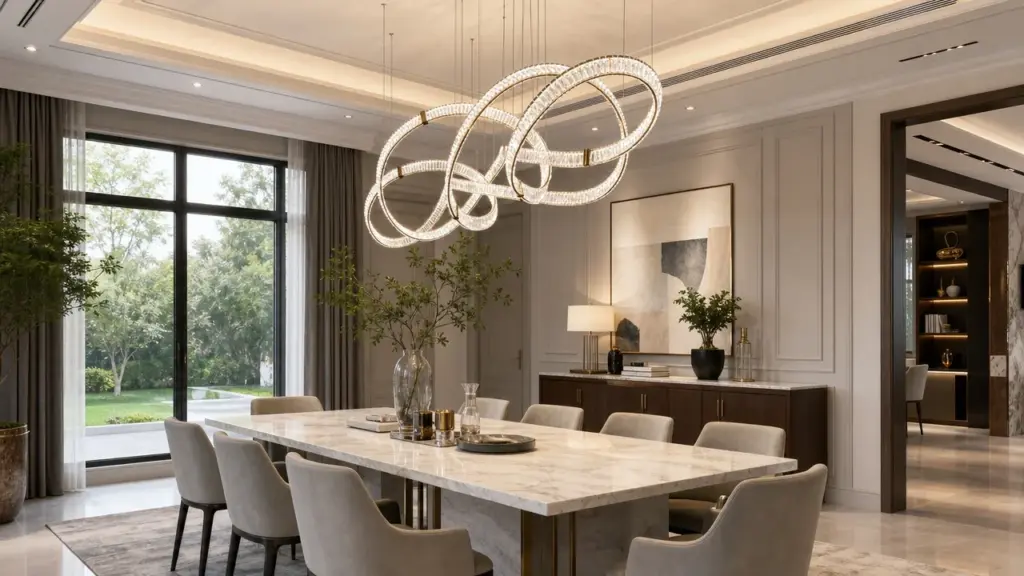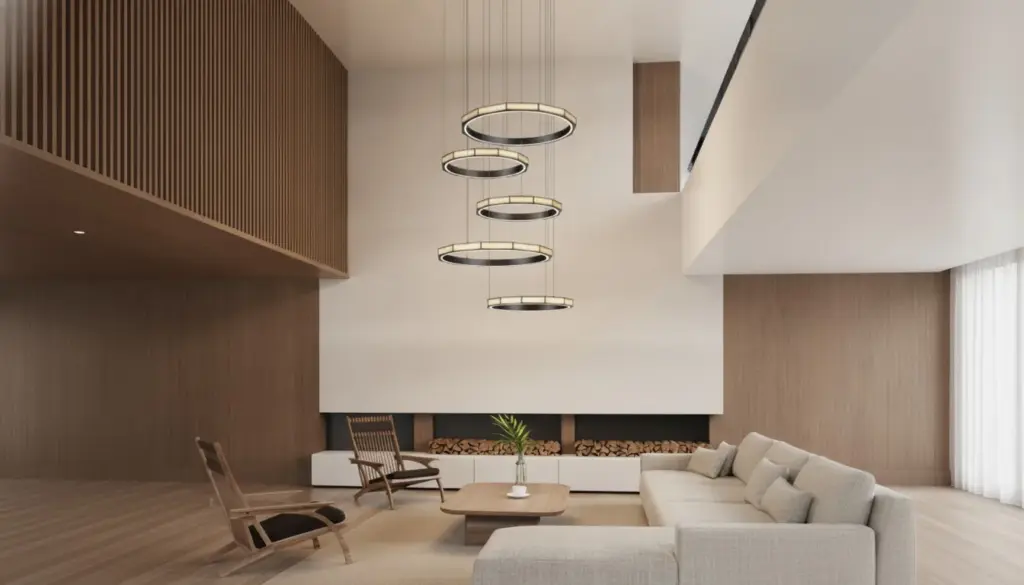
Choose the starting point for a villa lighting scheme from the rooms and the intended visual relationships. Room-by-room selection is useful when spaces have different proportions, uses or retained furniture. A collection-led approach is useful when a shared design language is already agreed and the available variants suit the actual rooms. Both can produce a coherent scheme; neither does so automatically. The practical comparison is between two ways of organizing the same brief, rather than between an eclectic house and a matching set.
Choose the Starting Point, Then Test the Whole Scheme
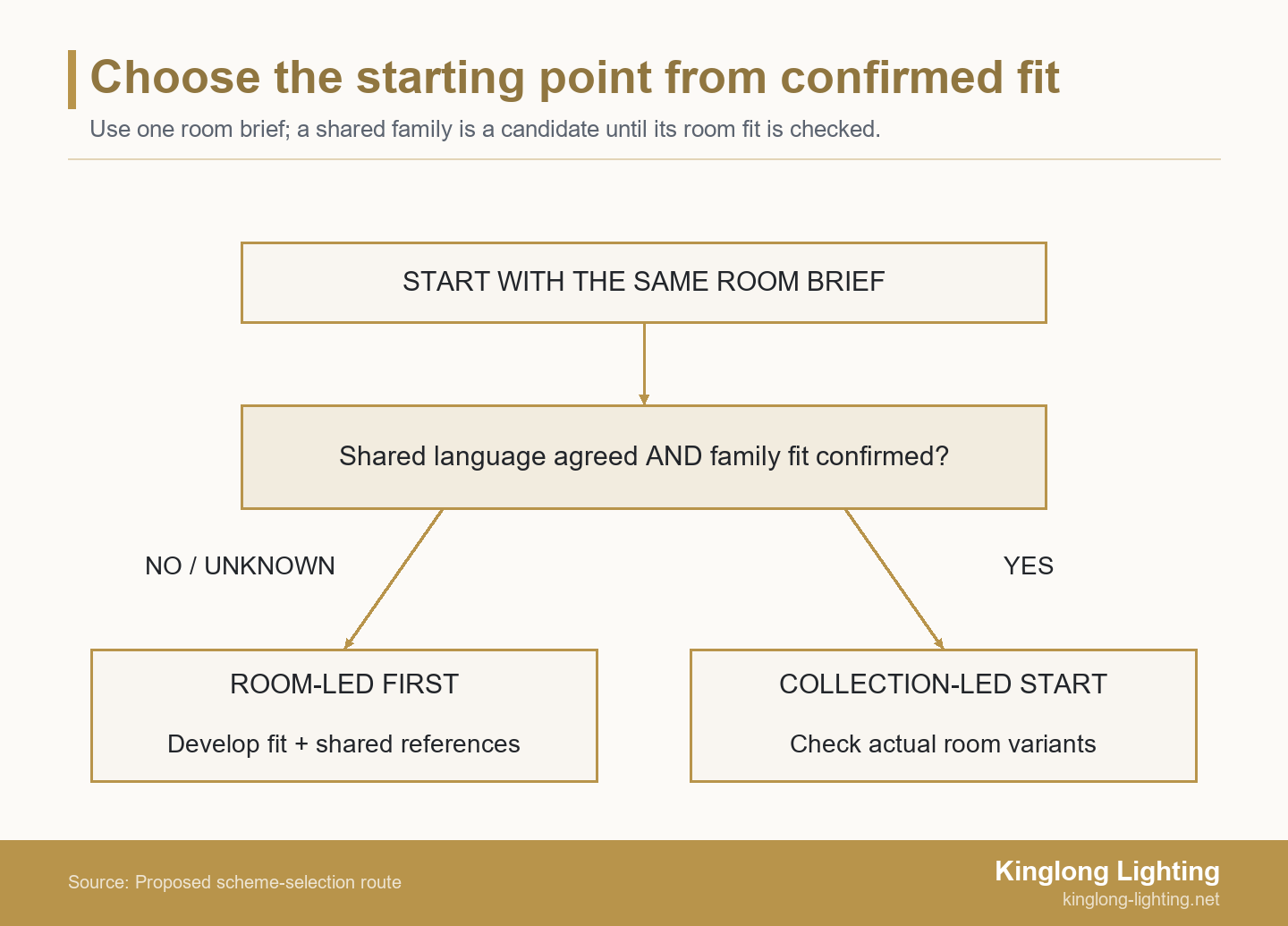
Start room-led when room needs differ materially or the common visual direction is still being developed. Start collection-led when the desired language is clear and suitable family variants have been checked against the rooms. A hybrid is useful when a family supports some connected spaces but a different form solves a genuine constraint elsewhere. It should have a reason beyond indecision.
- Choose room-led first for differing ceiling conditions, furniture arrangements, activities or existing pieces that need individual responses.
- Choose a collection-led start for an agreed material or form vocabulary with actual variants that meet the room brief.
- Review either route across connected views, then record exceptions and the checks still needed before purchasing.
If family coverage is unknown, keep the collection as a candidate and develop the room requirements first. A catalogue image is enough to begin a design conversation, but not to establish that the whole villa can use that family. Choosing a starting method organizes the design work; room and product reviews still determine whether the proposed scheme is suitable.
Room-by-Room Design Starts With What Each Space Must Do
Room-led design begins with each room’s use, architecture and furniture, then selects appropriate decorative forms. A narrow dining table, a double-height entrance and a bedroom with a restricted ceiling zone may call for different shapes. The advantage is freedom to address those differences. Its coordination task is to establish what connects the selections when someone moves through the house.
The Australian government’s YourHome lighting guidance relates choices to room activities, atmosphere and the features to highlight. That design principle supports beginning with the intended experience of each space. Its Australian regulatory context does not become a requirement for a villa elsewhere; the useful point here is to give each selection a defined purpose.
Write a short brief for every decorative position: what it relates to, where it will be seen, the available space and what other lighting is doing. Gather plans, furniture references and known constraints with the help of the lighting specification and procurement resources before comparing product options. A bedside fitting may need a different presence from an entrance feature even when both use warm metal. Include existing furniture and artwork early. Selecting around a retained object is easier to assess when that object appears in the brief rather than arriving after the lighting presentation.
Then review the selections together. Carry an identifiable reference between spaces, such as a finish sample, a curved profile or a restrained level of ornament, while allowing scale to change. Without that review, separate room decisions can compete in the same doorway view.
Collection-Led Design Starts With a Shared Visual Language
Collection-led design starts from a shared family of forms or a material vocabulary, then tests its actual variants in each room. The initial vocabulary might be repeated glass shapes, a recognizable metal detail or related linear and clustered arrangements. This provides a common reference for the presentation. It does not require the same pendant in every space, nor does it establish that a family contains every form the villa needs.
Make a coverage list before extending the idea across the house. Identify which candidate serves each decorative position, its proposed dimensions and the drawing or product information still required. A matching wall light may have a different projection or light source from the pendant. A smaller version may alter the visual balance. Treat those as actual selections to review, rather than presumed consequences of choosing the family name.
A decorative family also sits within a wider lighting design. Cooper Lighting Solutions’ residential layering guidance distinguishes ambient, task and accent lighting, each serving different purposes. That manufacturer-published guidance explains why a visual family is not a complete room-lighting plan. Keep the other required layers and the responsible designer’s work in view when assessing its coverage.
Kinglong Lighting’s catalogue presents named decorative families as starting points for selection. You can explore Kinglong’s decorative-lighting collections to identify a visual direction, then ask about the specific variants needed for the brief. Confirm dimensions, finish references and available development scope for those products. This comparison concerns planning methods; a catalogue entry alone does not prove that its family is the right answer for a particular villa.
Compare Both Routes Against the Same Villa Brief
Compare both routes using the same rooms, furniture plan, ceiling constraints, connected views and budget scope. Keep the level of development comparable too. A fully drawn collection proposal will naturally look more resolved than an early room-by-room mood board; that difference does not establish the method’s superiority. Ask what remains unresolved in each option and which information could change the preference.
| Decision dimension | Room-by-room starting point | Collection-led starting point |
|---|---|---|
| Starting information | Room activities, architecture, furniture and individual focal points. | Agreed shared form or material language, then room coverage. |
| Room fit | Select forms independently where spatial needs differ. | Check that actual family variants meet each spatial brief. |
| Connected views | Define the visual references linking separate selections. | Check whether repeated motifs support the intended hierarchy. |
| Variation and exceptions | Review contrasts together so they remain intentional. | Identify gaps and justify a different variant or family where needed. |
| Approval work | Track each selection and the cross-room coordination decisions. | Separate shared references from variant-specific approvals. |
| Complete commercial scope | Price the actual mixed package and its development work. | Price the actual family package, adaptations and exceptions. |
Use shared viewpoints to evaluate visual hierarchy: which fitting should draw attention first, and which should support it? In an open living-and-dining area, related forms can work at different scales. Equally, a deliberate contrast can distinguish the dining zone. Repeating a dramatic feature everywhere may make each piece less distinctive, while unrelated statement pieces may compete. Compare the proposed views rather than treating repetition or variety as a rule.
Present both options with the same room views and clearly identified proposed products. Label reference images separately from the selected variants. The decorative-lighting project portfolio can help discuss installed visual contexts. Use this villa’s plans, drawings and samples to establish its fit; photographs of another installation cannot settle its ceiling clearances, room proportions or concealed interfaces.
Check the Differences a Family Name Cannot Settle
First compare the actual geometry. Body size, overall drop, wall projection and canopy size answer different questions. Check the selected product against furniture, door movement, circulation, mounting position and maintenance access with the responsible project team. A collection can retain its identity through different forms, but only if those forms actually exist or a feasible development is agreed. Leave unresolved dimensions visible rather than assuming adjustment on site.
Then compare useful light information. Australia’s Energy Rating lamp-selection guidance distinguishes light output in lumens from electricity consumption in watts. A matching wattage is therefore not a brightness specification. Lamp output also does not establish the illumination delivered to a particular surface through the complete fitting. Obtain the relevant product information and have the lighting designer assess its application.
Keep metal finish and light appearance separate. CCT means correlated color temperature, describing the apparent shade of white light. The US Department of Energy’s LED guidance, from DOE, distinguishes color appearance from color fidelity and notes that condensing appearance to CCT loses information. Equal CCT labels alone do not establish matching light appearance. Review relevant source data and samples where neighboring fittings must look consistent.
Control compatibility needs its own evidence. In guidance for its specific Maestro LED+ Dual Control, Lutron identifies dimmer and LED-lamp incompatibility as a possible cause of flicker or buzzing when dimmed. This does not test every driver or any Kinglong fitting. Record the proposed light source or driver, control model and applicable compatibility information for technical review rather than assuming related-looking products behave alike.
For visual continuity, compare identified finish samples with the surrounding materials under the agreed viewing conditions. A common color name is a starting description, not the sample reference. Review the actual glass, shade or metal surface where its appearance matters. Product suitability for bathrooms, exterior positions and other special conditions also requires its own evidence; visual similarity cannot supply it.
Compare Complete Options Before Calling One Easier or Cheaper
A shorter collection shortlist does not establish fewer approvals or a lower package cost. One shared finish reference may simplify a particular decision, but different sizes, light sources, suspension details and room exceptions can still need separate review. A room-led proposal can also reuse confirmed details. Count the actual open decisions in each developed option instead of assigning an efficiency advantage to its label.
Compare offers in the same currency and on the same quantity and supply basis. Identify development work, samples, supplied light sources or gear, packing, freight, installation responsibilities and exclusions. Record uncertain costs as uncertain. Without quotations covering equivalent scope, the useful conclusion is which option better fits the brief and what must be priced next; it is not a claim that either planning method is cheaper.
If an option exceeds the allowance, return to the visual priorities and room constraints. An exception may be worth retaining because it solves a clearance problem, while a less prominent detail may offer flexibility. Use the decorative-lighting value engineering guide to frame the proposed alternative. Bring the changed product, scope and approval implications back into the same comparison before accepting it.
Try the Decision With an Open Living Area and a Low Bedroom
Consider an illustrative villa, not a documented Kinglong project. Its living and dining areas share a long view, the entrance has a taller ceiling, and a bedroom has a restricted ceiling zone. The owner likes a sculptural pendant family. Related living and dining forms could support the intended continuity, but the proposed bedroom pendant conflicts with the space available. The family name cannot resolve that conflict.
Using the room-led route, first define what belongs over the dining table, what should support the living area and which bedroom forms fit the ceiling condition. Then compare those choices together using the agreed material palette and visual hierarchy. The bedroom can use a shallower form while retaining a relevant finish or detail. Record the reason for the difference so it is treated as an intentional part of the scheme.
Using the collection-led route, ask for the actual family variants and their drawings. If a suitable shallow bedroom version is confirmed, the family may cover the brief without that exception. If it is unavailable or unsuitable, retain the family in the connected living and dining spaces and evaluate a separate bedroom candidate. A proposed custom adaptation remains unresolved until its feasibility, appearance and supplied scope are confirmed.
The changed condition changes the recommendation: confirmed room coverage supports a collection-led start; a genuine coverage gap supports room-led selection or a documented hybrid. If the owner instead decides that each room should have a distinct character, that preference may favor room-led planning even when suitable family variants exist. Neither route releases the purchase on its own. Check the resulting selections against the same room brief and connected views before choosing the package.
Turn the Chosen Approach Into a Supplier Brief
Record the chosen starting method and why it fits. Include the shared visual references, room-by-room positions and constraints, candidate products, deliberate exceptions and decisions still open. Distinguish an agreed design direction from a confirmed product specification. This gives the supplier something concrete to assess and keeps the next presentation from reopening every room without a reason.
Send the current plan and furniture layout, ceiling information, selected views, finish references and budget basis. Ask the supplier to identify available variants and the information needed to evaluate adaptations. Keep technical suitability, installation coordination and approval authority assigned to the relevant project parties. A response should make the candidate package clearer, with remaining questions visible rather than hidden behind a complete-looking mood board.
To review the whole-home villa lighting brief with Kinglong, bring those inputs and mark the proposed room exceptions. Kinglong’s published villa service describes review of plans, ceiling height, mood and budget, with physical sample or detail review in its bespoke process. Confirm which product options and review inputs are available for the actual enquiry. The aim is a coherent, room-appropriate candidate package with a clear basis for the next decision.
Frequently Asked Questions
Must a coherent villa use one metal finish everywhere?
A coherent villa does not require one metal finish everywhere; any contrast should be intentional and reviewed in the views connecting the rooms. Use identified samples and surrounding materials to judge the relationship. A finish change may help distinguish a private room from shared areas without abandoning the overall design direction.
Can an existing family heirloom sit within a collection-led scheme?
An existing heirloom can remain a deliberate exception if its location, scale and visual relationships are reviewed with the proposed collection. Include it in the initial room brief and presentation. Its presence may shape the shared palette or suggest a quieter neighboring fitting, rather than requiring every new piece to imitate it.
Does collection-led lighting mean ordering every fixture from one supplier?
Collection-led lighting describes the visual starting point; it does not by itself require one supplier for every fixture or lighting layer. Record who supplies each selected product and who coordinates samples, interfaces and approvals. A single purchase route may be convenient, but it does not remove those responsibilities.
Should bathrooms and outdoor areas follow the same decorative family?
Bathrooms and outdoor areas should use only products confirmed suitable for their actual locations, even when the visual language continues from inside. Ask for the applicable product documentation and local technical review. If the family lacks a suitable option, choose another product that supports the intended relationship without assuming equivalent performance from appearance.