Integrating sphere testing for chandeliers can help buyers understand light output, color behavior, and component consistency, but the report is often misunderstood. A sphere measures a defined sample under defined conditions. It does not automatically describe the entire installed chandelier, the room atmosphere, or every decorative material decision.
For custom decorative lighting, this distinction matters. A hotel lobby chandelier may use many light sources, crystal layers, metal shades, diffusers, and dimming scenes. A sphere report can support the technical file, but it must be connected to the actual component, room intention, and approval decision.
Kinglong Lighting can help buyers connect sphere reports to samples, drawings, source selection, and the custom chandelier workflow before a lighting package is released.
Key Takeaways
- Sphere data is sample-specific: The report is only as useful as the sample identity and method match the order.
- Lumens are not the room result: Output numbers need color quality, distribution, dimming, and material context; the trade-off is accepting a short mockup review before release instead of approving a source from one lumen figure.
- Calibration matters: Buyers should read method, standard lamp reference, date, and uncertainty boundaries.
- Decorative layers can change experience: Crystal, shades, glass, and diffusers affect the installed perception beyond a bare light-source test.
- Reports should release decisions: Use the report to approve a source, compare options, or request another test, not as generic paperwork.
Start with what the sphere actually measured
An integrating sphere report should answer a lighting decision, not decorate a technical folder.
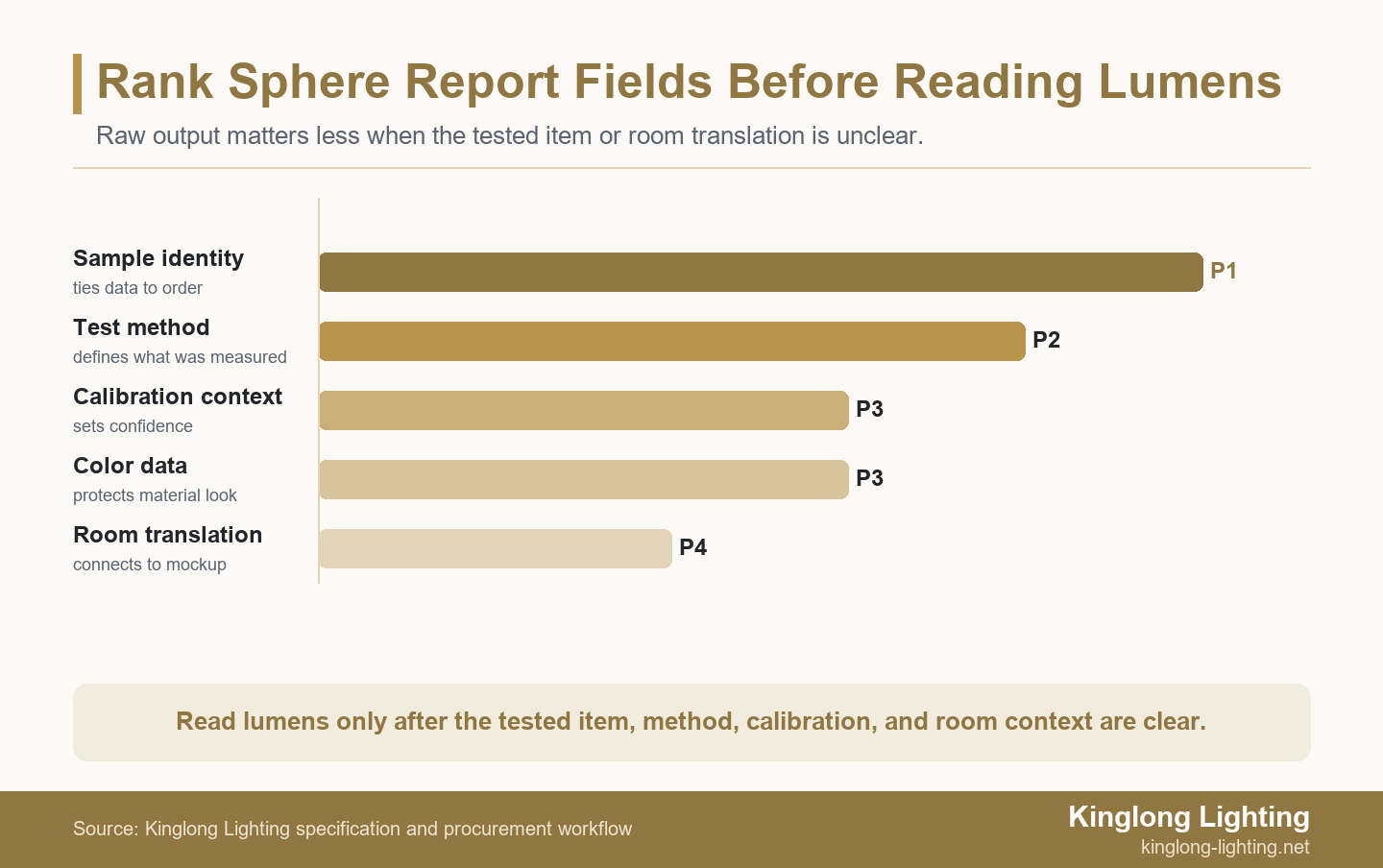
The first reading step is to identify the sample. Was the test performed on a bare LED module, a lamp, a small assembly, a diffuser group, or a representative luminaire? The answer decides how far the buyer can apply the result.
According to Lighting Global integrating sphere basics note, integrating sphere measurements compare a device under test against a standard lamp and depend on calibration and method control. For project buyers, the practical action is to connect the reported measurement to the exact device under test and calibration setup.
Sample identity controls the meaning
A report on an LED module may support source selection, but it may not prove the finished chandelier’s visual effect after crystal, glass, shade, dimmer, and installation height are added. The buyer should compare the report sample with the bill of materials and approved drawing.
If the sample identity is unclear, the buyer should not reject the report immediately. The better question is whether the result is being used for a decision it can actually support.
In practice, approve this as a integrating sphere report sample gate: record the master sample, the viewing distance, and one acceptable variation boundary. The decision rule is to compare the delivered batch within 7 days and hold the supplier to a written correction path if the visible result or replacement cost changes.
Method context keeps numbers honest
Sphere measurements depend on setup, calibration, method, and correction practices. The buyer does not need to become a lab engineer, but the report should show enough context to understand what was measured.
A single number without method context is weak evidence. A number tied to sample, method, date, and purpose is much stronger.
In practice, make this a integrating sphere report visibility gate: judge the sample under the room light, normal viewing distance, and cleaning condition. The decision rule is to document the threshold before release, then review any mismatch within 7 days if the owner-visible effect or maintenance cost changes.
Do not treat lumens as the whole chandelier promise
Lumens are useful, but decorative lighting is judged through mood, glare, sparkle, shadow, color, and material interaction. Sphere data is one part of that larger decision.
According to DOE LED lighting page, LED products differ in direction, color behavior, heat, lifetime, and application fit. For project buyers, the practical action is to review decorative materials under the specified light source and room condition, not as isolated samples.
The room may need less output than the buyer expects
A chandelier in a villa dining room may need warmth, dimming, and sparkle more than maximum output. A lobby chandelier may need presence and even glow, not just a high lumen value.
The buyer should decide whether the report supports ambient light, accent effect, decorative glow, or source comparison. Each use asks the number to do a different job.
In practice, make this a integrating sphere report visibility gate: judge the sample under the room light, normal viewing distance, and cleaning condition. The decision rule is to document the threshold before release, then review any mismatch within 7 days if the owner-visible effect or maintenance cost changes.
Color data can matter more than raw output
Two sources with similar output can make crystal, brass, leather, or glass look different. Color rendering and color temperature therefore belong in the same conversation as lumens.
According to DOE TM-30 FAQ, color quality needs more precise language than warm, cool, or beautiful when materials are being approved. For project buyers, the practical action is to interpret color quality data beside the material palette and intended viewing condition.
In practice, make this a integrating sphere report visibility gate: judge the sample under the room light, normal viewing distance, and cleaning condition. The decision rule is to document the threshold before release, then review any mismatch within 7 days if the owner-visible effect or maintenance cost changes.
Calibration and accreditation should be read as confidence layers
Lab evidence becomes stronger when the buyer can see traceability, method, and competence boundaries. That does not make the report unlimited, but it makes the right claim more trustworthy.
According to ISO/IEC 17025 overview, laboratory competence, valid results, and report acceptance depend on method and scope. For project buyers, the practical action is to check whether a material report identifies the sample, method, date, scope, and claim it actually supports.
Accreditation supports the process, not every claim
A CNAS-related or ISO/IEC 17025 context can increase confidence in the measurement process. It does not mean the chandelier is approved for every market, use condition, or visual promise.
According to CNAS English site, accreditation is a signal that a laboratory or inspection body has been assessed against recognized competence requirements. For project buyers, the practical action is to treat accreditation as a competence signal while verifying the exact scope and test item.
In practice, treat this as a integrating sphere report evidence gate: keep the report, sample ID, method, date, and claim boundary together. The decision rule is to accept only what the document actually proves, then flag any missing proof within 7 days before the buyer signs production release.
Recognition still depends on the receiving party
International buyers may need evidence that a consultant, importer, owner, or authority will accept. A technically good report can still be mismatched to a receiving-party format.
According to ILAC MRA and signatories page, international recognition of accredited test results depends on the accreditation body and recognition relationship. For project buyers, the practical action is to confirm recognition expectations and receiving-party rules before relying on a report for international approval.
In practice, make this a integrating sphere report visibility gate: judge the sample under the room light, normal viewing distance, and cleaning condition. The decision rule is to document the threshold before release, then review any mismatch within 7 days if the owner-visible effect or maintenance cost changes.
Decorative chandelier geometry can weaken direct translation
A chandelier is rarely a simple light source. Crystals, glass shades, metal arms, acrylic forms, and reflective finishes can all affect how people perceive the measured light.
According to UL 1598 standard page, decorative chandeliers are still luminaires that need product evidence and qualified installation review. For project buyers, the practical action is to keep sphere data connected to the complete luminaire boundary and product file.
A component test may need a fixture-level follow-up
If the source is hidden behind glass, crystal, or metal geometry, the buyer may need additional visual mockup review or fixture-level observation. The sphere result can still guide selection, but it may not close the decision alone.
This is especially true for chandeliers designed as luminous sculptures rather than task lights. The installed impression can depend on reflected light and shadow pattern.
In practice, treat this as a integrating sphere report evidence gate: keep the report, sample ID, method, date, and claim boundary together. The decision rule is to accept only what the document actually proves, then flag any missing proof within 7 days before the buyer signs production release.
Electrical and installation boundaries remain separate
A photometric result does not settle wiring method, branch circuit, local installation, or safety review. Those responsibilities need their own evidence and professional checks.
According to NFPA 70 National Electrical Code page, electrical installation and field acceptance decisions need local qualified code review. For project buyers, the practical action is to separate measured lighting data from local electrical installation responsibility.
In practice, make this a integrating sphere report visibility gate: judge the sample under the room light, normal viewing distance, and cleaning condition. The decision rule is to document the threshold before release, then review any mismatch within 7 days if the owner-visible effect or maintenance cost changes.
Turn the report into a release decision
The best report file ends with a decision. It should say whether the source is approved, whether another sample is needed, whether the room mockup should change, or whether the report only supports background confidence.
According to DOE TM-30 FAQ, color quality needs more precise language than warm, cool, or beautiful when materials are being approved. For project buyers, the practical action is to use color data to support a specific material and light-source decision rather than leaving metrics unused.
Write the decision in buyer language
A practical note might say: source option B approved for warm lobby chandelier mockup because output is sufficient, color quality supports brass and crystal samples, and dimming scene remains to be checked. That is clearer than storing the report without interpretation.
The decision should also state what the report does not prove, such as finished glare, site wiring, finish durability, or replacement consistency.
In practice, make this a integrating sphere report visibility gate: judge the sample under the room light, normal viewing distance, and cleaning condition. The decision rule is to document the threshold before release, then review any mismatch within 7 days if the owner-visible effect or maintenance cost changes.
Keep the report beside samples and drawings
Kinglong Lighting can store sphere evidence beside drawings, sample photos, and the decorative lighting collections so the technical number remains tied to the decorative decision.
When future maintenance teams replace a source, that record helps them avoid changing the chandelier’s visual character by accident.
In practice, treat this as a integrating sphere report evidence gate: keep the report, sample ID, method, date, and claim boundary together. The decision rule is to accept only what the document actually proves, then flag any missing proof within 7 days before the buyer signs production release.
Integrating sphere report reading table
Use this table to decide what the report can support and where another review is needed.
| Decision area | Owner risk if vague | Evidence to request | Acceptance action |
|---|---|---|---|
| Sample identity | Buyer applies result to the wrong assembly | Test item, drawing, BOM match | Confirm what was measured |
| Output | Lumens become room promise | Lumen value, use scene, dimming need | Connect to room purpose |
| Color data | Material palette shifts unexpectedly | CCT, color quality, sample review | Review with crystal and finish |
| Accreditation | Logo replaces report reading | Scope, method, traceability | Use as confidence layer |
| Release decision | Report is stored but not used | Approve, retest, mock up, or hold | Write the buyer action |
A three-layer sphere report scenario
Imagine a buyer comparing two LED modules for a custom chandelier. Option A has slightly higher output, while Option B has better color behavior with crystal and brass samples. If the room needs decorative warmth rather than high task light, Option B may be the better decision.
The scenario should be read through three layers: measured sample, material appearance, and room purpose. A report can be accurate at the first layer and still incomplete at the second or third layer.
A practical estimate is to ask whether the report changes a decision. If it does not approve a source, reject a source, trigger another mockup, or define a replacement rule, the buyer has not finished reading it.
The limitation is that sphere data is not a room simulation. It should support a defined choice, then be checked against the installed visual goal.
A buyer worksheet for reading sphere results
A sphere report becomes easier to use when the buyer fills in a short worksheet before approval. The worksheet should translate laboratory language into the exact decision the project team needs to make.
According to ISO/IEC 17025 overview, laboratory competence, valid results, and report acceptance depend on method and scope. For project buyers, the practical action is to check whether a material report identifies the sample, method, date, scope, and claim it actually supports.
Write the tested item in order language
Instead of writing tested LED, the file should name the module, lamp, diffuser assembly, or representative fixture sample in the same language used in the purchase order. This prevents a later team from applying the result to a different source or decorative assembly.
The worksheet should also name what is not covered. If the sphere report tested a bare source, it should not silently approve glare, fixture-level diffusion, crystal sparkle, dimming scene comfort, or site installation.
In practice, treat this as a integrating sphere report evidence gate: keep the report, sample ID, method, date, and claim boundary together. The decision rule is to accept only what the document actually proves, then flag any missing proof within 7 days before the buyer signs production release.
Turn each number into a buyer question
Output can answer whether the source is bright enough. Color data can answer whether the source supports the approved material palette. Power data can support efficiency comparison. None of those numbers matters until it is tied to a question.
A useful worksheet line reads like this: value measured, buyer question answered, decision made, open issue remaining. That format keeps the report from becoming technical clutter.
In practice, make this a integrating sphere report visibility gate: judge the sample under the room light, normal viewing distance, and cleaning condition. The decision rule is to document the threshold before release, then review any mismatch within 7 days if the owner-visible effect or maintenance cost changes.
Where sphere evidence should meet mockup review
Many chandelier decisions sit between measurement and visual judgment. The report can narrow the choices, while a mockup or sample cluster confirms whether the measured choice still delivers the room promise.
According to DOE LED lighting page, LED products differ in direction, color behavior, heat, lifetime, and application fit. For project buyers, the practical action is to review decorative materials under the specified light source and room condition, not as isolated samples.
Mockup review protects decorative intent
A source can look excellent in the report and still create harsh sparkle, weak diffusion, or unwanted color shift after it passes through crystal, glass, acrylic, or metal. Buyers should use the report to choose candidates, then use the mockup to approve the atmosphere.
This is especially important when the chandelier is a visual centerpiece rather than a task-lighting tool. People experience the fixture through brightness balance, reflection, shadow, and material glow.
In practice, make this a integrating sphere report visibility gate: judge the sample under the room light, normal viewing distance, and cleaning condition. The decision rule is to document the threshold before release, then review any mismatch within 7 days if the owner-visible effect or maintenance cost changes.
Replacement sources should follow the same evidence path
The report should not disappear after first installation. If a future replacement source changes output, color temperature, driver behavior, or beam distribution, it can change the chandelier even if the socket still fits.
A maintenance file should therefore preserve the approved source data, acceptable substitute rule, and visual reference photos. That makes the sphere report useful long after procurement.
In practice, treat this as a integrating sphere report evidence gate: keep the report, sample ID, method, date, and claim boundary together. The decision rule is to accept only what the document actually proves, then flag any missing proof within 7 days before the buyer signs production release.
How Kinglong Lighting uses sphere evidence in buyer files
Kinglong Lighting can help buyers connect integrating sphere reports with source samples, drawings, dimming needs, and material review inside the custom chandelier workflow.
If a buyer needs to read a sphere report, the useful next action is to send the photometric evidence brief with the report, source option, room purpose, finish palette, and approval question.
Before relying on an integrating sphere report
Use this short action list before the next approval meeting. It is intentionally practical, because vague approval language is the usual source of later rework.
- Identify the exact tested sample.
- Check method, date, calibration, and traceability.
- Connect output and color data to the room purpose.
- Separate component evidence from fixture-level appearance.
- Write the release decision in the project file.
For a project-specific photometric check, Kinglong Lighting can review the sphere report, source option, room purpose, finish palette, and approval question before the buyer releases the lighting package.
FAQ
What does an integrating sphere test measure?
It measures light from a defined sample under controlled conditions, often supporting output and color-related decisions.
Does a sphere report prove chandelier appearance?
No. It supports a lighting data decision, but the installed chandelier still needs room, material, dimming, and visual review.
What should buyers check in the report?
Check sample identity, method, date, calibration, traceability, output, color data, and the decision the report is expected to support.
When is another review needed?
Another review is needed when the tested sample does not match the order or when decorative materials may change the installed result.