A lighting materials glossary is most useful when it stops a label from standing in for a specification. In a decorative fixture brief, brass, a coating route, antique gold, salt spray, and RoHS can refer to different things: a base material, a surface process, a visual target, a test method, or a compliance boundary. Before approving any one of those words, identify the job it is doing and the record that completes it.
A shared line item gives the designer, buyer, factory, installer, and future service team the same starting point. It keeps the visible result, technical requirement, and replacement need from being compressed into one vague phrase.
Use the Glossary to Separate Four Different Kinds of Information
A glossary term is useful only when the reader knows whether it names a material, a process, an appearance reference, or evidence. A material tells the team what the component is made from; a process tells it how a surface is made; an appearance reference shows the approved look; and evidence establishes a separately stated property or compliance requirement.
- Material: identify the component and its base material, not only the colour seen from the room.
- Finish process: identify the route or system, then ask what is included in that system.
- Appearance reference: identify the approved sample, panel, image, or signed range under a stated view.
- Evidence: identify the report, declaration, test method, or laboratory scope needed for a separate requirement.
That separation prevents a quotation from turning “brass, gold-toned coating, salt spray tested, RoHS” into one attractive but uncheckable promise. Each phrase needs its own scope, reference, or document.
Material Terms: What the Fixture Is Made Of
The substrate is the base material or component that receives a finish. A shade arm, canopy, stem, decorative drop, diffuser frame, and mounting plate can look similar while using different substrates. A material term should therefore be paired with the affected component, not applied loosely to an entire fixture.
Brass is a copper-zinc alloy family, not a complete fixture-finish specification. The Copper Development Association’s UNS brass listings show that brass is a family of copper alloys with defined composition ranges. In a fixture brief, that still leaves open which visible parts use brass, whether a decorative coating sits over it, and which appearance reference controls approval.
An aluminum substrate can be presented through more than one surface treatment. The Aluminum Association’s processing overview lists anodized, etched, polished, textured, and painted presentations. “Aluminum” therefore describes a starting material, not the final visual result or the service expectation for a particular fixture component.
| Term | What it can describe | What it does not establish | Buyer question |
|---|---|---|---|
| Brass | A copper-based alloy family used for a named part. | The finish route, colour range, or construction of every component. | Which listed parts are brass, and what surface reference applies to each? |
| Aluminum | A light metal substrate for a frame, housing, or trim. | Whether the surface is anodized, painted, brushed, or another treatment. | Which treatment and approved visual reference apply to the aluminum part? |
| Decorative glass | A visible diffuser, shade, bead, or accent with a specified visual character. | A metal substrate, a corrosion test, or an automatic colour tolerance. | What sample, texture, translucency, and viewing condition define the intended look? |
| Acrylic | A polymer diffuser or decorative element. | Whether it is clear, frosted, tinted, patterned, or approved for a stated location. | Which grade, thickness, visual reference, and installation condition are required? |
Use the product page only as design context, never as a hidden material certificate. You can see a decorative fixture material context while deciding which visible parts deserve their own material-and-finish line.
Finish Terms: How the Surface Is Produced or Presented
A finish term should either name a surface route or name an appearance target. A route tells the team which kind of system is being requested; an appearance target tells it what the completed part should look like. Neither one replaces a component scope, a reference sample, or a project-specific acceptance rule.
Electroplating is typically a surface coating applied by electrodeposition. In plain language, it deposits a metal coating onto a named part. The U.S. EPA’s electroplating guidance describes the process as applying a coating for protective, functional, or decorative purposes. The word alone does not specify the component, coating stack, thickness, colour, substrate preparation, or the result expected after use.
Powder coating is a dry finishing process that is applied and cured into a coating film. The European Surface Treatment Association’s overview describes the dry coating and curing route. Treat “matte black powder coat” as the start of the brief: the buyer still needs the part scope, visual reference, texture or gloss expectation, and the applicable service condition.
PVD means physical vapor deposition, a vacuum-based coating route. In a lighting brief, it should name the surface system being requested rather than serve as a shortcut for every metallic colour or performance expectation.
| Finish term | Useful meaning in a brief | Record to request |
|---|---|---|
| PVD | Physical vapor deposition: a vacuum-based coating route, not a generic metallic colour. | Component, substrate, approved sample, and stated finish system. |
| Electroplating | A deposited surface coating route that may be decorative or functional. | Coated part, system details, reference, and the evidence actually required. |
| Powder coating | A dry, cured coating system. | Colour or texture reference, component scope, cure/system information, and service condition. |
| Anodized | An aluminum surface treatment rather than a colour by itself. | Alloy or part, colour or texture reference, and accepted visible range. |
| Brushed / polished / antique | A visible texture, sheen, or character target. | Direction, sheen, sample, viewing light, and variation boundary. |
For every decorative finish, write the intended answer to one simple question: What will the reviewer compare, on which component, under which conditions? That question is more useful than adding a marketing adjective after the colour name.
Evidence Labels: What a Test or Compliance Term Actually Covers
Tests, laboratory references, and regulatory labels are valuable when they stay attached to their boundaries. They do not turn an appearance label into proof, and they should not be used to infer conditions that the method or document does not cover.
A salt-spray result describes a controlled corrosive exposure, not a stand-alone prediction of service life. ASTM B117 describes the apparatus and conditions for a salt-spray environment but does not prescribe product-specific specimens, exposure periods, or interpretation. Ask which component was tested, which coating system it carried, how long it was exposed, and what acceptance criterion was applied.
ISO/IEC 17025 describes a laboratory competence context, not a product-finish description. ISO’s overview of ISO/IEC 17025 addresses laboratory competence, impartiality, and consistent operation. A report can be credible in that context while still needing review for the specimen, method, result, and scope relevant to the ordered fixture.
RoHS is a restricted-substances compliance context for electrical and electronic equipment, not a visible finish description. The European Commission’s RoHS guidance explains the directive’s restricted-substances purpose. Keep the compliance declaration beside, rather than inside, the finish reference: it cannot tell an installer whether a surface matches the approved brass tone, sheen, or brushing direction.
| Label on a quotation | What to keep with it | What not to infer |
|---|---|---|
| Salt-spray result | Specimen, coating system, duration, method, criterion, and report identity. | A universal life prediction for every fixture location. |
| ISO/IEC 17025 laboratory | Report scope, method, sample identity, result, and issuing laboratory details. | That the named finish has been described or approved visually. |
| RoHS | Relevant declaration and the scope of electrical or electronic equipment covered. | A colour, sheen, adhesion, or appearance guarantee. |
This distinction also protects the factory relationship. A clear evidence request lets a supplier answer with a document or a limitation; a blended label creates a dispute where no one can tell whether the open issue is visual, technical, or regulatory.
Turn a Glossary Entry into a Four-Part Specification Note
A usable material-and-finish note names scope, reference, evidence, and service rule. Put the selected term at the head of the line, then use those four fields to turn it into something that can be quoted, reviewed, and revisited without relying on memory.
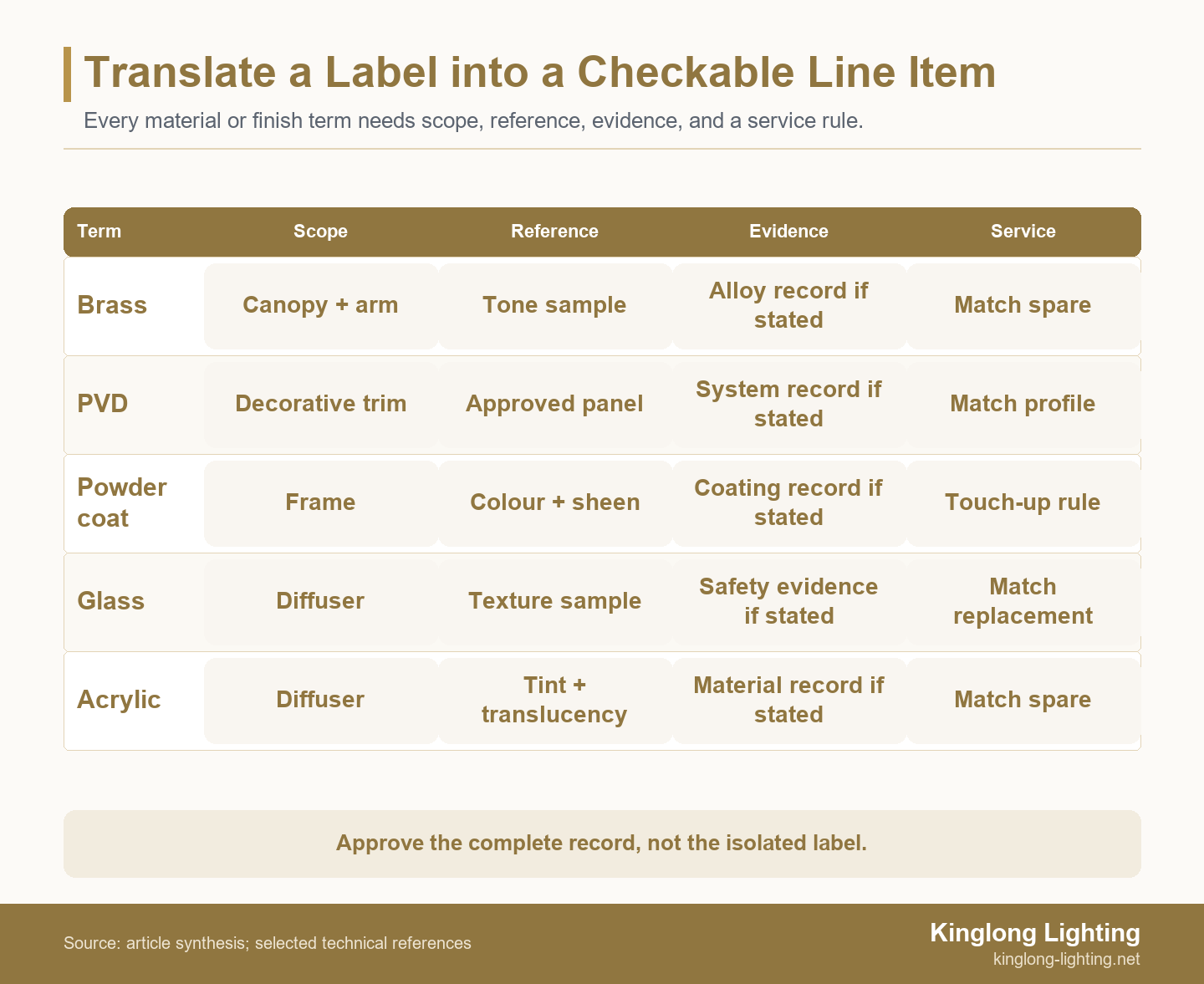
- Scope: name the fixture component, quantity or location, substrate, and whether the note applies to all visible faces or only stated parts.
- Reference: name the approved sample, panel, controlled photograph, drawing callout, or signed variation range and the viewing condition used for approval.
- Evidence: name the exact declaration, method, report, or test record required for a separately stated property. Do not use a test label as a substitute for the visual reference.
- Service rule: state how a later spare, repair part, or replacement will be matched to the approved fixture and which record must travel with that request.
For example, “antique brass finish” becomes a controlled line only when it says which component carries it, which master or range controls the look, whether a separate document is required, and how a replacement will be compared. Teams can prepare the approved sample and the project’s service needs, then start a custom lighting material brief.
Keep open decisions visible. If a buyer has selected an appearance but not yet named the exact report, write “evidence to be confirmed” rather than implying that a colour sample settles a compliance or durability requirement. The same discipline applies to a future spare: record what must match before the fixture is installed, not after a visible part needs replacement.
The Same Finish Can Need Different Acceptance Notes in Different Locations
A finish should be judged where it will be seen and used. A high-level trim ring may need an overall colour and sheen check, while a lower canopy in a public lobby may also need a brushing direction, touch-up boundary, and spare-part matching rule. The component may share a finish name, but the acceptance note should reflect visibility, handling, cleaning exposure, and adjacent materials.
TM-30 describes light-source color-rendering properties, so the viewing light belongs in a material-colour decision. The U.S. Department of Energy’s TM-30 guidance explains that the method evaluates and communicates light-source colour-rendering properties. It does not set a finish tolerance, but it is a good reason to record the light source when a project makes colour or tone a decision point.
Consider two pendants described with the same words, “brushed antique brass.” One is a focal fixture above a reception desk; the other sits in a less visible circulation area. The first note may need the master sample, brushing direction, visible-face scope, and a replacement comparison under the installed light. The second may have the same materials line but a different visible-range note. The distinction is not a lower standard; it is an honest statement of how each component will be evaluated.
For a broader decorative-lighting context after the acceptance conditions are clear, teams can inspect Kinglong Lighting project finish references.
Send a Material-and-Finish Brief That Can Be Quoted and Rechecked
A supplier-ready brief carries the term, component scope, reference, evidence request, and replacement rule together. That single record lets a supplier price the right work, lets the buyer review the right sample, and gives a service team a defensible starting point if a matching part is needed later.
Keep the first message concise: fixture name and component; the selected material or finish term; an attachment or reference identifier; the appearance decision needed; any evidence request; the installation or service condition that changes the acceptance note; and the intended next review point. If an item is still undecided, write it as an open field rather than burying the uncertainty in a broad adjective.
Before the supplier starts sample work, confirm which file is the controlling reference and which person may approve a visible variation. State whether the record covers a single trim, all exposed metalwork, a diffuser family, or the full fixture. That boundary prevents a correct sample from being applied to a part that was never included in the original decision. It also gives a later replacement request a practical starting point.
With the component list, controlling reference, and open questions assembled, teams can send a material-and-finish inquiry.
FAQs
The FAQ keeps labels, visible references, and evidence records separate. Use the short answers below to identify the next question; use the specification note to record the answer for the actual fixture.
Is PVD the same as electroplating?
No: a shared colour name does not establish an identical system or service result for a decorative lighting part. PVD and electroplating are different deposition routes. Ask for the route, component substrate, approved visual reference, and the evidence that the project actually requires. Do not use the process name alone to infer thickness, scratch resistance, or life in a particular location.
Does a brass finish mean the fixture is solid brass?
No: request the base material and component scope for every visible part before treating a brass appearance as a construction claim. A brass-finish label does not by itself identify the substrate. A brass appearance can be a target over different underlying components, while a brass alloy part can receive a separate surface treatment. The purchase record should state both the material and the approved appearance reference.
Does a salt-spray result predict chandelier life?
No: read the method and report alongside the actual fixture component, coating system, project location, and cleaning regime. A salt-spray result needs its specimen, duration, and acceptance criterion before it informs a project decision. It can be relevant evidence without becoming a stand-alone forecast of installation life.
Is RoHS a finish specification?
No: keep the compliance documentation with its electrical or electronic scope and the visual record with the specified part. RoHS is a restricted-substances compliance context, not a finish specification. It cannot replace an approved surface sample or colour range, even when both records matter to the same fixture.