
A clear chandelier drop can look premium and still leave the most important purchasing question unanswered. Visual inspection can establish whether a component matches the approved appearance; it cannot, by itself, prove a named crystal category, composition, lead-free claim, or laboratory performance. The useful field check is therefore not a scorecard. It is a way to decide what can be accepted visually, what must be isolated, and what needs another form of proof.
Use a Field Check to Route the Decision, Not to Grade the Crystal
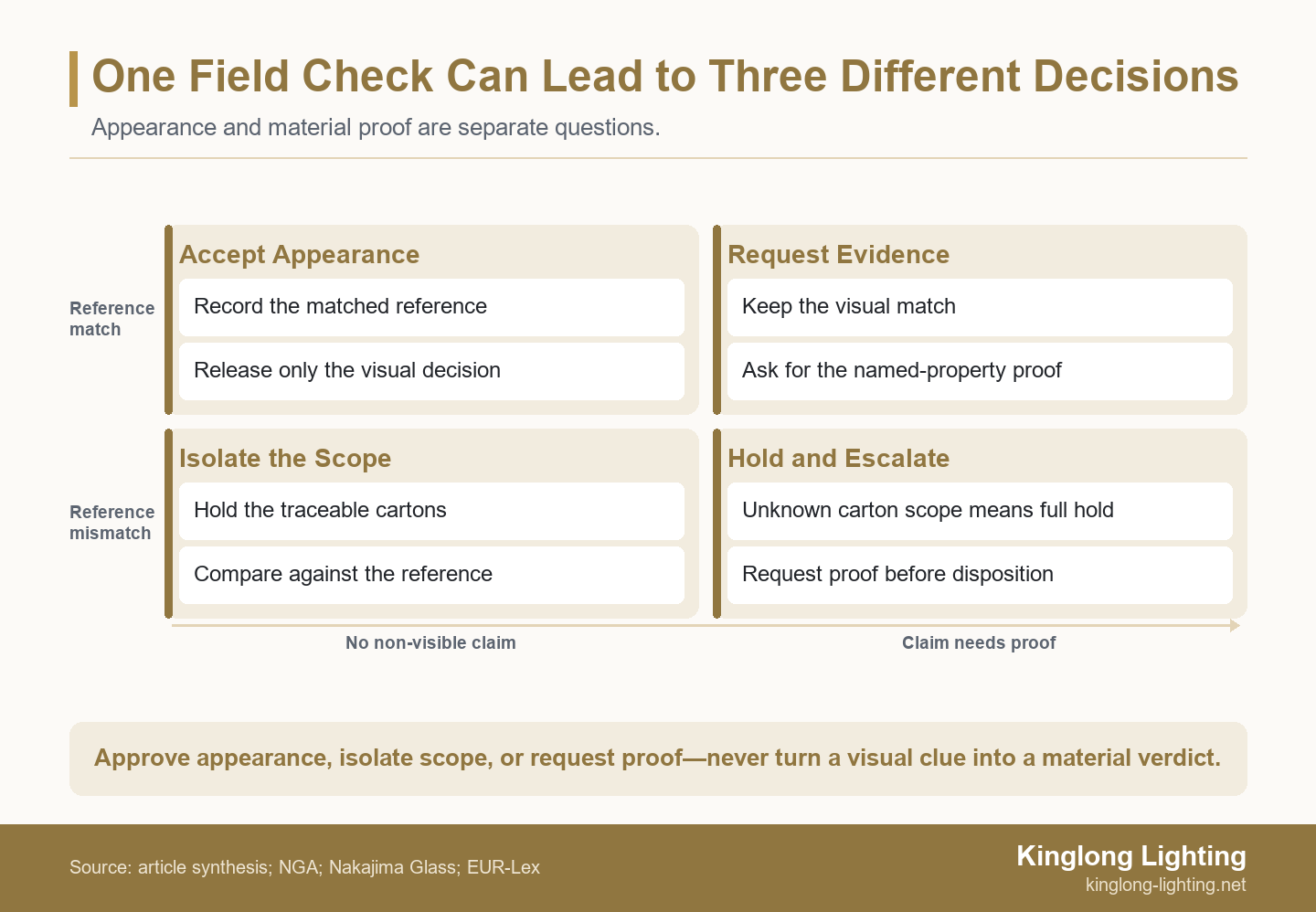
A visual field check should route the next decision, not assign a single crystal grade. A buyer needs three possible outputs: approve the appearance against a known reference, isolate a traceable scope when the appearance does not match, or request documents or testing when the purchase requirement concerns a property the eye cannot establish.
- Record a feature before naming a cause: “fine clustered bubbles near the drilled end” is more useful than “low-grade crystal.”
- Compare like with like: the same reference, lighting direction, viewing angle, background, and installed orientation.
- Let traceability set the temporary hold scope. A carton boundary is safer than a guess about which individual pieces belong together.
- Match the evidence request to the claim: a visual mismatch needs a disposition; a composition claim needs documentary or laboratory evidence.
Make the Observation Repeatable Before You Call It a Concern
A visual finding becomes comparable only when the reference and viewing conditions are stated. Start with the approved sample, drawing, or signed image; then note the light source, viewing direction, background, distance, component orientation, and whether the part is loose, mounted, or already grouped in a fixture. This turns “it looks different” into a finding another reviewer can reproduce.
Before the check, prepare an approved reference set: the master component and matching image used for appearance comparison. Keep that set with the review record so a remote supplier, designer, or receiving team is comparing the same target rather than a remembered impression.
The discipline is borrowed, not copied, from architectural-glass practice. The National Glass Association’s viewing guidance ties a visual decision to defined positions, angles, lighting, and criteria. Those acceptance limits do not govern chandelier components, but the underlying control is valuable: agree how the part is seen before arguing about what was seen.
Use two views where the project makes both relevant. A neutral, diffuse view is good for comparing clarity, haze, or colour cast. A controlled side-light view is better for revealing surface interruption, edge damage, and internal features. Record the lighting rather than treating either view as a universal truth. A separate NGA paper on decorative-glass colour variance explains why light, angle, texture, gloss, and environment alter perceived appearance. For a chandelier buyer, that is a reason to preserve the viewing setup in the field note, not a reason to import glazing tolerances.
Read Each Component Through Four Visual Lenses
Classify what the eye sees before deciding what the supplier must prove. Separating surface condition, internal features, optical response, and interface geometry prevents one word—“quality”—from mixing a cosmetic concern, a handling risk, a material claim, and a fit issue into the same dispute.
| Visual lens | Record the observation | Do not infer | Next decision |
|---|---|---|---|
| Surface condition | Scratch path, chip location, edge mark, or suspected crack; photograph both the whole drop and the close view. | That every mark is a forming defect or a material-classification issue. | Protect and isolate any suspected crack; ask whether it is handling damage, then determine the release scope. |
| Internal features | Bubble cluster, single inclusion, streak-like feature, density, location, and repeatability across components. | The chemical cause, grade, or universal acceptability of the feature. | Compare with the reference and request a focused explanation only if the stated requirement depends on it. |
| Optical response | Grey cast, haze, uneven sparkle, visible line, or colour shift under the agreed view. | Composition, refractive index, or named crystal category. | Approve the appearance, hold the visual mismatch, or request evidence for the named property. |
| Interface geometry | Hole position, facet alignment, cap contact, pin fit, bead spacing, and orientation in the fixture. | That the glass is internally stressed or that a fit problem is cosmetic. | Check the component against the assembly reference and contain the relevant carton or lot if fit is affected. |
A bubble is an observable feature, not a universal quality verdict. Nakajima Glass notes that bubbles formed while glass is molten can remain after cooling; a seed is a very small gas bubble that still needs a project-specific decision. Its glossary also distinguishes bubbles from scratches, foreign matter, and cracks. That distinction matters because a suspected crack should be handled as a potential breakage concern, while a retained bubble is first a feature to describe and compare. See its technical defect terminology for the separate meanings.
Record a streak-like variation as an observation; do not declare its root cause from appearance alone. British Glass describes striae in relation to incomplete homogenization, but a received chandelier component does not reveal enough process history to diagnose that cause. The appropriate supplier question is whether the feature sits within the approved visual range and which production record applies to the component.
Treat a crack as a handling and breakage concern, not as a clarity issue. Mark its location, prevent further handling that could worsen it, and keep the wording factual until the supplier assesses the component. This is different from rejecting every fine mark: the project reference, installed visibility, and component role still determine the visual disposition.
When a component-level observation needs to be understood in a real decorative-lighting context, Kinglong Lighting offers a way to see a Crystal Tube fixture reference. Use it to consider how a feature reads across a fixture, not to infer a material specification from a product photograph.
A Feature Is Intentional Only When the Reference Says So
A feature is intentional only when the approved reference makes it intentional. A formed texture, air-trap effect, small inclusion, or slight variation can be part of the design character, but a buyer should be able to point to the master sample, image, signed range, or project note that establishes that character. The Getty’s glass glossary is useful for naming fine bubbles and forming-related features precisely; it does not convert those features into automatic acceptance criteria.
Where no reference exists, write the observation and suspend the adjective. “Three pinprick inclusions visible under side light” preserves a reviewable fact. “Handmade character” or “poor crystal” commits the team to an interpretation that may not match the design intent, the lot scope, or the purchase requirement.
Know When the Eye Has Reached Its Limit
The eye can approve appearance; it cannot certify a material category. Glass types differ because their constituent materials and proportions differ, as the Nakajima Glass material overview explains. A clear, sharply faceted component may satisfy the approved visual reference, but that observation alone does not establish a trade designation, chemical composition, or performance characteristic.
The directive’s crystal-glass categories are verified by chemical and physical methods, not by appearance alone. Council Directive 69/493/EEC lists category characteristics and corresponding methods in its annexes. It is not a universal regulation for every chandelier component, yet it makes the evidence boundary clear: a category claim is a claim about defined properties, not a conclusion drawn from sparkle or transparency.
Escalate Claims, Not Just Unusual Appearance
Escalate a claim when the purchase decision depends on a property the eye cannot establish. Ask for the evidence that matches the exact requirement: a supplier declaration and traceable material record for a named designation; relevant test evidence for a specified optical or physical property; or a revised approval record when the reference itself has changed.
- Appearance-only decision: compare the part with the approved reference under recorded conditions.
- Named material or composition: request the document trail and, when required by the specification, the appropriate test evidence.
- Safety or fit concern: isolate the affected scope and have the supplier address the component condition before release.
For a made-to-order fixture, the cleanest prevention is to put the reference, visible range, component identity, and non-visible proof requirements into the development request from the start. You can shape a custom chandelier brief around the reference set without turning a visual note into an unsupported material certification.
When Two Visual Families Appear in the Same Carton Group
If the lot boundary is unknown, the hold follows the unknown boundary rather than the first pieces noticed. A component lot is a traceable group of parts with the same production identity; when that identity is not known below carton level, the carton group is the only review scope the buyer can prove. The buyer’s task is to protect the decision while the supplier maps the components, not to decide from appearance alone why the two visual families exist.
The Carton Label Is the Boundary Until Proven Otherwise
Until mapping proves a narrower scope, the carton label is the hold boundary. The following receiving case is illustrative, but its decision chain is practical for a custom chandelier package where visual approval and traceability have been allowed to drift apart.
A hospitality-design procurement team receives decorative drops for a custom chandelier package shortly before final installation. The team must protect the intended look in public-facing areas while avoiding a last-minute claim that the supplier cannot verify from the buyer’s photographs alone.
The illustration covers 24 fixtures with 16 drops each, plus 48 service spares. The arithmetic is 24 × 16 = 384 installed drops; adding the spares creates a 432-component review scope. That number is useful only for defining the temporary hold, not for estimating a defect rate.
The buyer has an approved reference image and a master component, but the cartons identify fixture sets rather than the individual component lots inside them. Installation hardware is ready, so a broad hold has schedule cost; an untraceable release has replacement and consistency risk.
Under the agreed side-light view, 18 components show a clustered pinprick-bubble pattern near one end and a slightly greyer appearance than the master component. The field note records the location, viewing setup, photographs, carton labels, and fixture-set labels rather than a material diagnosis.
Other components are closer to the reference, yet both appearance families occur in more than one fixture carton. The observed pieces therefore do not form a clean lot by themselves; taking only those 18 aside would create false confidence about the unobserved components packed with them.
The visual evidence supports an appearance mismatch and a traceability problem, not a claim about chemical composition or crystal category. The carton group is the narrowest identity the buyer can currently prove. The decision protects a reversible scope while allowing unrelated fixture work to continue where the components are independent. For broader installed context after the receiving decision, buyers can look through Kinglong Lighting project contexts.
The team isolates cartons containing both appearance families and pauses visual release for that component group. It does not reject the entire order, certify a material failure, or release the apparently clear pieces. The temporary disposition is “hold pending component-to-lot mapping and reference comparison.”
The supplier is asked for a component-lot map, a reference set reviewed under the stated conditions, and the declaration or test evidence required by any named-property requirement in the purchase specification. The buyer then attaches the photographs and carton list to the request rather than sending an unscoped complaint.
After the supplier separates the lots, the buyer rechecks a documented subset from each mapped lot under the same viewing conditions. Release can resume only when the packing list carries the reviewed lot identity and the subset is consistent with the approved visual range; otherwise the hold remains with the mapped scope. Before a release email is sent, retain an approved reference image, one receiving image for each reviewed lot, and a pack-list line tying every released carton to its mapped lot. This gives the installer a traceable basis for a later matched-spare request.
The 24 fixtures, 16 drops, 48 spares, 18 observed pieces, and 432-component scope are illustrative assumptions. They are not a customer project record, sampling standard, defect statistic, or test method. They demonstrate why traceability, not the first visible difference, determines the safe scope for isolated cartons.
Once a component has a confirmed visual range, it can be helpful to review the fixture arrangement in Mofun so the approved drop is judged in its installed composition rather than as an isolated object. That layout review is separate from the material-evidence request.
Turn the Field Note into an Evidence Pack
A useful acceptance pack separates the reference, the observation, the lot scope, and the proof still required. It gives the supplier a decision-ready record instead of an invitation to debate whether a photograph looks premium.
- Reference: attach the approved master, signed image, or dated drawing and state which component view is controlling.
- Viewing record: note the light direction, angle, background, component orientation, and whether the photo shows an installed or loose part.
- Observation: describe the feature, location, repeatability, and visible consequence without assigning a root cause.
- Scope: list carton labels, fixture sets, component counts, known lot identities, and any cartons already separated.
- Requested proof: ask for the exact record, declaration, mapping, sample comparison, or test evidence that resolves the remaining claim.
Keep visual acceptance and material verification in adjacent lines rather than one combined instruction. For example, “match the reference under the recorded view” is an appearance request; “provide evidence for the named material designation” is a separate evidence request. The distinction tells the supplier what can be dispositioned immediately and what remains open.
Send an Acceptance Brief That a Supplier Can Use
A supplier can act on a field finding only when the observation and the requested proof travel together. Put the title of the brief, project identifier, component description, reference attachment, viewing record, carton scope, and requested response on the first page or in the first message.
State one decision owner and one due point. The owner may be the buyer’s project lead, the lighting designer, or the supplier’s quality contact; the important part is that the response distinguishes visual disposition from a non-visible claim. Ask the supplier to answer with the mapped scope, the corrective path, the recheck material, and the evidence attached to each named requirement.
For a decorative-lighting inquiry that needs this level of specificity, prepare the reference and carton details for Kinglong Lighting first, then send a component-level visual acceptance brief.
FAQs
The FAQ keeps visual acceptance separate from material verification. Use these answers to close a field decision, not to turn an appearance check into a universal crystal grading system.
Can I identify K9 Crystal by looking at it?
A K9 Crystal designation cannot be established by looking at the component. A visual receiving inspection can record clarity, faceting, colour cast, surface condition, and consistency against an approved reference, but a named designation is a material claim. Request the supplier’s documentation and, where the purchase specification calls for it, the appropriate test or traceable material evidence. Do not use a clear appearance as a substitute for that proof.
Are tiny bubbles always a rejectable defect?
A tiny bubble is not automatically a rejectable defect. First record its location, density, visibility under the agreed view, and whether it appears in the approved reference or across a mapped lot. Then apply the project’s stated visual range. A bubble near a concealed end may lead to a different decision from a cluster visible in a focal area, but neither observation alone proves a cause or material category.
How should crystal components be photographed for approval?
A useful photo record connects the view, the feature, and the component identity. Capture a full-component image, a close view of the concern, the matching reference view, and the carton or lot label. State the light direction, viewing angle, background, and orientation in the note. Avoid tightly cropped images with no scale or identity; they can prove that a mark exists, but not which scope needs review.
When should a buyer request laboratory verification?
Request laboratory or documentary verification when the decision depends on a non-visible property. Typical triggers include a named material category, composition, lead-free status, a specified optical property, or an agreed physical-performance requirement. Keep the request proportional: ask for the evidence that resolves the stated claim, while using the visual record separately to approve appearance or control the temporary hold scope.