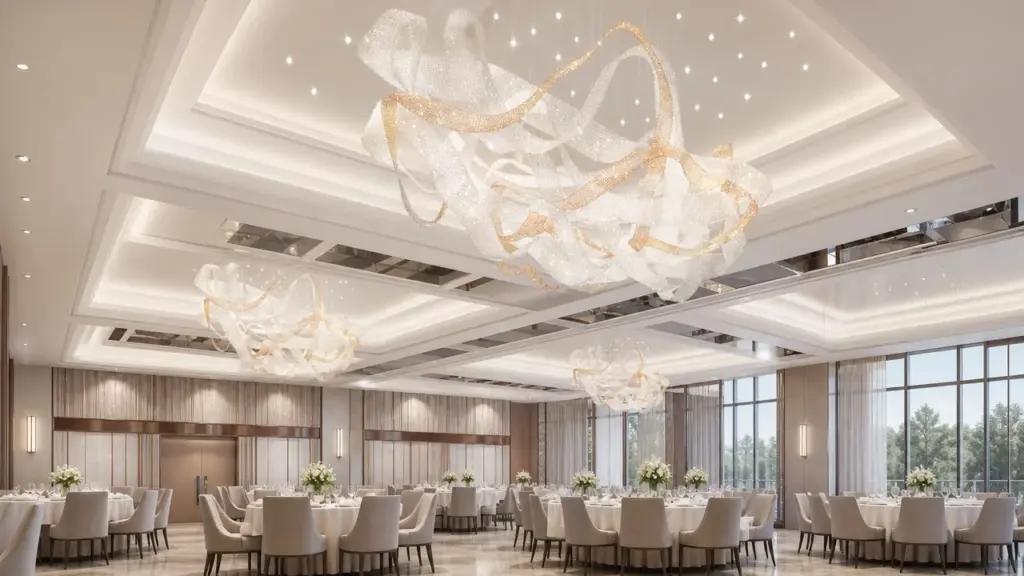
Acrylic in high-end lighting is often dismissed because people hear plastic and imagine cheap imitation glass. That reaction misses the point. Acrylic can be the better luxury material when the fixture needs lower weight, larger form, softer diffusion, safer handling, or easier replacement.
It can also be the wrong material when the project ignores scratch risk, heat, UV exposure, cleaning chemistry, yellowing, surface hardness, or a visible replacement mismatch. Acrylic is not a universal upgrade. It is a project tool.
Kinglong Lighting can help buyers evaluate acrylic responsibly when the choice is tied to room intent, component function, sample evidence, and the Diamond Orb acrylic series or another custom lighting file.
Key Takeaways
- Acrylic is not fake glass by default: It can solve weight, diffusion, form, and service problems that glass cannot solve well.
- Prestige is not the only material value: A material is luxury when it protects the room and ownership path.
- Aging risks need boundaries: UV, heat, scratch, cleaning, and surface change should be discussed before approval.
- Evidence matters more than label: Samples, report scope, part map, and replacement rule should define acrylic quality.
- Use acrylic honestly: Do not hide acrylic as glass; explain why it was selected for the room.
Acrylic outperforms glass only in the right job
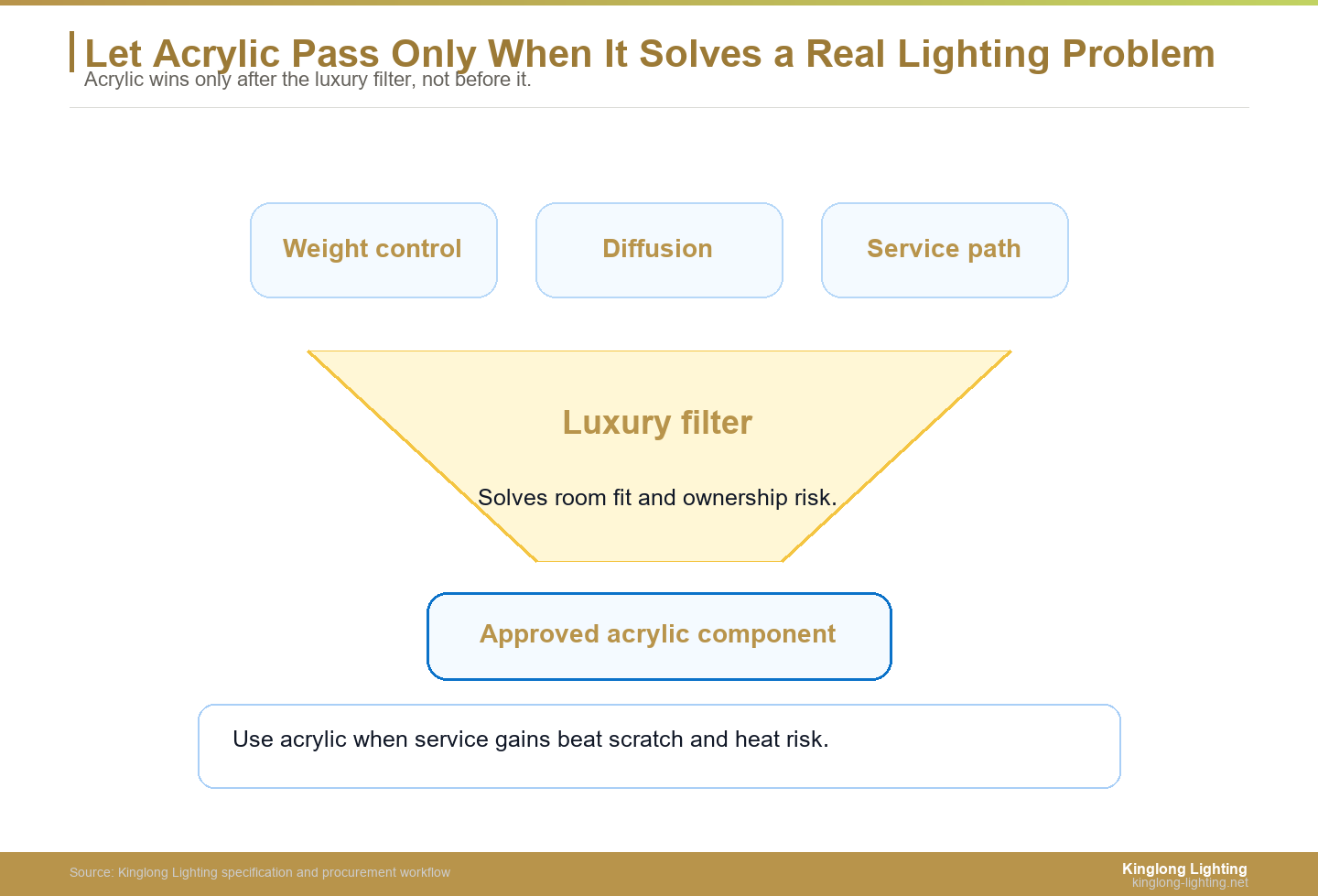
Acrylic outperforms glass only when the buyer can name the problem it solves.
Acrylic should not be chosen because it is cheaper or easier to shape. It should be chosen because the chandelier needs a property that acrylic handles better than glass in that room.
According to DOE LED lighting page, LED products differ in direction, color behavior, heat, lifetime, and application fit. For project buyers, the practical action is to review decorative materials under the specified light source and room condition, not as isolated samples.
Large forms can become safer and more practical
A large sculptural diffuser, orb, blade, or luminous panel may be more practical in acrylic because weight affects support, packing, handling, and service access. If glass makes the fixture too heavy or fragile, the premium material may create a worse project.
The buyer should compare installed behavior, not material hierarchy. If acrylic allows a larger, cleaner, more serviceable form while maintaining the desired optical effect, it can be the better luxury decision.
In practice, make this an acrylic lighting visibility gate: judge the sample under the room light, normal viewing distance, and cleaning condition. The decision rule is to document the threshold before release, then review any mismatch within 7 days if the owner-visible effect or maintenance cost changes.
Diffusion can be the real luxury feature
Some rooms need soft, even glow rather than sharp sparkle. Acrylic can support diffusion, curved forms, or translucent volume where glass would add glare, seams, or weight.
According to DOE TM-30 FAQ, color quality needs more precise language than warm, cool, or beautiful when materials are being approved. For project buyers, the practical action is to review material appearance and color quality together so acrylic diffusion is judged under the selected light source.
In practice, make this an acrylic lighting visibility gate: judge the sample under the room light, normal viewing distance, and cleaning condition. The decision rule is to document the threshold before release, then review any mismatch within 7 days if the owner-visible effect or maintenance cost changes.
Weight, shape, and diffusion can make acrylic the luxury choice
Luxury lighting is not always about using the heaviest or most traditional material. It is about achieving the intended experience reliably. Acrylic can support forms that would be impractical in glass.
According to UL 1598 standard page, decorative chandeliers are still luminaires that need product evidence and qualified installation review. For project buyers, the practical action is to keep acrylic component decisions connected to the complete luminaire file and product boundary.
Weight reduction changes the whole project
Lower weight can simplify suspension, ceiling coordination, lifting, packing, and service. It may also reduce risk during installation in a finished villa or hotel space.
The article’s scenario estimate is practical: if acrylic reduces enough weight to simplify support and access, the owner may save time and risk even if the material itself carries less prestige than glass.
In practice, make this an acrylic lighting visibility gate: judge the sample under the room light, normal viewing distance, and cleaning condition. The decision rule is to document the threshold before release, then review any mismatch within 7 days if the owner-visible effect or maintenance cost changes.
Shape freedom can carry the design
Acrylic can support large curves, repeated modules, faceted shapes, or luminous forms that would be costly, heavy, or fragile in glass. In these cases, the material’s form-making ability is the luxury value.
Kinglong Lighting can connect shape decisions to the Glazed Color resin and art-material reference when the project needs sculptural form rather than traditional sparkle.
In practice, make this an acrylic lighting visibility gate: judge the sample under the room light, normal viewing distance, and cleaning condition. The decision rule is to document the threshold before release, then review any mismatch within 7 days if the owner-visible effect or maintenance cost changes.
Scratch, heat, UV, and cleaning risks need boundaries
Acrylic can fail when the buyer approves only the first-day look. The owner should understand scratch risk, heat exposure, UV exposure, yellowing concern, and cleaning chemistry before production.
According to ASTM G154 accelerated weathering standard page, accelerated weathering tests expose materials to controlled UV and moisture cycles that need careful interpretation. For project buyers, the practical action is to read accelerated weathering evidence as controlled exposure, not as a universal aging promise.
Surface care should be part of the approval
Acrylic may be more scratch-sensitive than glass depending on grade, finish, coating, and use. The owner should know what cleaning cloth, cleaner, and service method are allowed.
If a diffuser is high and rarely touched, scratch risk may be low. If it is near people or cleaned often, the maintenance rule matters as much as the sample.
In practice, make this an acrylic lighting visibility gate: judge the sample under the room light, normal viewing distance, and cleaning condition. The decision rule is to document the threshold before release, then review any mismatch within 7 days if the owner-visible effect or maintenance cost changes.
Heat and UV should be reviewed by location
Acrylic near high heat, intense sun, or strong cleaning chemicals needs more caution. The buyer should ask about LED heat, driver placement, ventilation, sunlight, and whether the material is used indoors, near windows, or in a humid zone.
The evidence should match the risk. A general material statement is weaker than a sample, report boundary, and use condition tied to the actual fixture.
In practice, make this an acrylic lighting visibility gate: judge the sample under the room light, normal viewing distance, and cleaning condition. The decision rule is to document the threshold before release, then review any mismatch within 7 days if the owner-visible effect or maintenance cost changes.
Acrylic should be engineered as a component, not hidden as glass
Acrylic becomes risky when a supplier treats it as a silent substitute for glass. It becomes strong when it is openly engineered as the right component for the design.
According to European Commission RoHS Directive page, restricted substance rules make material declarations and supply-chain evidence relevant for electrical lighting products. For project buyers, the practical action is to include material declarations where the product destination or buyer file requires them.
Honest specification protects trust
If the buyer expects glass and receives acrylic, the problem is not only material. It is trust. Acrylic should be named in the specification, with the reason it was chosen and the evidence that supports it.
An honest acrylic specification may say: lower weight, safer large form, softer diffusion, better replacement, or controlled cost. That is stronger than pretending it is glass.
In practice, make this an acrylic lighting visibility gate: judge the sample under the room light, normal viewing distance, and cleaning condition. The decision rule is to document the threshold before release, then review any mismatch within 7 days if the owner-visible effect or maintenance cost changes.
Reports should identify the exact claim
Material evidence should say what it proves: restricted substances, weathering, flammability, scratch resistance, impact behavior, or cleaning limits. The buyer should not let one report become proof for every acrylic claim.
According to ISO/IEC 17025 overview, laboratory competence, valid results, and report acceptance depend on method and scope. For project buyers, the practical action is to check whether a material report identifies the sample, method, date, scope, and claim it actually supports.
According to ILAC MRA and signatories page, international report acceptance depends on accreditation body and recognition boundaries. For project buyers, the practical action is to check whether acrylic test evidence comes from a laboratory and recognition route the destination buyer can use.
According to the CNAS English site, laboratory accreditation and international cooperation are part of its public accreditation services. For acrylic components sourced through China-based supply chains, the practical action is to match any CNAS-related report to the exact acrylic sample and method.
In practice, treat this as an acrylic lighting evidence gate: keep the report, sample ID, method, date, and claim boundary together. The decision rule is to accept only what the document actually proves, then flag any missing proof within 7 days before the buyer signs production release.
Evidence and spares matter more than the word plastic
The word plastic is too vague for a luxury lighting decision. The buyer needs component role, sample, finish, light behavior, cleaning boundary, packing, and replacement path.
According to ISTA 3A test procedure page, packing evidence should be selected around the distribution environment and package profile. For project buyers, the practical action is to connect packing and movement evidence to fragile or scratch-sensitive acrylic components.
Packing should protect surface quality
Acrylic can be damaged by abrasion during packing or handling. The buyer should ask how surfaces are protected, labeled, separated, and inspected before shipment.
Acrylic that arrives scratched will feel cheap even if the design logic is strong. Surface protection is therefore part of the luxury promise.
In practice, make this an acrylic lighting visibility gate: judge the sample under the room light, normal viewing distance, and cleaning condition. The decision rule is to document the threshold before release, then review any mismatch within 7 days if the owner-visible effect or maintenance cost changes.
Spares should match translucency and finish
Replacement parts should match color, translucency, texture, and finish. A spare diffuser that is slightly different may be more visible than a spare hidden bracket.
The handover file should include part codes, cleaning notes, and replacement strategy so future service does not depend on guessing the material.
In practice, make this an acrylic lighting service gate with 3 records: part code, spare quantity, and replacement match rule. The decision rule is to confirm the future repair path before shipment so a small breakage does not become a cost, delay, or owner trust problem.
Acrylic vs glass decision table
Use this table to decide whether acrylic is a premium solution or a weak substitution.
| Decision area | Owner risk if vague | Evidence to request | Acceptance action |
|---|---|---|---|
| Large diffuser | Glass adds weight and fragility | Weight, support, heat, diffusion sample | Use acrylic when scale becomes safer |
| Close-up decorative part | Scratch or prestige concern dominates | Surface sample, cleaning test, replacement rule | Use glass unless acrylic solves a real problem |
| Luminous sculptural form | Material hidden behind glow | Light sample, color stability, seam review | Use acrylic for even diffusion |
| High-touch zone | Cleaning damages surface | Cleaner rule, scratch boundary, spare path | Avoid or protect acrylic |
| Shipping and service | Surface damage creates cheap impression | Packing, labels, inspection, spares | Plan protection before shipment |
A weight-and-service scenario for acrylic lighting
Imagine a large luminous orb that can be made in glass or acrylic. Glass may carry higher material prestige, but it increases weight, packing risk, installation complexity, and replacement cost. Acrylic may allow a larger smooth form with better service access.
The decision becomes clearer if the fixture is high, viewed as a glowing volume, and rarely touched. In that case, the owner may not gain enough visible value from glass to justify the added structural and service burden.
The limitation is that acrylic must be specified honestly. If the owner wants close-up sparkle, hard surface feel, and traditional material prestige, acrylic may be wrong. If the owner wants scale, diffusion, and serviceability, it may be the more intelligent luxury material.
A practical comparison should include four ownership variables: support weight, packing risk, cleaning method, and replacement match. Glass may win prestige and scratch resistance, while acrylic may win the support and service calculation. The buyer should decide which variables matter from the normal viewing position.
For example, a 1.2-meter luminous acrylic form mounted high in a stair void may be judged by glow, silhouette, and maintenance access. The same acrylic material used as a close-up dining ornament may feel wrong if the owner expected hard crystal sparkle. The material did not change; the job changed.
This is why acrylic should be approved through a component role. Is it a diffuser, lens, shade, sculptural volume, protective cover, or decorative accent? Each role has different evidence needs. A diffuser needs light and color review. A touchable accent needs surface durability and cleaning rules. A large suspended form needs weight and packing evidence.
Acrylic also changes the way designers can hide or reveal seams. A molded or thermoformed component may reduce visible joints compared with assembled glass, but it can introduce its own tolerance and surface risks. The buyer should inspect the edge, seam, mounting point, and light leakage rather than only the center of the sample.
For hospitality or villa projects with repeated acrylic modules, replacement consistency matters. A new diffuser with a slightly different translucency can stand out when it sits beside older pieces. The handover file should therefore store color, finish, supplier reference, and a spare strategy, especially for custom tones.
The decision rule is not acrylic versus glass in the abstract. It is whether the material protects the lighting effect at the scale, distance, and maintenance condition of the project. If acrylic does that better, calling it plastic does not make the decision less premium.
Acrylic approval should also include a replacement visibility test. If a single module breaks, will the replacement sit beside older acrylic in a way that exposes a tone shift? If yes, the project needs stored spares or a tighter supplier reference. If no, a future remake may be acceptable.
The same test should be applied to packing. A material selected for lower weight should not lose its advantage because surfaces are rubbed, stacked, or labeled poorly. Acrylic needs a surface-protection plan, not only a material approval.
If the packing plan is vague, the acrylic approval is still incomplete.
How Kinglong Lighting uses acrylic responsibly
Kinglong Lighting can support acrylic chandelier decisions by connecting component role, sample photos, light behavior, packing protection, cleaning rules, and spare planning to the Diamond Orb Series or a custom project file.
If a design is considering acrylic, the useful next action is to send the acrylic lighting brief with fixture size, viewing distance, diffusion target, touch level, sunlight exposure, and replacement expectations.
Before choosing acrylic for high-end lighting
Use this short action list before the next approval meeting. It is intentionally practical, because vague approval language is the usual source of later rework.
- Name the problem acrylic solves.
- Approve diffusion and surface samples.
- Check heat, UV, scratch, and cleaning boundaries.
- Protect surfaces in packing and handling.
- Plan replacement color and translucency match.
Before final release, Kinglong Lighting can review the acrylic lighting brief against the component role, diffusion sample, packing plan, cleaning rule, and replacement path so the material is approved for the job it actually performs.
FAQ
Can acrylic be used in luxury chandeliers?
Yes, when acrylic solves weight, diffusion, scale, safety, or service problems better than glass and is specified honestly.
Is acrylic cheaper-looking than glass?
It can look cheaper if used as a hidden substitution, but it can look premium when the design uses acrylic for form, glow, and scale.
What are acrylic lighting risks?
Common risks include scratching, heat exposure, UV aging, cleaning damage, yellowing concern, packing abrasion, and replacement mismatch.
When should buyers avoid acrylic?
Avoid acrylic when the fixture needs close-up glass sparkle, hard surface feel, high scratch resistance, or traditional material prestige.