Brass chandelier finishes can make a room feel polished, warm, historical, architectural, or deliberately aged. But polished brass, brushed brass, satin brass, antique brass, dark bronze, and patina effects are not interchangeable.
The buyer should approve brass as a finish system: substrate, surface preparation, visible tone, texture, protective coating, aging behavior, cleaning rule, replacement path, and acceptable variation. A color photo alone is too weak for a luxury chandelier.
Kinglong Lighting can help when brass finish approval is tied to room boards, sample photos, cleaning expectations, and the Jiangnan material collection or another custom lighting file.
Key Takeaways
- Brass is a mood decision: Polished, satin, antique, and patina finishes create different room identities.
- First-day color is not enough: Owners should approve aging, touch, cleaning, and replacement behavior.
- Lighting changes brass tone: Warm light, daylight, stone, timber, and mirror can shift perceived finish color.
- Patina needs language: Natural variation is acceptable only when the buyer defines the intended range.
- Cleaning is part of the finish: Wrong cleaning can damage tone faster than normal aging.
Brass finish selection starts with the room mood
A brass finish should be approved for how it will live in the room, not only how it photographs on day one.
A brass finish changes the emotional temperature of a chandelier. Polished brass can feel formal and bright. Brushed brass can feel quieter. Antique patina can connect a fixture to heritage, craft, or cultural material language.
According to DOE LED lighting page, LED products differ in direction, color behavior, heat, lifetime, and application fit. For project buyers, the practical action is to review decorative materials under the specified light source and room condition, not as isolated samples.
Polished brass creates high attention
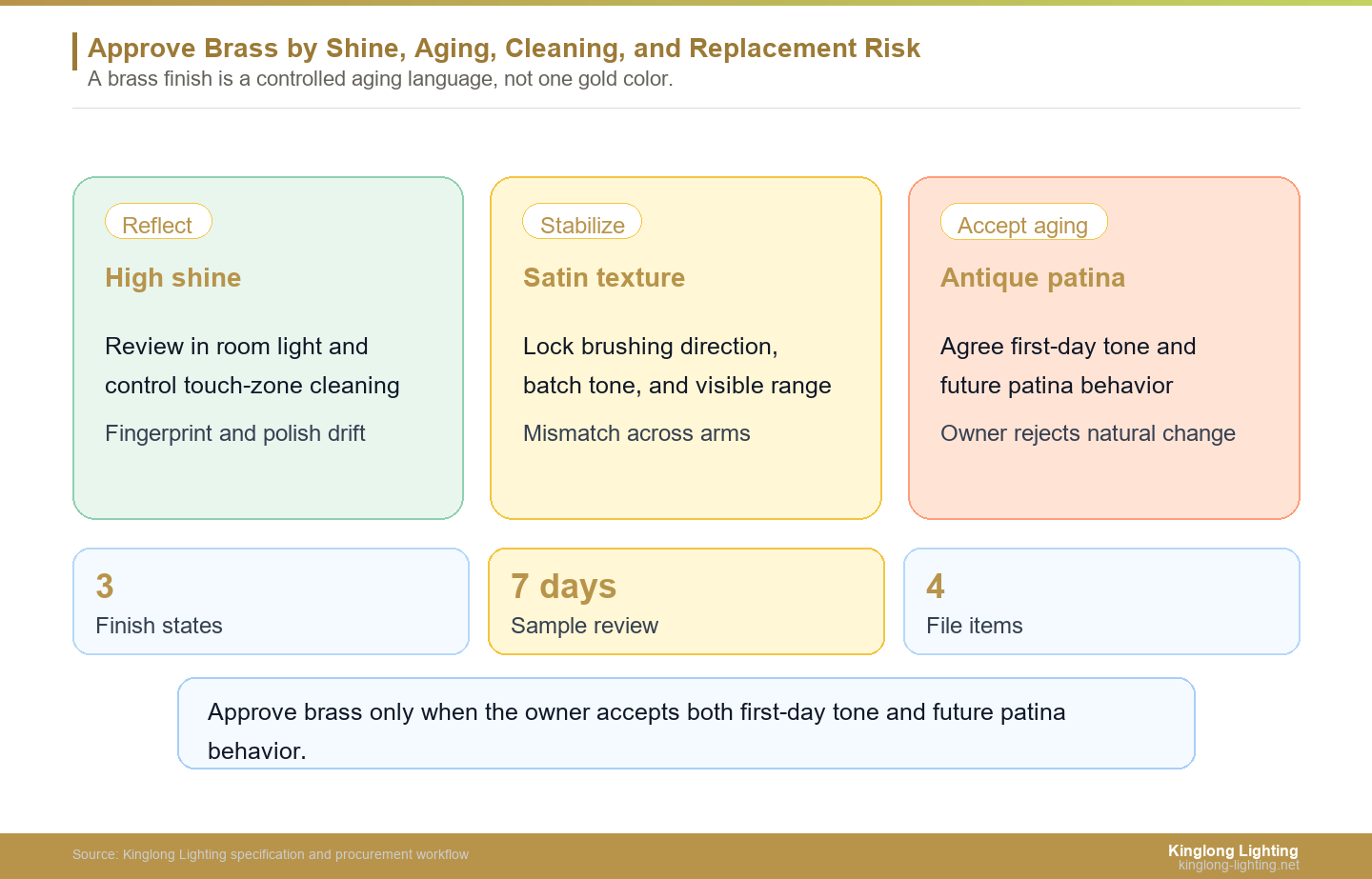
Polished brass reflects light and surrounding surfaces strongly. It can make a chandelier feel ceremonial, but it can also show fingerprints, dust, and mismatch more readily.
The buyer should use polished brass when the room benefits from sparkle, formality, or a jewelry-like accent. It should not be selected only because it looks rich in a close-up product photo.
In practice, make this a brass chandelier finish visibility gate: judge the sample under the room light, normal viewing distance, and cleaning condition. The decision rule is to document the threshold before release, then review any mismatch within 7 days if the owner-visible effect or maintenance cost changes.
Satin and antique finishes soften the signal
Satin, brushed, antique, and patina finishes can reduce glare and make a chandelier feel integrated with stone, leather, timber, and warm interiors. They may be better for villas where luxury should feel lived-in rather than theatrical.
According to DOE TM-30 FAQ, color quality needs more precise language than warm, cool, or beautiful when materials are being approved. For project buyers, the practical action is to review brass samples under the selected light source so warm metal tones are judged in the real room palette.
In practice, make this a brass chandelier finish visibility gate: judge the sample under the room light, normal viewing distance, and cleaning condition. The decision rule is to document the threshold before release, then review any mismatch within 7 days if the owner-visible effect or maintenance cost changes.
Polished, brushed, antique, and patina finishes age differently
Different brass finishes carry different aging expectations. Some owners want a stable tone. Others want soft patina. Problems appear when the buyer and supplier never define which aging path is intended.
According to ASTM B117 salt spray standard page, salt spray testing is a controlled corrosion exposure method and should not be treated as a direct lifetime promise. For project buyers, the practical action is to use corrosion-related testing as controlled evidence, not as a broad promise about patina or lifetime appearance.
Aging can be a feature or a defect
Patina is attractive when it is intended, balanced, and consistent with the room story. It becomes a defect when one area darkens unevenly, a cleaned surface changes tone, or replacement parts do not match.
The approval file should say whether the finish is expected to remain stable, mellow gradually, or show deliberate antique variation. That single sentence prevents many later arguments.
In practice, make this a brass chandelier finish visibility gate: judge the sample under the room light, normal viewing distance, and cleaning condition. The decision rule is to document the threshold before release, then review any mismatch within 7 days if the owner-visible effect or maintenance cost changes.
Touch zones need a separate rule
Canopies, collars, exposed arms, and low-hanging decorative parts may be touched during cleaning or maintenance. These areas may age differently from untouched upper components.
A high-touch brass zone should have cleaning instructions and an acceptable change boundary. Otherwise normal use can look like premature failure to the owner.
In practice, make this a brass chandelier finish visibility gate: judge the sample under the room light, normal viewing distance, and cleaning condition. The decision rule is to document the threshold before release, then review any mismatch within 7 days if the owner-visible effect or maintenance cost changes.
Substrate and coating decisions sit behind the visible brass tone
The finish people call brass may involve solid brass, brass-plated parts, coated metal, lacquer, PVD-like color, or antique treatments. The visible tone is only the surface of a deeper construction decision.
According to ISO/IEC 17025 overview, laboratory competence, valid results, and report acceptance depend on method and scope. For project buyers, the practical action is to check whether a material report identifies the sample, method, date, scope, and claim it actually supports.
According to ILAC MRA and signatories page, accredited results can be recognized internationally when the accreditation and scope match the service. For brass finish approval, the buyer should confirm that any report belongs to the tested finish, not only to a supplier profile.
The buyer should know what is actually brass
A chandelier can use solid brass in some parts and brass-finish metal in others. That may be perfectly acceptable if the buyer knows the boundary. It is risky when the finish name hides the construction.
The approval file should separate visible decorative parts, hidden structural parts, and service parts. Each may need a different material or finish route.
In practice, make this a brass chandelier finish visibility gate: judge the sample under the room light, normal viewing distance, and cleaning condition. The decision rule is to document the threshold before release, then review any mismatch within 7 days if the owner-visible effect or maintenance cost changes.
Restricted-substance evidence may apply
Destination market, buyer policy, and electrical product requirements may require material declarations or restricted-substance evidence. The buyer should ask what evidence exists and what it covers.
According to European Commission RoHS Directive page, restricted substance rules make material declarations and supply-chain evidence relevant for electrical lighting products. For project buyers, the practical action is to connect material declarations to the relevant product and market boundary without treating them as visual-quality proof.
In practice, treat this as a brass chandelier finish evidence gate: keep the report, sample ID, method, date, and claim boundary together. The decision rule is to accept only what the document actually proves, then flag any missing proof within 7 days before the buyer signs production release.
Cleaning, humidity, and touch points decide durability risk
A brass finish can fail in perception even when the part is structurally fine. Clouding, spotting, uneven darkening, scratches, or cleaner damage may become the real owner complaint.
According to ASTM G154 accelerated weathering standard page, accelerated weathering tests expose materials to controlled UV and moisture cycles that need careful interpretation. For project buyers, the practical action is to read accelerated weathering evidence within its exposure method when finishes face UV, heat, or cleaning stress.
Cleaning rules should be approved with the sample
The owner should know whether the finish can be wiped with a dry cloth, damp cloth, neutral cleaner, or special method. Abrasive cleaners and polishing compounds can change texture or color.
A brass sample without a cleaning rule is incomplete. The buyer is approving beauty but not the maintenance behavior that protects it.
In practice, approve this as a brass chandelier finish sample gate: record the master sample, the viewing distance, and one acceptable variation boundary. The decision rule is to compare the delivered batch within 7 days and hold the supplier to a written correction path if the visible result or replacement cost changes.
Process and worker-safety boundaries still matter
Finish discussions should not ignore plating, coating, or chromium-related process controls. The buyer does not need factory process details, but should avoid vague claims that treat all finishes as harmless decorative color.
According to OSHA hexavalent chromium exposure controls page, metal finishing and chromium-related process decisions need process control and worker-safety awareness, not only appearance review. For project buyers, the practical action is to treat metal finishing as a controlled process topic with safety and evidence boundaries.
In practice, treat this as a brass chandelier finish evidence gate: keep the report, sample ID, method, date, and claim boundary together. The decision rule is to accept only what the document actually proves, then flag any missing proof within 7 days before the buyer signs production release.
Samples should define acceptable aging, not freeze time
A sample cannot promise that brass will never change. It can define the intended first-day appearance, the acceptable range, the cleaning method, and the replacement standard.
According to UL 1598 standard page, decorative chandeliers are still luminaires that need product evidence and qualified installation review. For project buyers, the practical action is to keep finish decisions connected to the complete luminaire file and future service path.
Use a three-sample finish file
A useful finish file includes the target sample, an acceptable variation sample, and a reject example. For antique brass, the acceptable range matters more than a single perfect chip.
This method helps owners approve a finish language rather than chase an exact color that may shift with light, angle, or age.
In practice, approve this as a brass chandelier finish sample gate: record the master sample, the viewing distance, and one acceptable variation boundary. The decision rule is to compare the delivered batch within 7 days and hold the supplier to a written correction path if the visible result or replacement cost changes.
Replacement parts should match the finish language
If replacement collars, arms, screws, or decorative caps may be needed later, the handover file should include finish code, sample photo, cleaning rule, and acceptable patina note.
Kinglong Lighting can connect those records to the custom chandelier workflow so brass does not become a memory-based decision years later.
In practice, make this a brass chandelier finish service gate with 3 records: part code, spare quantity, and replacement match rule. The decision rule is to confirm the future repair path before shipment so a small breakage does not become a cost, delay, or owner trust problem.
Brass chandelier finish comparison table
Use this table to compare brass finishes by room mood and ownership risk.
| Decision area | Owner risk if vague | Evidence to request | Acceptance action |
|---|---|---|---|
| Polished brass | Fingerprints and glare look like failure | Target sample, cleaning note, touch-zone rule | Use for high-formality sparkle |
| Brushed brass | Texture direction or color varies | Grain direction, sample range, light note | Use for quieter luxury |
| Antique brass | Aging appears uncontrolled | Patina range, reject sample, replacement note | Use when heritage tone is intended |
| Protected coating | Owner assumes it cannot change | Coating boundary, cleaner limits, report scope | Use where stability matters |
| Replacement parts | New parts do not match aged finish | Finish code, sample photo, spare rule | Plan before handover |
A patina acceptance scenario for owners
Imagine an antique brass chandelier over a dining table. The owner wants warmth and craft, not mirror shine. If the supplier delivers small tone variation across arms, the result may be beautiful. If the canopy and arms age in two different directions after cleaning, the owner may see a defect.
The scenario rule is to approve patina as a range with maintenance conditions. A monthly cleaning zone should be judged differently from a high ceiling arm no one touches. If the owner cannot accept visible change in a high-touch zone, the project should choose a more stable finish path.
The limitation is that brass finish language varies by supplier. Polished, brushed, satin, antique, and patina should be defined by samples, not by names alone.
A stronger owner file separates first-day approval from aging approval. First-day approval records color, sheen, grain, and texture. Aging approval records what normal darkening, touch marks, or patina are allowed to do over time. Without this separation, a finish can pass delivery and still fail the owner’s expectation six months later.
The scenario estimate is monthly touch. If a visible brass collar is cleaned or handled twelve times a year, the finish should not be judged only by its untouched sample. The owner should ask whether the touch zone needs a different coating, a clearer cleaning rule, or a less sensitive finish.
This matters most in dining rooms, stair rails, low pendants, and hospitality corridors where brass sits close to hands, cloth, or cleaning teams. In a high ceiling chandelier, the same brass tone may age mostly through dust and light exposure, so the risk profile is different.
A buyer can also separate brass decisions by part category. Highly visible arms and collars need tight color control. Hidden brackets may need corrosion or structural evidence more than perfect tone. Decorative caps may need replacement match because they are small but obvious when missing. Treating every metal part as the same brass finish is how budgets drift.
For antique patina, the approval should include a no-surprise rule: if the supplier intentionally darkens edges, corners, or recesses, the owner should see that pattern before production. If the owner expects a soft all-over aged tone but receives high-contrast distressing, the disagreement is aesthetic even if the material is technically acceptable.
The best brass finish file therefore contains four assets: a master sample, a lighting-context photo, a cleaning note, and a replacement note. None is complicated. Together they prevent a finish name from carrying more responsibility than it can handle.
One more approval rule is useful for villas: decide whether the owner wants brass to lead or support the room. Lead finishes can be brighter and more expressive because they define the fixture. Support finishes should harmonize with timber, stone, leather, and fabric without pulling attention away from the whole interior.
That lead-or-support choice also affects photography and resale perception. A brighter finish may sell the first impression, while a softer finish may keep the room calm for daily living. The owner should approve the role before approving the tone.
If the team cannot state the role in one sentence, the finish decision is not ready.
How Kinglong Lighting supports brass finish control
Kinglong Lighting can support brass chandelier finishes with sample boards, finish range photos, lighting-context review, cleaning notes, packing labels, and replacement references connected to the Jiangnan Series or a custom fixture.
If your project uses polished, brushed, or antique brass, the useful next action is to send the brass finish brief with room materials, target tone, lighting color, touch zones, cleaning expectation, and replacement concerns.
Before approving brass chandelier finishes
Use this short action list before the next approval meeting. It is intentionally practical, because vague approval language is the usual source of later rework.
- Approve samples under project lighting.
- Define stable tone, patina, or aging expectation.
- Separate visible brass from hidden substrate decisions.
- Write cleaning rules before handover.
- Plan replacement match for future service.
Before final release, Kinglong Lighting can review the brass finish brief against the sample board, room lighting, cleaning rule, and replacement note so the owner approves both the first-day look and the long-term service boundary.
FAQ
What brass finish is best for chandeliers?
The best brass finish depends on room mood, viewing distance, touch level, cleaning expectations, and whether the owner wants stable color or patina.
Does antique brass naturally change over time?
It can, depending on process, coating, cleaning, humidity, and touch. Buyers should define acceptable aging before production.
How should brass finish samples be approved?
Approve the target tone, acceptable variation, reject boundary, cleaning rule, and replacement standard under the intended room lighting.
Is polished brass harder to maintain?
Often yes, because polished brass can show fingerprints, dust, scratches, and color mismatch more visibly than satin or antique finishes.