
PVD coating vs electroplating is not a simple better-or-worse question for chandelier metalwork. Both can produce attractive finishes. Both can fail if the substrate, pretreatment, geometry, cleaning rules, exposure, and quality evidence are weak.
The real decision is where the finished metal will live: high-touch dining room, coastal villa, humid spa, hotel lobby, shaded stair void, or low-contact decorative canopy. A finish that is excellent in one environment may be unnecessary or risky in another.
Kinglong Lighting can help buyers compare finish routes when samples, substrate notes, durability evidence, cleaning rules, and the custom chandelier workflow are connected before production release.
Key Takeaways
- PVD is not automatically superior: It depends on substrate, process, color target, geometry, and exposure.
- Electroplating is not automatically outdated: It can be appropriate when color, cost, and proven process fit the room.
- Testing needs boundaries: Salt spray or weathering tests support a claim only within method and sample scope.
- Color match can decide cost: A finish route that is durable but hard to match may create expensive replacement problems.
- Cleaning rules belong in approval: Finish durability depends partly on how the owner cleans and touches the metalwork.
Start with the environment, not the finish name
The strongest chandelier finish is the one whose appearance and evidence match the room exposure, not the one with the most impressive process name.
The same finish can behave differently in a dry living room, humid bathroom corridor, coastal villa, high-touch dining space, or hotel lobby. The buyer should define exposure before asking whether PVD or electroplating is better.
According to DOE LED lighting page, LED products differ in direction, color behavior, heat, lifetime, and application fit. For project buyers, the practical action is to review decorative materials under the specified light source and room condition, not as isolated samples.
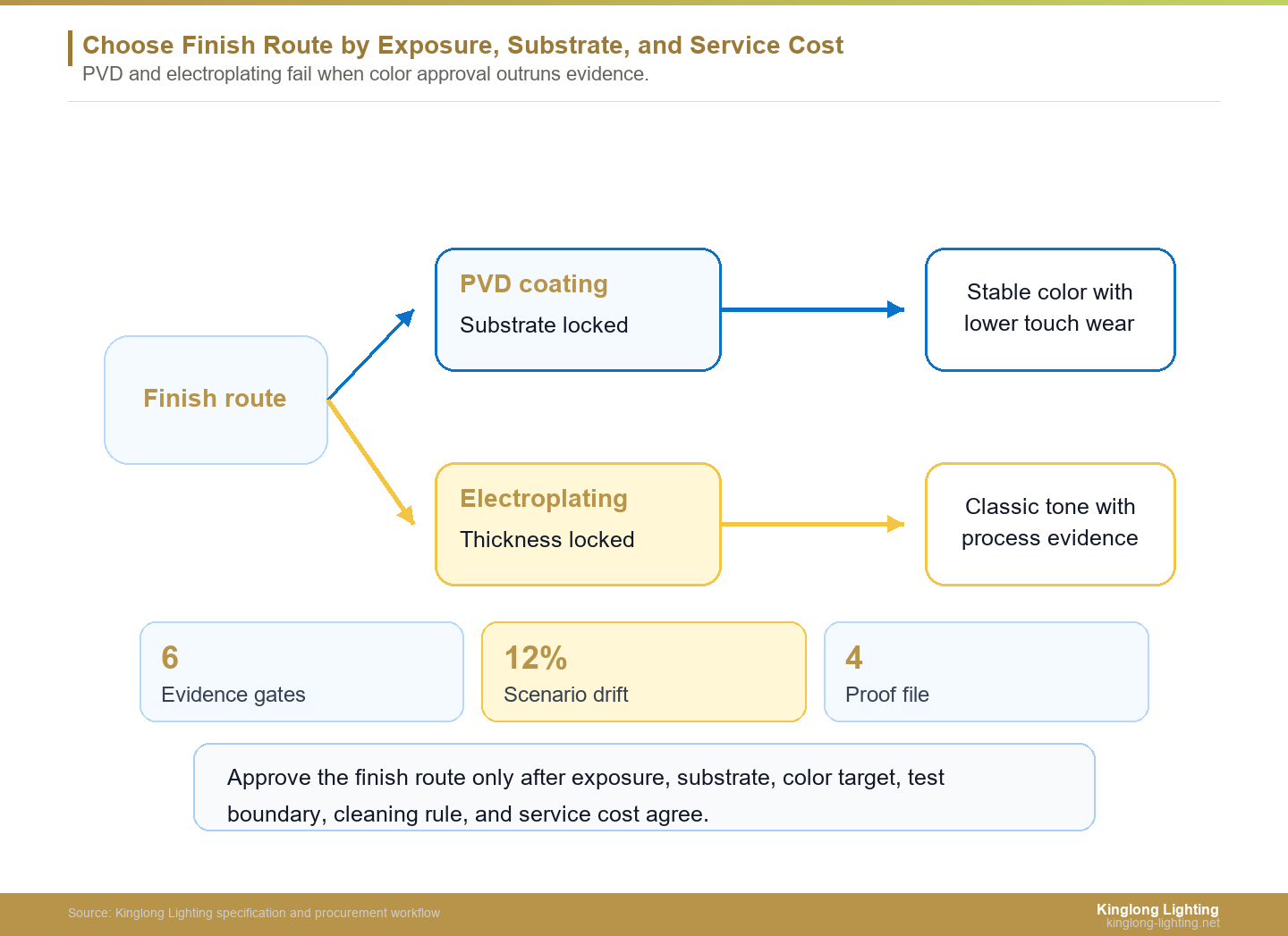
Touch and cleaning are part of the environment
Chandelier metalwork is not always touched, but canopies, stems, arms, decorative collars, and low-hanging parts may face fingerprints, cleaning chemicals, dust, humidity, and polishing habits. These conditions can matter more than the label on the finish.
The buyer should ask where the finish is visible, where it can be reached, and how it will be cleaned. A premium finish with no cleaning rule can fail because the owner treats it like ordinary hardware.
In practice, make this a chandelier metal finish visibility gate: judge the sample under the room light, normal viewing distance, and cleaning condition. The decision rule is to document the threshold before release, then review any mismatch within 7 days if the owner-visible effect or maintenance cost changes.
Light can expose finish mismatch
Warm metal finishes look different under 2700K, 3000K, high-CRI, low-CRI, grazing light, and mixed daylight. A small color mismatch may be invisible in a ceiling canopy and obvious on a visible arm near stone or mirror.
According to DOE TM-30 FAQ, color quality needs more precise language than warm, cool, or beautiful when materials are being approved. For project buyers, the practical action is to review finish samples under the intended light source so gold, brass, bronze, and black tones are not judged under misleading illumination.
In practice, make this a chandelier metal finish visibility gate: judge the sample under the room light, normal viewing distance, and cleaning condition. The decision rule is to document the threshold before release, then review any mismatch within 7 days if the owner-visible effect or maintenance cost changes.
PVD and electroplating solve different coating problems
PVD is a vacuum-based thin-film route often discussed for decorative and protective coatings. Electroplating uses an electrochemical process. The buyer does not need to become a coating engineer, but should understand that these processes create different evidence needs.
According to PVD decorative applications review, decorative PVD coatings should be evaluated by process, substrate, appearance, durability, and application boundary. For project buyers, the practical action is to ask how the coating process, substrate, geometry, and decorative application relate to the finish claim.
PVD can help when surface performance matters
PVD may be attractive when the project needs a thin decorative coating, wear resistance, color stability, or a controlled modern finish. But PVD still depends on substrate preparation, process quality, geometry, and the intended environment.
A buyer should not accept PVD as a magic word. Ask for a sample on the actual substrate or a close equivalent, then review color, adhesion expectation, cleaning rules, and whether the geometry can be coated consistently.
In practice, make this a chandelier metal finish visibility gate: judge the sample under the room light, normal viewing distance, and cleaning condition. The decision rule is to document the threshold before release, then review any mismatch within 7 days if the owner-visible effect or maintenance cost changes.
Electroplating can still fit a decorative brief
Electroplating may be appropriate when the desired color, cost, repair path, and supplier capability are well understood. For some chandelier finishes, established plating routes can provide the exact warmth or antique tone the designer wants.
The risk is not that electroplating is old. The risk is weak pretreatment, poor thickness control, bad color consistency, unsuitable cleaning, or unexamined environmental conditions. The buyer should compare evidence, not stereotypes.
In practice, make this a chandelier metal finish visibility gate: judge the sample under the room light, normal viewing distance, and cleaning condition. The decision rule is to document the threshold before release, then review any mismatch within 7 days if the owner-visible effect or maintenance cost changes.
Durability evidence should be read by exposure and geometry
Durability claims often sound stronger than the evidence behind them. Salt spray, weathering, adhesion, and cleaning tests can help, but each test has a method, sample, and limit.
According to ASTM B117 salt spray standard page, salt spray testing is a controlled corrosion exposure method and should not be treated as a direct lifetime promise. For project buyers, the practical action is to read salt spray evidence as controlled corrosion exposure rather than a direct lifetime guarantee.
A test result is not a lifetime promise
A corrosion or weathering test can help compare finish routes, but it does not say exactly how a chandelier will look after years in a specific villa. Room humidity, cleaning, touch, and coating geometry still matter.
According to ASTM G154 accelerated weathering standard page, accelerated weathering tests expose materials to controlled UV and moisture cycles that need careful interpretation. For project buyers, the practical action is to interpret accelerated weathering exposure within its method and avoid converting it into an exact service-life promise.
In practice, treat this as a chandelier metal finish evidence gate: keep the report, sample ID, method, date, and claim boundary together. The decision rule is to accept only what the document actually proves, then flag any missing proof within 7 days before the buyer signs production release.
Reports should identify sample and method
The buyer should ask whether the tested sample matches the chandelier substrate and finish. A report on a flat coupon may not fully represent curved arms, joints, welds, threaded parts, or high-touch decorative collars.
According to ISO/IEC 17025 overview, laboratory competence, valid results, and report acceptance depend on method and scope. For project buyers, the practical action is to check whether a material report identifies the sample, method, date, scope, and claim it actually supports.
In practice, treat this as a chandelier metal finish evidence gate: keep the report, sample ID, method, date, and claim boundary together. The decision rule is to accept only what the document actually proves, then flag any missing proof within 7 days before the buyer signs production release.
Cost comparison must include rework, color match, and lead time
A finish route with a lower quote can become more expensive if it creates rework, poor color match, longer sampling loops, or hard-to-replace parts. A higher finish cost can be rational if it reduces those risks.
According to UL 1598 standard page, decorative chandeliers are still luminaires that need product evidence and qualified installation review. For project buyers, the practical action is to keep finish decisions connected to the complete luminaire documentation and installed product file.
The cheapest finish can be expensive after installation
If a finish mismatch requires a site return, replacement canopy, or remade decorative arms, the original finish saving may disappear. That is why the buyer should compare installed cost, not only process cost.
The article’s scenario estimate is simple: a finish that costs 12% more can be cheaper if it prevents one visible rework, one site return, or one replacement batch. The number is illustrative, but the cost logic is useful.
In practice, make this a chandelier metal finish visibility gate: judge the sample under the room light, normal viewing distance, and cleaning condition. The decision rule is to document the threshold before release, then review any mismatch within 7 days if the owner-visible effect or maintenance cost changes.
Color match is a hidden cost center
Gold, champagne, bronze, black, antique brass, and brushed finishes can be hard to match across batches and suppliers. The approval file should define a master sample, acceptable range, lighting condition, and replacement rule.
A finish route that gives excellent durability but poor color repeatability may be wrong for a chandelier where metal arms are close to the viewer. A slightly less advanced process may be better when color harmony is the main owner value.
In practice, make this a chandelier metal finish visibility gate: judge the sample under the room light, normal viewing distance, and cleaning condition. The decision rule is to document the threshold before release, then review any mismatch within 7 days if the owner-visible effect or maintenance cost changes.
Approval should lock sample, substrate, and cleaning rules
The finish approval file should not stop at a swatch. It should lock the metal substrate, visible finish, process boundary, cleaning method, spare strategy, and owner expectation.
According to OSHA hexavalent chromium exposure controls page, metal finishing and chromium-related process decisions need process control and worker-safety awareness, not only appearance review. For project buyers, the practical action is to treat chromium-related finishing and worker-safety issues as process-control topics rather than decorative afterthoughts.
Compliance declarations may be part of the file
Depending on destination and buyer requirements, metal finishes and electrical lighting products may need material declarations or restricted-substance evidence. The buyer should ask what is available and what claim it supports.
According to European Commission RoHS Directive page, restricted substance rules make material declarations and supply-chain evidence relevant for electrical lighting products. For project buyers, the practical action is to connect restricted-substance evidence to the buyer's market and documentation requirements without treating it as a broad finish-quality claim.
In practice, make this a chandelier metal finish visibility gate: judge the sample under the room light, normal viewing distance, and cleaning condition. The decision rule is to document the threshold before release, then review any mismatch within 7 days if the owner-visible effect or maintenance cost changes.
Cleaning rules should be visible before handover
A finish can be damaged by the wrong cleaner, abrasive cloth, polishing habit, or moisture exposure. The handover file should state how to clean the visible metalwork and what not to use.
Kinglong Lighting can connect those finish rules to the custom chandelier workflow so the owner receives an installed product and a maintenance path.
In practice, make this a chandelier metal finish service gate with 3 records: part code, spare quantity, and replacement match rule. The decision rule is to confirm the future repair path before shipment so a small breakage does not become a cost, delay, or owner trust problem.
PVD vs electroplating comparison table
Use this table to compare the finish route by project risk instead of process reputation alone.
| Decision area | Owner risk if vague | Evidence to request | Acceptance action |
|---|---|---|---|
| PVD coating | Buyer assumes it always outperforms plating | Actual substrate, sample, process boundary, cleaning note | Use when exposure and color target fit |
| Electroplating | Buyer assumes it is automatically weaker | Pretreatment, thickness, color range, report scope | Use when established finish path fits the room |
| Durability test | Report is used outside its method | Sample identity, ASTM method, date, exposure | Read as controlled evidence |
| Color match | Batch replacement visibly differs | Master sample, light condition, acceptable range | Lock color before production |
| Cost | Quote ignores rework and service | Sampling, rework, replacement, cleaning, lead time | Compare ownership cost |
A finish-life scenario for chandelier metalwork
Imagine two finish routes for a champagne-gold chandelier arm. Route A costs less but needs two sample loops and has uncertain replacement color. Route B costs 12% more but locks the substrate, sample, cleaning rule, and replacement range. Route A may still be cheaper if the fixture is high, low-touch, and visually forgiving.
Route B becomes rational when the finish is close to the viewer, touched during cleaning, exposed to humidity, or likely to need matched replacement parts. One visible rework can erase the original saving. The buyer should therefore calculate finish cost as quote plus sample loops, rework risk, color-match risk, and service burden.
The limitation is that no comparison can crown PVD or electroplating in every project. The correct route is the one whose evidence matches the room, substrate, geometry, and ownership file.
A second decision layer is geometry. Thin rods, curved arms, deep grooves, collars, canopy seams, and screw heads may not receive or show finish the same way. The buyer should not approve only a flat sample chip if the chandelier contains complex shapes. Ask for one sample on the closest real part or a mock-up with similar geometry.
The final approval should also say what happens if a replacement part is needed two years later. A finish that is durable but impossible to match can still create an owner problem. For visible chandelier metalwork, repeatability is part of durability.
This is why the finish file should include a replacement-lighting note. If the first sample was approved under a bright factory bench light and the replacement is judged under warm villa lighting, the owner may see a mismatch that is partly caused by the review condition. Record the lighting condition with the sample so future comparisons are fair.
For final selection, ask the supplier to identify one decision that would change the finish route. If the answer is humidity, touch level, geometry, budget, or color match, the team has found the real variable. If the answer is only PVD is better or plating is cheaper, the comparison is still too shallow.
How Kinglong Lighting supports metal finish approval
Kinglong Lighting can support metal finish approval by connecting sample boards, substrate notes, coating boundaries, cleaning rules, packing labels, and replacement strategy to the decorative lighting collections and project file.
If a project is comparing PVD coating and electroplating, the useful next action is to send the metal finish brief with room exposure, target finish, touch level, cleaning expectation, destination market, and replacement concern. Kinglong Lighting can then help compare finish routes by evidence.
Before selecting a chandelier metal finish
Use this short action list before the next approval meeting. It is intentionally practical, because vague approval language is the usual source of later rework.
- Define room exposure and touch level.
- Approve a master sample under project lighting.
- Ask for substrate, process, and report boundaries.
- Compare rework and replacement cost, not quote alone.
- Add cleaning rules to the handover file.
FAQ
Is PVD coating better than electroplating for chandeliers?
Not always. PVD can be stronger in some finish applications, but electroplating may fit better when color, cost, and process evidence match the room.
Does salt spray testing prove chandelier finish life?
No. Salt spray testing is controlled corrosion exposure, not an exact lifetime promise for a specific villa, hotel, or cleaning routine.
What evidence should buyers request for metal finishes?
Request the finish sample, substrate note, process boundary, test method, cleaning rule, acceptable color range, and replacement strategy.
Why do chandelier metal finishes mismatch?
Mismatch can come from substrate variation, process settings, batch change, lighting condition, viewing angle, cleaning, or uncontrolled replacement parts.