
Choosing crystal for a chandelier is not simply a question of which name sounds most premium. Swarovski, Preciosa, Asfour, and K9 represent different routes: identity evidence matters when a named component supports the design story, while specification evidence matters when a K9 component must meet repeatable visual criteria. Choose the route that fits the intended light effect, budget, replacement strategy, and level of component identity required.
Key Takeaways
Choose the evidence path before choosing the crystal label. First decide whether the project needs a named component or a written K9 specification, then state the evidence that proves the selected component. That keeps a named-brand request from becoming an unsupported substitute line and a K9 request from becoming an undefined quality tier.
- Use a named-brand route only when the actual component can be connected to a verification method, a sample, and the purchase record.
- Use a K9 route only when the quotation states the full material or supplier designation, the visible component criteria, and the approved reference sample.
- Compare Swarovski, Preciosa, Asfour, and K9 by the evidence each route can carry into the chandelier schedule, not by unverified claims about sparkle or price.
- Release crystal purchasing only after the component code, evidence path, sample ID, and acceptance check point to the same item.
Start With the Design Promise
Swarovski, Preciosa, and Asfour are named component routes; K9 is a supplier-used description that needs its own written specification. This distinction does not say that one option is automatically more suitable. It says that the buyer is asking for different proof. A named route may call for an identity marker or verification record. A K9 route may call for a material designation, cut and size description, visible-condition criteria, and a sealed reference sample. If neither set of evidence can be supplied, the quotation is still a discussion, not an approval.
Under Council Directive 69/493/EEC, the regulated crystal-glass descriptions are linked to composition, manufacturing characteristics, and labeling within the Directive’s scope. That is useful legal context, not a worldwide chandelier-material standard. Its buyer-side lesson is modest: a description gains meaning from the conditions and record attached to it. Do not convert a word in a catalogue, a quotation, or a sample tag into a broader promise than the supporting record actually makes.
A Brand Name Is Useful Only When It Can Be Bound to the Component
A brand name is useful in a chandelier brief only when it can be bound to the actual component. The binding can be a component code, manufacturer documentation, an applicable verification method, and a sample reference that all describe the same pendant, drop, bead, or prism. The brand name alone does not prove that the supplied part matches the selected cut, colour, size, or workmanship expectation. For a hotel lobby feature ring, that difference is material: the design team may be buying a recognizable named component, while the factory needs an item-level line it can purchase and inspect.
Write the item in the schedule, not merely in the mood board. Identify the component position, nominal dimensions, finish or colour requirement, quantity, and the record that verifies the named route. If the supplier offers an alternative, give that alternative its own line rather than leaving the word “equivalent” to absorb the difference. This protects both the design promise and the supplier from a late dispute about what the named word was meant to cover.
K9 Must Become a Specification, Not a Quality Tier
Here, K9 means a supplier label; request the full material designation and a specification sheet before treating it as a chandelier component requirement. The first question is not whether the label sounds premium. Ask which exact part it covers, whether the same designation applies to every size in the fixture, and which observable characteristics will be checked against the approved reference. A buyer can then compare offers on a shared schedule instead of assuming that the same short label guarantees the same delivered component.
A technical supplier cautions that Chinese use of the abbreviation K9 can extend beyond H-K9L to similar optical glass and crystal-glass descriptions. Treat that as a naming boundary, not as a universal certification claim for decorative lighting. It is precisely why an RFQ should expand a short label into the supplier’s material statement, component dimensions, cut or form, colour expectation, edge condition, sample ID, and acceptance criteria.
HOYA classifies optical glass by refractive index and Abbe number. That does not mean every decorative chandelier tender needs lens-grade values. It does show why a meaningful technical claim needs a stated basis rather than a broad quality adjective. When optical properties are genuinely relevant, request the named material and measurement context. When the design decision is mainly visual, define the observable cut, consistency, clarity, colour, and sample-match conditions instead.
Compare the Four Options by Project Need
The table below deliberately avoids a one-dimensional winner. It compares the procurement promise a buyer can reasonably request, the evidence that makes that promise usable, and the question that keeps a quotation from becoming ambiguous. Before comparing physical forms in a wider fixture context, buyers can compare chandelier crystal paths alongside the schedule fields below.
| Option named in the brief | What the buyer may be trying to preserve | Evidence to request before release | Question that prevents ambiguity |
|---|---|---|---|
| Swarovski | A named component identity where that identity is part of the design promise | Applicable identity route, component code, approved sample, and purchase-record match | Which selected component can be verified, and how is it connected to this schedule line? |
| Preciosa | A named component identity with a documented verification route | Package or finished-good verification route, component code, approved sample, and record match | Does the verification information apply to the exact component and quantity being supplied? |
| Asfour | A defined crystal-parts request rather than a broad brand adjective | Actual part family, component code, sample, dimensions, and visible-condition criteria | Which crystal part is being offered, not simply which brand word appears in the quotation? |
| K9 | A repeatable material-and-appearance specification without a named-brand promise | Full supplier designation, component criteria, approved sample ID, and lot acceptance rule | Which written criteria prove that the delivered part matches the approved reference? |
Asfour’s official shop separates crystal parts from lighting categories. That portfolio distinction is helpful because it encourages a more precise request: name the actual crystal part or component family that belongs in the chandelier schedule. The comparison points to a conditional choice, not a brand hierarchy. If the design promise is named identity, ask for a verifiable named route. If it is repeatable appearance, ask for a specification-bound route. Kinglong Lighting’s fixture context should be read as a design reference, not as evidence for an external brand claim.
Choose Between a Named Component and a Written Specification
For chandelier procurement, selection needs two evidence paths: an identity path for named brands and a specification path for K9. Start by asking which promise is non-negotiable for this fixture line. If the written design intent requires a named component, the buyer needs an identity path. If the project needs a controlled visual result but does not require that named claim, the buyer needs a specification path. If the supplier cannot document either path, hold that component line rather than allowing a vague substitute to move into purchasing.
Use the Identity Path When the Named Component Is Part of the Design Promise
On the identity path, the buyer should record the exact component description, confirmation method, selected sample, and the document that will travel with the purchase line. The verification method may have limitations, so it should be checked against the particular component rather than treated as a blanket fixture certificate.
Swarovski Lighting says its genuine components feature a permanent, laser-engraved Quality Signature and that, with stated exceptions, it appears on crystals from 18 mm. The useful procurement action is to ask whether the selected pendant falls within that route, then record the answer alongside the component code and approved sample. Do not infer that a brand reference alone approves a fixture, a batch, or an alternative component.
Preciosa directs buyers to verify branded crystal using QR packaging information or a verification code. Put the relevant route in the schedule while the sample is still under review, not after the order has been consolidated. That small timing change turns a branded preference into a question the purchaser and inspector can answer. The same discipline applies to every visual alternative: establish the component identity before treating an image as an approval record.
Use the Specification Path When Repeatability Is the Project Promise
When repeatability is the project promise, approve K9 through observable component criteria and a matched reference sample. For a product-family context, buyers can see crystal tube component options after they have written the criteria that will govern comparison. A practical line can state the supplier’s full designation, component drawing or dimensions, form or cut, colour expectation, visible-condition limits, approved sample ID, and the viewing conditions for a match. The requirements should be proportionate to the fixture: a small concealed prism does not need the same visible-condition record as a pendant ring at eye level in a lobby.
Keep the specification route honest about what it does not prove. It can control the requested material statement and visible component target; it does not create a named-brand claim. It also needs an inspection plan. Define which component code is being checked, what counts as a meaningful difference from the reference, and what happens if a carton cannot be traced to the approved line. Ask whether the drawing, carton label, and reference tag will repeat the same code, because that small check makes a later visual comparison much less subjective. That is more useful than trying to turn K9 into a universal premium or budget category.
Turn the Choice into a Clear Chandelier Brief
A crystal choice becomes production-safe only when its evidence path is attached to the same component record used for purchasing and inspection. In a custom chandelier, a visually correct sample can lose its value if the buyer cannot tell which component line, order quantity, or production lot it governs. Make the selected path visible in the same record that identifies the pendant, its location in the fixture, its quantity, and the approval reference. This is where a material discussion becomes a delivery decision. For the next handoff, buyers can review custom component schedules with the design and production teams.
Keep the Selected Component Clear Through Approval
A component schedule is a part-by-part list that binds the brand or material route to the approved sample, drawing reference, quantity, and acceptance check. For a named route, include the available verification or documentation path. For a specification route, include the full supplier designation and the observable criteria. In both cases, seal or clearly identify the approved reference and make sure the purchase order uses the same component code. If a supplier submits a substitute, require a new line and a new review rather than silently changing the meaning of the approved one.
Preciosa says it can provide proper documentation and a signed declaration to customers who need that certification. That is not a promise for every project or every brand. It illustrates the right buyer question: can the document be tied to the actual component record being purchased? A documentation file with no component code is easier to misread than a shorter file that clearly identifies the selected line.
ISO 2859-1:2026 describes lot-by-lot attribute sampling plans indexed by AQL. The standard does not select a universal inspection percentage for chandelier pendants. Its relevance is the discipline of defining the lot, the attributes, and the acceptance rule before interpreting an inspection. For a crystal component, first state which cartons or quantity belong to the line, then apply the project-specific check consistently. This protects the schedule from being treated as a decorative note after purchasing has begun. Once those fields are settled, buyers can see completed crystal lighting projects for a wider decorative-lighting reference.
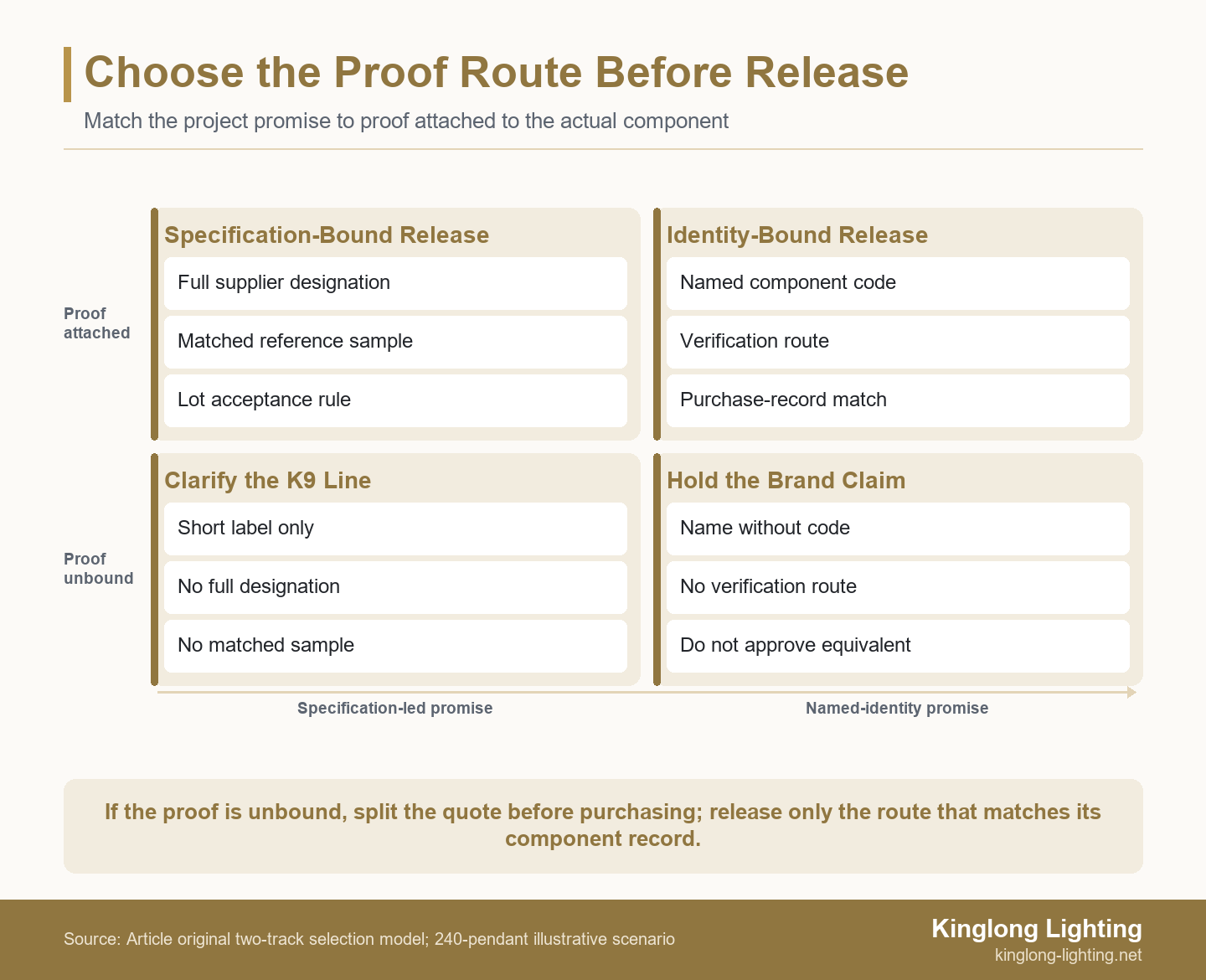
A 240-Pendant Quote That Needed Two Evidence Branches
This illustrative scenario follows a hotel-design buyer specifying a custom lobby chandelier whose crystal pendants are a visible part of the arrival experience. It is not a verified Kinglong Lighting client case.
The order covers 240 pendants across 12 fixtures, with two visible pendant sizes and a written request for a named crystal option in the feature ring. The feature ring covers 60 pendants in 3 lobby fixtures.
The metal frame sample is approved, but the production component schedule has not yet been released to purchasing.
The quotation says “Swarovski or equivalent” without a component code or stated alternative.
The pendant sample tag identifies the size but does not show a brand verification route or full K9 specification.
The issue is not simply brand preference. The feature-ring requirement has two possible evidence paths, but neither was bound to the 240-pendant component schedule, so an unpriced substitution could enter production.
When a quote says ‘Swarovski or equivalent’ without a mapped component record, split the choice before purchasing instead of treating the label as approved. Hold the feature-ring pendant release and separate it into a named-brand branch and a specification-bound alternative branch.
Issue one corrected schedule that names the verified branded component and a second schedule that states the alternative material, cut, size, approved-sample ID, and acceptance criteria.
Use a split release: release only the traceable subset whose sealed reference sample, purchase record, and schedule all carry the same component identity or specification.
This illustrative scenario shows a quote-stage split; it does not claim that every Asfour, Preciosa, Swarovski, or K9 component has the same risk. Its purpose is to keep an unbound alternative from changing the approved feature-ring promise by accident.
What to Include in a Crystal Selection Brief
A production-safe crystal choice needs a drawing, an evidence path, an approved sample, and an acceptance check in the same handoff. Send these four items together, plus the quantity and component location. A supplier can then respond to a defined request instead of trying to interpret broad terms such as “premium crystal” or “equivalent.”
- Drawing and component code: identify the pendant, prism, bead, or trim location, nominal dimensions, quantity, and which fixtures use it.
- Evidence path: state either the named component and its verification route, or the full supplier designation and visible component criteria.
- Approved reference: provide a labelled sample, images, or both, plus the viewing conditions that govern visual comparison.
- Acceptance check: state the population or lot, inspection timing, key visible conditions, and the action for an untraceable or non-matching component.
This brief is deliberately neutral about supplier choice. It can be applied to every bidder, including Kinglong Lighting, so the comparison remains about proof and project fit. It also gives the purchasing team a concise way to ask for corrections before a substituted part becomes a production assumption. If the drawing and sample already exist but the evidence route needs a neutral review, request a crystal evidence review
Related Guides
That distinction matters because a component selection has a narrow job: it identifies what will be purchased and checked. A wider guide can help the team discuss design language, but it should not silently change the named identity or the specification route written into the purchase record. Use a fresh review if a new visual direction requires a different part, size, or reference sample. When the existing selection is stable and the next question is about adjacent material or fixture context, readers can read more chandelier material guides
Frequently Asked Questions
Is Swarovski always the best choice for a chandelier?
No. A named Swarovski component can be the right route when the project promise specifically requires a verifiable named identity. It is not a blanket approval for every cut, size, fixture location, or production lot. The buyer still needs an applicable verification route, a component-coded schedule, and an approved sample that matches the purchase record.
Can K9 be specified for a premium hospitality chandelier?
Yes, if the project does not require a named-brand claim and the supplier can provide a complete, controlled component specification. Define the full supplier designation, dimensions, form or cut, appearance criteria, approved reference sample, and acceptance process. The decision should rest on the project record and sample match, not on K9 as a standalone tier.
How should an “or equivalent” crystal quote be handled?
Do not approve it as a single undifferentiated line. Keep the named route as one evidence branch and ask the supplier to state the alternative as a separate component specification with its own sample and acceptance criteria. Then approve, reject, or hold each branch according to the same schedule fields rather than relying on a general similarity claim.
What must match before crystal purchasing is released?
The drawing or component code, evidence path, approved reference sample, purchase record, and acceptance check should all identify the same supplied item. If a document or sample cannot be traced to that line, pause the release and correct the schedule. This is the simplest way to prevent a polished crystal label from becoming an uncheckable production assumption.