What Chandelier Materials Change
A chandelier material label is not a complete specification. Crystal, glass, metal, and acrylic do not make the same contribution to a chandelier. Crystal and glass shape sparkle, refraction, and visual weight; a metal frame carries the composition and establishes its finish language; acrylic can reduce weight or enable forms that would be impractical in glass. The material label should identify the component role as well as the material itself.
Compare optical pieces, structural parts, and surface finishes separately before choosing a final palette. That makes it easier to match the intended effect, installation setting, and practical care needs, then carry the same choice through to the finished installation.
Key Takeaways
- Specify the role of every visible material: optical effect, structure, finish, or care-sensitive component.
- Treat a crystal or glass label as the start of evaluation, then compare the declared category, approved sample, and production component.
- Separate a metal base from its visible finish so the brief does not imply unsupported structural or durability claims.
- For mixed-material fixtures, record a cleaning approach that is safe for the connected assembly, not simply for one surface.
The Material Role Comes Before the Material Name
A material name becomes useful only when it answers a design or supply question. Is the component intended to refract light, hold a load, establish a finish tone, diffuse the source, or survive a particular care routine? A pendant and a frame can both be “glass and metal,” while performing completely different roles in the finished chandelier. Buyers who begin with roles can compare like with like across quotes, request the right samples, and decide which variation is visual preference versus a change that requires re-approval. You can compare chandelier material families in the Kinglong Lighting collection before narrowing a palette for a specific room type.
Soda-lime glass is a common glass family made chiefly from silica, soda, and lime. The cited reference reports silica at about 60–75 percent, soda at 12–18 percent, and lime at 5–12 percent. Those proportions are helpful for identifying a broad glass family; they do not predict the look or performance of every formed chandelier component. Thickness, geometry, surface treatment, color, and the way the part sits near a light source still shape the result. Ask the supplier to show the actual component or a representative swatch under an appropriate light condition instead of drawing a conclusion from the family name alone.
| Material role | Buyer question | Useful evidence |
|---|---|---|
| Optical component | What light effect, transparency, texture, or color is intended? | Approved pendant, diffuser, or swatch viewed in the relevant lighting condition |
| Structural component | Which visible part also participates in the fixture assembly? | Material designation, component drawing, and manufacturer confirmation for the intended configuration |
| Finish system | Is the requested tone a base material appearance or a finish applied to another base? | Finish sample, stated finish name, and signed visual reference |
| Care-sensitive component | What must be protected during installation and routine cleaning? | Assembly-aware care instruction and fixture manufacturer guidance |
The conclusion is simple: write the requested effect and verification method next to each material. A “clear pendant,” for example, becomes more actionable when the brief states its intended optical appearance, sample reference, and the production lot that will be checked against that reference.
How to Read Crystal Without Guesswork
In the cited EU framework, crystal-glass descriptions are tied to defined composition, characteristics, and labeling categories. In a purchasing brief, crystal glass means a glass category evaluated through a composition declaration and label, rather than an optical adjective. That distinction matters when a project team uses a familiar market term but needs a repeatable buying record. Council Directive 69/493/EEC is a terminology reference, not a universal certification for every chandelier or an automatic statement of fixture performance.
Use the label to frame questions, not to finish the evaluation. First, request the supplier’s composition declaration or material identification for the specific optical component. Next, compare an approved sample for clarity, cut, color, surface consistency, and the intended light effect. Finally, identify how the production component will be matched to that sample: a retained control sample, a signed swatch, an item code, or an agreed incoming inspection record. The final check is especially valuable when the component is a repeated pendant or prism, because a small optical variation can become conspicuous across a multi-arm installation.
“Crystal” is most useful in a purchase brief when it points to a defined category, a visible reference, and a production comparison method.
Do not ask a supplier to promise sparkle in the abstract. Explain where the fixture will be viewed, whether the goal is sharp refraction or a softer decorative glow, and which conditions make a variation acceptable or unacceptable. A hospitality lobby, a residential stairwell, and a retail feature installation can each demand a different visual response from a similar-looking pendant. This is also where a physical sample earns its place: it lets the team evaluate the optical component in context before finalizing repeated production parts.
Choose the Structural Material for Load, Finish, and Service
Brass is a copper-zinc alloy whose properties change with alloy composition. In a decorative fixture brief, that is a reason to name the intended component and confirm its configuration with the manufacturer, rather than treating “brass” as a universal promise about strength, corrosion resistance, or long-term finish behavior. It is equally important to distinguish a brass base from a brass-colored finish on another base material. Both may support the visual direction, but they are different requests and should be recorded that way.
Start with the assembly. Identify the visible frame, arms, canopy, decorative collars, or connectors that need a material callout. Then state whether the buyer is selecting a base material, a visible surface tone, or both. For a project with a closely controlled visual identity, include the finish sample, sheen expectation, and viewing conditions in the approval package. For a project where access matters, ask how the selected components can be serviced without disturbing nearby pendants or damaging the finish. These are production questions, not generic material claims.
Once the roles are separated, it becomes easier to turn a material palette into an OEM ODM chandelier brief. The document can identify the visible effect the design team wants, while leaving fixture engineering, suspension, electrical requirements, and configuration-specific validation with the responsible manufacturer and project team. That keeps the request clear without pretending that a material name alone has answered the engineering question.
A finish reference sets the look to approve. A component material record identifies what must be supplied. A well-built brief keeps both records visible.
Glass, Acrylic, and Mixed Materials: Make the Trade-Off Explicit
Clear PLEXIGLAS products are specified by the manufacturer with up to 92 percent visible-range transmission, depending on the material type and thickness. That product-specific reference is useful because it shows why a broad transparency claim is not enough. When acrylic is being considered for a diffuser, shade, or decorative optical element, request the exact material type, thickness, finish, and sample condition that will be used. PMMA is an acrylic transparent polymer often considered where form, weight, and optical appearance need to be balanced; the final choice still depends on the component and use case.
A glass option may align with the desired look and tactile character, while an acrylic option may support a different form or handling preference. Neither option is a shortcut around a detailed sample review. Confirm the edge treatment, color or frosting, how the part will be retained, and the expected appearance when the fixture is illuminated. If a statement about transmission, impact behavior, UV behavior, or cleaning compatibility matters to the purchase decision, obtain it for the selected product and thickness rather than transferring it from a general material family.
LED systems still require a thermal path through the board, housing, heat sink, or luminaire frame. Decorative materials near a light source therefore have to be considered with the whole luminaire assembly. A pendant, diffuser, or trim may contribute to the appearance, but it is not evidence that the fixture’s thermal design is appropriate. Keep that technical verification with the manufacturer’s configuration-specific documentation and applicable project requirements.
Attached components can be affected by water, solvents, acids, or alkalis used on a nearby transparent surface. The cited conservation guidance concerns display cases, so the practical chandelier implication is deliberately narrow: connected materials deserve consideration when a cleaning approach is chosen. Follow the fixture manufacturer’s care instructions, isolate power before maintenance, and avoid converting a general cleaning note into a universal method for an assembled light fixture.
A mixed-material fixture should be cleaned with a method that is safe for its attached components, not only for its glass or acrylic surface. Put the assembly-level care limits on the project record: which parts must stay dry, which finishes need protection, and when the installer or manufacturer should be consulted. That turns a general care warning into a usable maintenance boundary.
For a product conversation, this means listing the materials that sit together: transparent pendants, coated arms, plated collars, gaskets, decorative adhesives, and accessible metalwork. The supplier can then identify the approved care path for that assembly rather than offering isolated advice for a loose material coupon. If the design calls for long repeated glass elements, you can review a Crystal Tube application by material role and carry the same questions into a project-specific sample discussion.
Turn the Material Palette into a Clear Project Brief
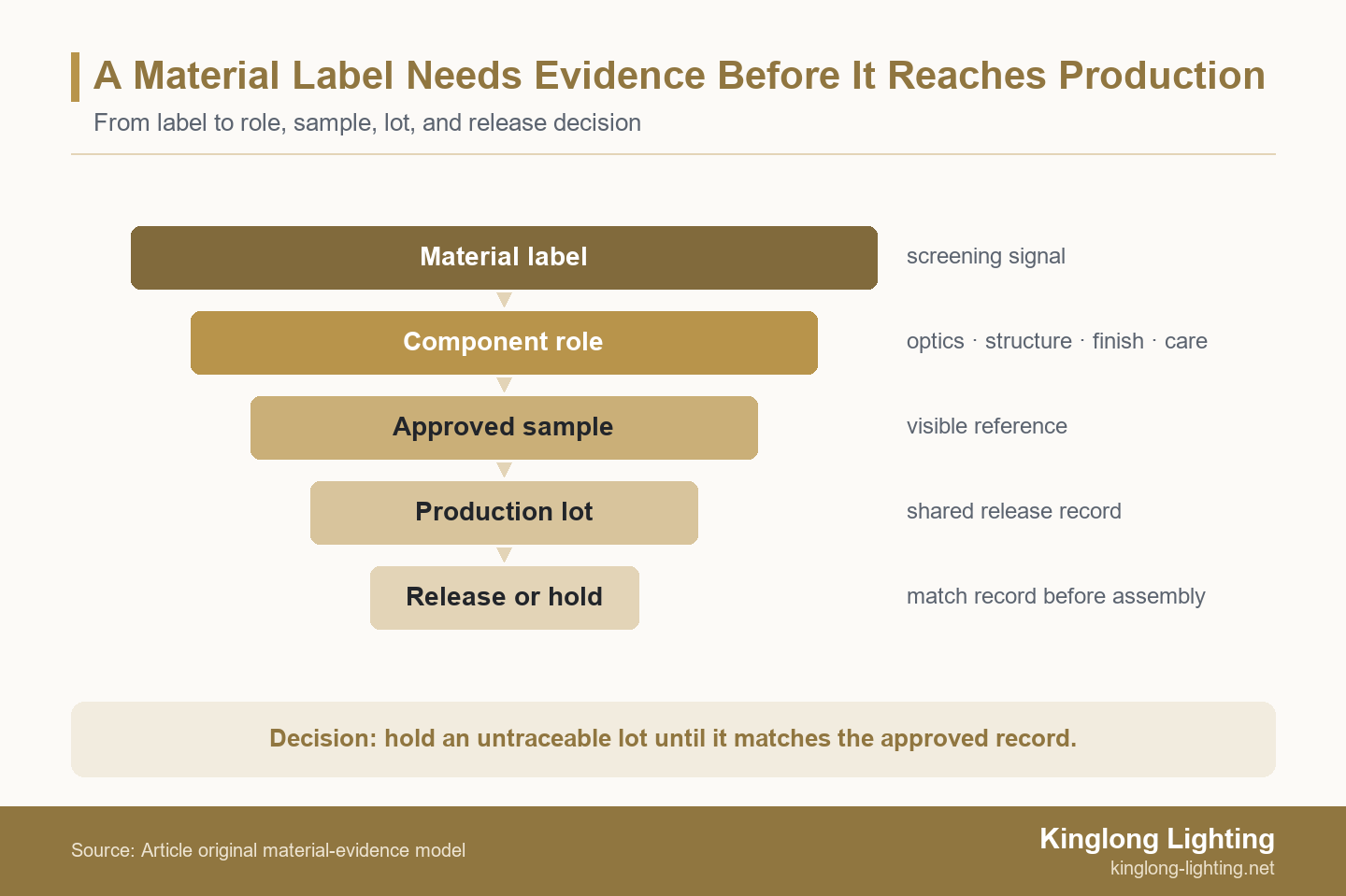
A production decision is complete only when the approved reference, the production identification, and the verification step can be linked. Once the palette is selected, that simple comparison prevents a small change in a repeated pendant, metal tone, or translucent part from changing the visual rhythm of the finished installation. The record needs to show what was approved, what is being made, and who compares a meaningful difference before final assembly.
Illustrative scenario: when the sample and production record diverge
Buyer context. This illustrative scenario is not a Kinglong client case. A hospitality design team is specifying a lobby chandelier with visible pendants and a metal frame, and the team needs the optical pieces to match the approved lighting concept.
Order context. The project requires 40 chandeliers and 9,600 optical pendants, with 1 pendant lot across 40 fixture assemblies. The repeated optical population means that a small visual change can affect the completed installation at scale.
Readiness state. A pre-production sample is approved, but production material records have not yet been released. The incoming lot has a supplier packing list, yet it does not connect the optical parts to the retained approval reference or agreed component code.
Observation 1. The approved sample names crystal glass and a brushed brass finish, but the pendant composition is not listed on the production component record. The missing description prevents a reliable comparison with the approved optical reference.
Observation 2. Two of eight production comparison pieces show a different color cast under the intended 3000 K lamp than the approved sample. The variation is visible in the intended lighting condition and cannot be dismissed from a carton-level check.
Analysis. The visual discrepancy cannot be isolated by changing a single material name because the evidence gap is tied to the pendant lot and the light-behavior requirement. The team records the component code, lot reference, observed differences, and decision owner while comparing representative production pieces with the retained sample.
Decision. When a production pendant lot cannot be tied to the approved sample record, hold that component lot until the comparison is completed. Hold the affected pendant lot, keep the frame work separate, and compare a documented production sample against the approved optical and finish references before assembly resumes.
Corrective action. Add the pendant material description, part reference, finish reference, and light-condition comparison to the component approval sheet. Record the lot identifier and release authority, while treating photos as supporting evidence rather than a replacement for the retained approval where the project requires one.
Verification gate. Release the held pendants only after the compared production sample matches the approved record under the agreed viewing condition. Keep that release record with the project file so any replenishment or service discussion begins from the same material baseline.
Boundary. This illustrative example does not establish a structural, electrical, or legal compliance decision. Those configuration-specific responsibilities remain with the responsible manufacturer, project team, and applicable requirements.
A Four-Line Material Request for Custom Chandelier Quotes
A four-line material brief makes the first supplier comparison more specific. It gives a chandelier manufacturer enough context to respond to the real decision without turning an early inquiry into an incomplete engineering specification. Kinglong Lighting can use the same concise format to identify the right sample path before a detailed custom quotation is developed.
- Room and fixture context: state the room type, approximate fixture scale, and where the viewer will experience the light.
- Optical effect: describe the intended clarity, color, texture, refraction, diffusion, or decorative rhythm, and attach any visual reference.
- Base and finish: identify the component that needs a base-material callout and the visible finish or surface tone to be approved.
- Sample and production check: name the sample to approve and how the production component or lot will be compared with it.
Send that brief with drawings, room photos, or a concept board when available. It creates a better starting point for questions about material options, sample availability, assembly constraints, and the information needed for a project-specific review. You can request a material matching review for your project brief.
Questions to Resolve Before Ordering
These short answers keep the final checks tied to the same buying record: identify the part, approve the visible reference, and apply care instructions to the complete assembly.
Frequently Asked Questions
Is a crystal label enough to approve a chandelier pendant?
No. A label may identify a category or market description, but the buying decision still needs a component-level reference. Ask for the supplier’s material identification where relevant, then approve a representative pendant under conditions that reflect the project. Record what visual characteristics matter: cut, clarity, color, surface consistency, and the intended light effect. For repeat production, add a way to compare the incoming component with the approved sample, such as an item code, a retained reference, or an agreed inspection record.
When should acrylic be considered instead of glass?
Consider it when the design needs a particular form, handling characteristic, visual effect, or material balance that an acrylic component can support. The choice should not be based on a generic statement that one family is always better. Request the exact material type, thickness, finish, edge treatment, and representative sample. Review how the component looks when illuminated, how it is retained in the assembly, and what the fixture manufacturer specifies for care. The final selection should document the intended component, not just the word “acrylic.”
Can a brass finish be treated as the same request as a brass base?
No. A brass base identifies the material used for a particular component, while a brass-colored or brass-toned finish indicates a visible appearance that may be applied to another base. Both can be part of an effective decorative design, but the production questions differ. State which component is involved, what visual tone or sheen is expected, and which sample governs acceptance. For structural, suspension, electrical, or configuration questions, rely on the responsible manufacturer’s project-specific documentation rather than a finish name.
How should a mixed-material chandelier be cleaned?
Care choices must follow the relevant component and assembly, not a generic chandelier label. A transparent pendant may sit beside coated metal, plated details, seals, adhesives, or electrical elements that need different precautions. De-energize the fixture before maintenance and follow the fixture manufacturer’s instructions for the completed assembly. If a cleaning product or method is being considered, confirm its suitability for the connected materials and finish system rather than applying advice written for an isolated piece of glass or acrylic.