Villa lighting project updates should not arrive randomly. A private owner needs enough communication to make timely decisions, but not so much noise that every photo, question, or supplier note becomes a meeting. The right cadence changes by project stage.
A concept stage may need weekly decision notes. A sampling stage may need updates when evidence arrives. A shop drawing stage needs issue-based replies. Production needs milestone proof. Shipping needs document and receiving visibility. Installation needs readiness confirmation and close-out notes.
Kinglong Lighting can make project updates more useful when the owner connects communication to the custom chandelier workflow and clear approval dates. The update should answer three questions: what changed, what is blocked, and what decision does the owner need to make next?
Key Takeaways
- Cadence follows risk: High-risk stages need tighter updates; quiet stages need milestone evidence rather than daily chatter.
- Updates should carry evidence: Photos, drawings, samples, packing records, and issue logs are more useful than status adjectives.
- Owner decisions need due dates: A project can lose weeks through slow replies even when production is on schedule.
- Escalation rules reduce anxiety: The owner should know what triggers an immediate message instead of waiting for the next routine update.
- Handover needs a final communication rhythm: The last updates should close open items, warranty records, spares, and maintenance notes.
Set cadence by project stage, not by habit
The best villa lighting update is not frequent; it is timely, evidence-backed, and tied to the next owner decision.
A villa lighting project has different communication needs at different moments. Using the same update rhythm across concept, sampling, drawings, production, shipment, and installation creates either silence at risky moments or noise when nothing important has changed.
The WBDG building commissioning page gives a useful boundary because commissioning connects design intent, installation quality, operation, and owner handover. For project buyers, the practical action is to connect updates to acceptance evidence, handover, and owner decisions rather than casual progress notes.
Concept updates should close direction
During concept, the owner needs updates that clarify direction: room intent, visual mass, reference translation, and open constraints. A useful concept update does not simply show another pretty option. It asks the owner to approve, reject, or narrow a direction.
The Mofun Design Platform can make this stage more concrete because it gives the owner scale evidence instead of relying only on mood images. A weekly concept update is often enough if each update carries a decision.
Sampling updates should wait for evidence
Sampling does not need daily messages unless something goes wrong. It needs evidence when the sample is ready, delayed, revised, or rejected. The update should include what was tested or made, what changed from the last reference, and what the owner should approve.
This is where communication should slow down to protect attention. Owners do not need a stream of factory activity. They need the moment when finish, glass, crystal, color, or material evidence is ready for judgment.
Use escalation triggers instead of vague urgency
The owner should know what deserves an immediate message. Without escalation triggers, every issue either feels urgent or disappears until the next scheduled update. Both patterns create stress.
The UL 1598 standard page gives a useful boundary because decorative chandeliers are still luminaires that need product evidence and qualified installation review. For project buyers, the practical action is to escalate when product evidence, installation assumption, or luminaire boundary changes the owner's approval risk.
Immediate updates should be reserved for decision risk
Immediate updates are justified when a decision affects cost, time, visual outcome, installation, safety boundary, sample match, or shipment release. For example: a finish cannot match the approved sample, a module size affects the route, or a driver assumption changes service access.
Routine activity should not be labeled urgent. If every message is urgent, the owner stops seeing real risk. A clear escalation rule protects the owner’s attention and makes genuine issues easier to resolve.
Local review triggers should be named
Some updates should trigger local professional review rather than owner taste review. Electrical assumptions, support questions, access safety, and authority-controlled matters should be routed to the right local party.
The NFPA 70 National Electrical Code page gives a useful boundary because electrical installation and field acceptance decisions need local qualified code review. For project buyers, the practical action is to separate electrical responsibility from manufacturer communication so owner updates do not overclaim local code decisions.
The update should say what evidence changed
The best updates are short but evidence-rich. They name the stage, what changed, which evidence is attached, what remains open, and what decision is due. This prevents the owner from reading tone instead of facts.
The DOE lighting design page gives a useful boundary because lighting decisions should be judged around the whole space and its use, not only fixture appearance. For project buyers, the practical action is to connect update content to room use, visual quality, and whole-space lighting intent.
A photo update needs a decision caption
A factory photo without a decision caption is entertainment. The caption should say whether the photo is for scale confirmation, finish comparison, component count, assembly progress, inspection, packing, or damage evidence.
Owners should ask for the decision behind the image. Does this photo ask for approval, show progress, document a risk, or close an item? If the answer is unclear, the update may create more questions than confidence.
Document updates should show version and status
Drawings, samples, packing lists, and claim records should show version, date, status, and owner action. A file named latest drawing is weaker than a file that states revision, open items, and approval request.
Version discipline is a communication tool. It prevents the owner, designer, supplier, and installer from acting on different files while believing they are aligned.
Build the owner decision calendar
The communication cadence should include a decision calendar. This does not need to be complex. It should name concept freeze, sample sign-off, drawing approval, production release, inspection release, shipment release, receiving confirmation, and handover close.
The ICC Incoterms 2020 page gives a useful boundary because international delivery responsibility should be named before goods, crates, and spare parts move. For project buyers, the practical action is to include shipping documents, responsibility, and destination handoff in update timing before the fixture moves.
Slow owner replies can hide as supplier delay
If a project has six decision stages and each stage waits two extra business days for an owner answer, the calendar loses roughly twelve business days without a single visible production delay. That is almost two and a half working weeks.
This estimate is illustrative, but it explains why cadence matters. The update rhythm should protect decision timing, not merely report activity after delay has already occurred.
Shipping updates should switch from design to logistics
Once the fixture is packed, updates should change tone. The owner needs crate count, label logic, documents, delivery responsibility, destination contact, receiving date, and site readiness. Design discussion should not reopen unless a serious issue appears.
The ISTA 3A test procedure page gives a useful boundary because packing evidence should be selected around the distribution environment and package profile. For project buyers, the practical action is to connect fragile packing evidence to receiving and damage-prevention communication.
Close with a handover communication record
The final updates should become the handover record. They should close open items, confirm accepted variation, attach final drawings, record spare parts, explain cleaning, and name the warranty path.
The OSHA aerial lifts page gives a useful boundary because overhead installation and later service require planned access and trained site practice. For project buyers, the practical action is to include access and maintenance conditions in final communication before overhead service becomes a future surprise.
The last update should not be only a thank-you
A polite closing message is fine, but the useful closing update is factual. It should say what was accepted, what was repaired, what remains deferred, where spares are stored, how the chandelier should be cleaned, and who to contact for replacement parts.
This record protects the owner after the original project team leaves. Future maintenance staff should not depend on old chat history to understand a custom chandelier.
Warranty communication begins before a claim
The handover update should include what evidence is needed for a future claim: fixture code, room location, symptom photos, maintenance record, and any local checks. If the owner learns this only after a problem, support becomes slower.
Kinglong Lighting can help by keeping communication tied to the villa lighting project support file instead of leaving updates scattered across personal messages.
Villa lighting project update cadence table
Use this table to decide how often the owner should hear from the project team and what each update should contain.
| Decision area | Owner risk if vague | Evidence to request | Acceptance action |
|---|---|---|---|
| Concept | Too many options without a decision | Weekly direction update with scale or reference evidence | Approve, narrow, or reject direction |
| Samples | Owner waits without knowing evidence status | Update when sample is ready, revised, delayed, or rejected | Approve sample or request change |
| Shop drawing | Team works from different versions | Revision status, open items, local review needs | Approve layers or hold specific items |
| Production and shipment | Progress feels vague until a delay appears | Milestone photos, inspection status, crate and document notes | Release production or shipment |
| Installation and handover | Final knowledge stays in messages | Readiness, punch items, spares, cleaning, warranty path | Close owner file |
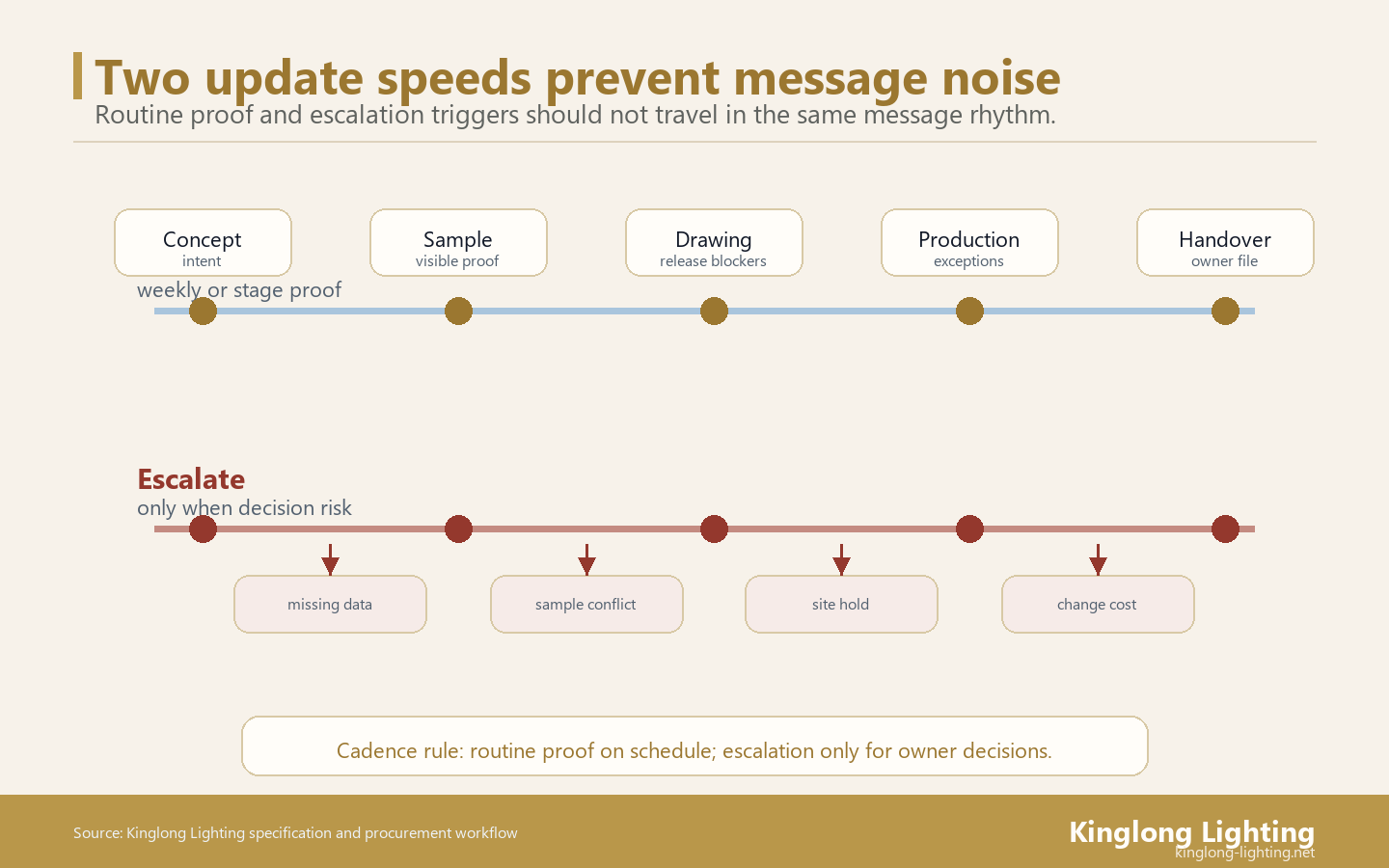
The two-speed cadence rule
Use slow cadence for quiet production and fast cadence for owner-dependent decisions. Slow cadence means weekly or milestone-based updates when no decision is needed. Fast cadence means same-day or next-day communication when the owner must approve, clarify, or escalate a risk.
This rule prevents two common failures. The first is silence during a decision window, where the project loses days waiting for approval. The second is constant messaging during stable production, where the owner becomes tired and starts ignoring useful information.
A clear cadence also protects the supplier. It lets the manufacturer say when evidence will arrive and when owner input is required. The project becomes calmer because the communication rhythm is visible before anxiety appears.
For a real villa project, the cadence can be written as a compact operating rule: weekly during concept, evidence-triggered during sampling, revision-triggered during shop drawings, milestone-based during production, document-triggered during shipment, and same-day during installation blockers. That rule gives the owner a normal rhythm and an exception path at the same time.
The most useful part is the trigger language. A photo of normal assembly belongs in the weekly or milestone update. A finish mismatch, route conflict, missing ceiling dimension, shipping document gap, or owner preference that changes the approved drawing belongs in the fast lane. This keeps the project team from debating how much communication is enough after the delay has already started.
The limitation is that cadence cannot replace authority. If the owner, designer, purchasing manager, and site representative all approve different things, better update frequency will only broadcast confusion faster. The decision calendar should therefore name one approver for each stage and one backup approver when the main decision-maker is traveling or unavailable.
For the owner, the final test is simple: every routine update should reduce uncertainty, and every fast-lane update should protect a decision deadline. If an update does neither, it should probably be shorter, delayed until evidence exists, or moved into the handover file instead of interrupting the project team.
How Kinglong Lighting structures project updates
Kinglong Lighting can structure villa lighting project updates around concept decisions, sample evidence, shop drawing revisions, production milestones, packing records, and handover tasks. This keeps the custom chandelier workflow readable for owners who need decisions, not noise.
If communication has become unclear, the useful next action is to send the villa lighting update file with current stage, open decisions, target date, evidence already received, and the next owner decision. Kinglong Lighting can then help map which updates should be routine and which should escalate.
Before you agree on an update rhythm
Use this short action list before the next approval meeting. It is intentionally practical, because vague approval language is the usual source of later rework.
- Define routine cadence by stage and escalation triggers by risk.
- Ask every update to include stage, evidence, open item, and owner action.
- Put owner decision dates on the calendar before production starts.
- Separate local professional review from owner taste approval.
- Turn the final updates into the handover file.
FAQ
How often should a villa lighting project update the owner?
Weekly updates are often enough during stable stages, but decision-dependent stages need faster updates when owner approval, sample evidence, drawing revision, or shipment release is due.
What should a lighting project update include?
It should include current stage, evidence attached, what changed, what is blocked, who owns the next action, and the date when the owner decision is needed.
Are daily updates useful for custom lighting?
Usually not unless the project is in a high-risk or time-sensitive stage. Daily messages can create noise if they do not carry decisions or evidence.
When should a supplier escalate immediately?
Escalation is appropriate when cost, timing, finish, structure, electrical assumptions, access, packing, shipment, or owner acceptance may be affected.