A hotel lighting warranty is not valuable because it sounds generous. It is valuable only when the hotel team can use it after the installer leaves. Owners should evaluate warranty, spare parts, and maintenance contracts as one support system, because a failure rarely arrives in a neat legal category.
A chandelier arm may be damaged during cleaning. A driver may fail. A crystal strand may be lost. A finish issue may be caused by site chemicals, guest impact, humidity, or manufacturing. A spare part may exist but take too long to identify. If the support file does not explain the path, the hotel will lose time before anyone debates whether the warranty applies.
Kinglong Lighting can support this topic when the buyer treats post-installation service as part of the hotel lighting project scope. The support conversation should begin before shipping, with part maps, packing references, warranty boundaries, maintenance access, and replacement logistics already visible.
Key Takeaways
- Warranty is a workflow: Coverage matters less if the hotel does not know how to document, submit, and resolve a claim.
- Spares are an operations decision: The right spare kit reflects component uniqueness, room criticality, shipping time, and maintenance capacity.
- Maintenance access changes coverage value: A replacement part is less useful if the hotel cannot reach the driver, canopy, glass, or suspension safely.
- Evidence protects both sides: Photos, installation records, cleaning notes, and inspection files reduce blame-shifting.
- Support should be priced before handover: Maintenance expectations are cheaper to define before defects and urgent requests appear.
Warranty is useful only when the claim path is usable
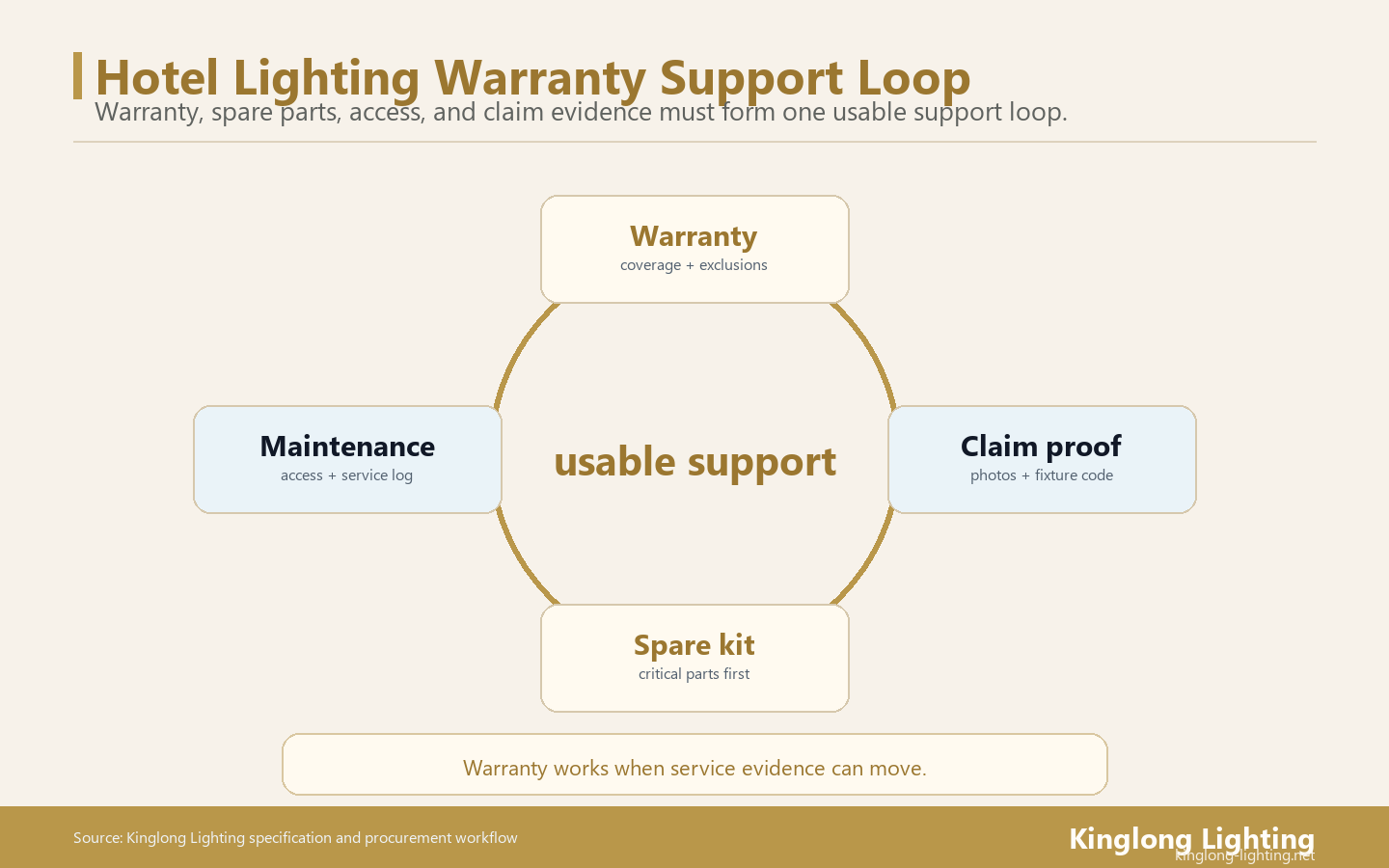
A hotel warranty should answer three questions before failure occurs: what is covered, how the claim is proven, and how the hotel keeps operating while it is resolved.
The first support question is not how many years appear in the warranty line. The first question is whether the hotel can use the claim path without recreating the whole project history. A usable claim path names the part, location, failure symptom, installation date, maintenance history, photo evidence, and contact route.
The UL 1598 standard page gives a useful boundary because decorative chandeliers are still luminaires that need product evidence and qualified installation review. For project buyers, the practical action is to keep luminaire evidence, installation limitations, and product identification connected to the warranty file.
Coverage needs categories, not adjectives
Warranty language that says quality guaranteed or long service life does not help the hotel engineer at 10 p.m. Owners should ask for categories: structural frame, finish, crystal or glass components, LED modules, drivers, dimming accessories, packaging damage, consumable items, misuse, cleaning damage, and site environmental damage.
Each category should explain the evidence needed for a claim. A driver failure may need installation date, control channel, photos, and electrical checks. A finish complaint may need cleaning method, humidity context, sample comparison, and close-up images. The clearer the category, the faster the supplier can say replace, repair, inspect, or reject.
Claim evidence should be easy for hotel teams
Hotels are busy operating environments. A support policy that requires vague proof creates delay because the engineering team does not know what to collect. A practical warranty file includes a simple claim template: project name, fixture code, room or area, symptom, date noticed, photos, maintenance action already taken, and urgency level.
The NIST NVLAP accreditation page gives a useful boundary because test evidence is stronger when the method, traceability, competence boundary, and report scope are clear. For project buyers, the practical action is to treat test reports as scoped evidence and avoid using them as a blanket answer to every field failure.
Separate product warranty, wear, and site damage
Hotel owners should not accept a support discussion where every issue is either fully covered or fully denied. Post-installation reality is more nuanced. Some problems are product defects, some are wear, some are handling damage, some are site compatibility issues, and some are owner preference changes after opening.
The DOE LED lighting page gives a useful boundary because LED performance, heat, service life, and operating behavior need to be part of luminaire decisions. For project buyers, the practical action is to connect LED performance, heat, driver behavior, and service expectations to replacement decisions.
Drivers and light engines need their own record
Decorative lighting often hides technical components behind the romance of glass, crystal, metal, and form. Owners should still request driver references, light source information, dimming compatibility notes, replacement path, and any thermal or access assumptions. If these details are missing, future support becomes detective work.
The warranty file should show whether a component is standard, project-specific, supplier-stocked, or third-party sourced. This matters because a standard driver can often be replaced faster than a custom decorative glass piece, but only if the file identifies it clearly and the local team understands compatibility limits.
Finish complaints need cleaning and environment context
Finish issues can be caused by manufacturing, shipping damage, installation handling, aggressive cleaning chemicals, coastal humidity, pool chemicals, guest contact, or simple aging. Owners should ask the supplier for cleaning notes and finish boundaries before handover. That protects the hotel from avoidable damage and protects the supplier from unfair claims.
The best support file includes a signed finish master or finish reference, installed photos, cleaning recommendation, and location notes. A lobby chandelier in conditioned air, a spa fixture near humidity, and a restaurant pendant exposed to cleaning routines should not be treated as identical warranty environments.
Build a spare parts policy around downtime
Spare parts are often discussed too late, after a visible area has already failed. Hotel owners should decide the spare kit before shipping by asking which components are unique, fragile, guest-visible, difficult to ship, or difficult to access. The point is not to buy every possible spare. The point is to buy time.
The ICC Incoterms 2020 page gives a useful boundary because international delivery responsibility should be named before goods, crates, and spare parts move. For project buyers, the practical action is to document who owns international movement, replacement delivery, insurance, customs, and destination handoff for urgent spares.
Critical spares are not the same as extra pieces
A critical spare is a component that can restore a high-value area quickly. It may be a driver, glass element, crystal strand, custom metal part, canopy cover, suspension accessory, or specialty lamp. Extra pieces that cannot be identified, stored, or installed are not a support strategy.
A useful rule is to rank spares by downtime impact and replacement friction. If a broken component darkens a signature lobby feature, appears in guest photos, or needs international production to replace, the owner should consider holding a project spare. If a component is local, standard, and hidden, the spare policy can be lighter.
Spare kit cost should be compared with disruption cost
A hotel may resist a spare kit because it looks like an extra cost. The better comparison is disruption. If an urgent replacement requires identification, production, packing, international shipping, customs, site access, and after-hours installation, the real cost includes management time and guest-area disruption, not only the part price.
The ISTA 3A test procedure page gives a useful boundary because packing evidence should be selected around the distribution environment and package profile. For project buyers, the practical action is to ask how replacement parts will be packed and moved so fragile spares arrive usable rather than merely shipped.
Turn maintenance contracts into observable work
A maintenance contract should not be a vague promise to support the project. It should describe what will be inspected, how often, by whom, what evidence will be recorded, and which actions are included or excluded. The more decorative and custom the lighting, the more important this clarity becomes.
The OSHA aerial lifts page gives a useful boundary because overhead installation and later service require planned access and trained site practice. For project buyers, the practical action is to include access route, lift restrictions, trained personnel, and guest-area protection in maintenance planning.
Access is part of the maintenance price
A maintenance price that ignores access is incomplete. Cleaning a low pendant, servicing a ballroom chandelier, and replacing a driver above a double-height lobby are different tasks. Owners should ask whether the maintenance scope includes lift rental, floor protection, off-hour work, local permits, safety coordination, or only remote technical advice.
The contract should also say what the supplier can realistically do from overseas and what must be handled by local licensed professionals. A manufacturer can provide part identification, drawings, replacement components, guidance, and remote troubleshooting. Local teams still own electrical work, site safety, and authority requirements.
Inspection photos should build a service history
Hotels often lose the service history of decorative lighting because maintenance activity is informal. A better contract creates a record: date, area, fixture code, condition, cleaned components, replaced parts, open concerns, photos, and next review. Over time, that history shows whether failures are random, seasonal, cleaning-related, or design-related.
This service history also helps future purchasing. If a hotel later expands, renovates, or replaces a lighting family, the owner can see which components performed well and which details created support load. That knowledge should return to the next specification instead of disappearing with the old project team.
Make support evidence part of procurement
The best time to improve warranty support is before the purchase order is released. At that point the buyer can still ask for part maps, spare recommendations, maintenance notes, warranty categories, packing references, and claim procedures. After installation, those documents are harder to reconstruct.
The WBDG building commissioning page gives a useful boundary because commissioning connects design intent, installation quality, operation, and owner handover. For project buyers, the practical action is to connect support records to commissioning and owner handover rather than leaving them as separate after-sales promises.
Ask for a support file before shipment
A support file should include fixture codes, room or area schedule, approved drawings, final finish references, component list, recommended spares, cleaning notes, replacement ordering path, warranty categories, claim evidence template, and supplier contact route. For large custom pieces, assembly and disassembly notes should also be included.
This file does not need to be visually elaborate. It needs to be usable by hotel engineering, purchasing, housekeeping, and future renovation teams. If the file cannot help a new employee identify the broken part and submit a meaningful request, the support system is too dependent on memory.
Support terms should influence vendor comparison
Two lighting quotes that look similar can have very different support value. One may include clear spare logic, tested packing, fixture codes, and a claim procedure. Another may rely on a broad warranty phrase. Owners should compare support evidence before choosing the lowest apparent price.
That is where Kinglong Lighting’s custom manufacturing workflow can be evaluated as a support process, not only a production process. The buyer should ask what evidence will travel with the fixture after installation and how replacement parts will be identified years later.
Warranty and spare parts evaluation table
Use this table before purchase order release and again before handover. It helps the buyer judge whether support can actually operate.
| Decision area | Owner risk if vague | Evidence to request | Acceptance action |
|---|---|---|---|
| Warranty categories | Broad coverage language creates slow claim arguments | Coverage table by part, failure type, exclusion, and evidence | Approve only when claim path is usable |
| Spare kit | Visible areas wait for international replacement | Critical spare list by fixture code and room priority | Buy spares where downtime and replacement friction are high |
| Maintenance access | Service requires unsafe or disruptive access | Lift path, canopy access, driver location, local labor boundary | Price maintenance with access assumptions visible |
| Claim evidence | Hotel staff submit incomplete requests | Claim template, photo rules, installation record, service history | Use one evidence format for all support requests |
| Replacement logistics | Parts ship late, wrong, or poorly protected | Part map, packing reference, delivery responsibility, destination contact | Confirm movement terms before urgent need |
How Kinglong Lighting supports post-installation service
Kinglong Lighting can support hotel owners by connecting decorative lighting production records to after-sales reality: fixture codes, drawings, component references, spare part planning, packing notes, and support boundaries. This turns decorative lighting collections from installed objects into maintainable hotel assets.
If a project already has open support concerns, the buyer should send the warranty and spare parts file with room schedule, fixture photos, symptoms, part codes, installation date, and urgency level. Kinglong Lighting can then respond with a clearer part identification path, replacement recommendation, and evidence request instead of a generic warranty reply.
Before you accept a hotel lighting warranty
Use this short action list before the next approval meeting. It is intentionally practical, because vague approval language is the usual source of later rework.
- Ask for warranty categories by part type, failure type, evidence, exclusion, and response route.
- Rank spare parts by downtime impact, custom uniqueness, shipping friction, and site access difficulty.
- Attach support files to commissioning records so later claims have a factual starting point.
- Define what the manufacturer can support remotely and what local qualified professionals must handle.
- Treat maintenance access, cleaning instructions, and service photos as part of the post-installation package.
FAQ
What should a hotel lighting warranty cover?
It should define covered parts, exclusions, claim evidence, response path, replacement logistics, and local work boundaries for drivers, finishes, glass, crystal, structure, and accessories.
How many spare parts should a hotel order?
There is no universal number. The owner should rank spares by visibility, uniqueness, shipping time, fragility, access difficulty, and whether a missing part disrupts guest areas.
Are maintenance contracts worth it for chandeliers?
They can be worthwhile when the contract names inspection scope, access method, cleaning rules, photo records, included labor, excluded work, and the supplier’s practical role.
Can warranty support replace local electrical service?
No. Manufacturer support can identify parts and provide evidence, but local qualified professionals should handle electrical, access, safety, and authority-controlled work.