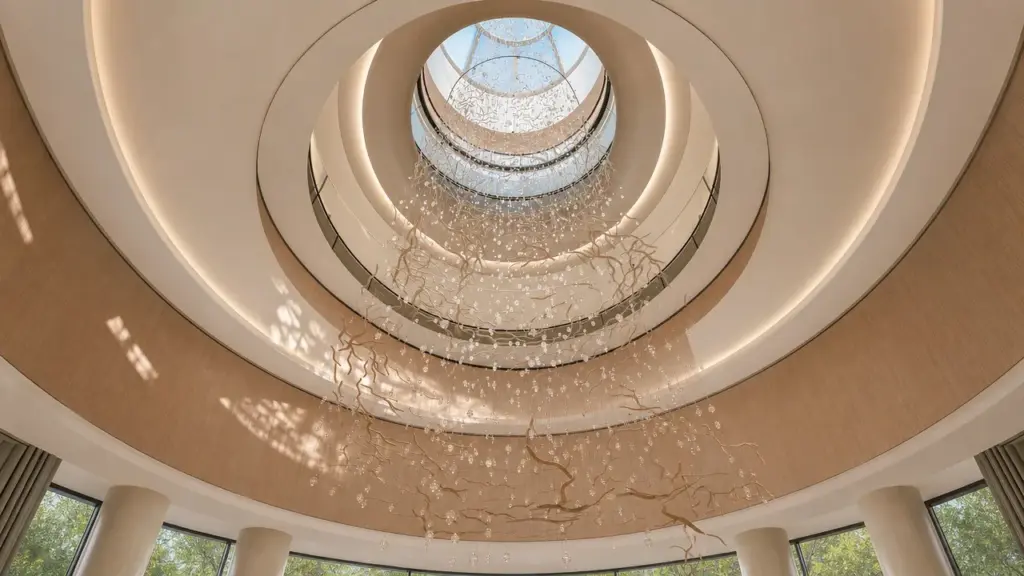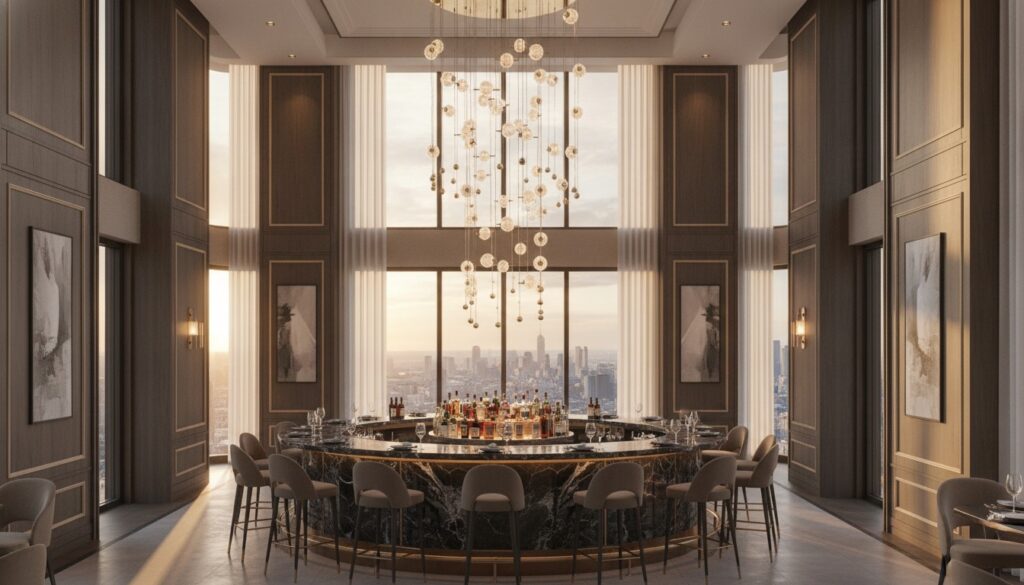
A villa lighting retrofit is not the same as choosing a new chandelier for new construction. The existing room already has wiring, ceiling support, plaster, stone, furniture, access limits, control systems, and owner disruption boundaries. The new fixture must answer the old room before it can improve the room.
The retrofit mistake is to buy the chandelier first and survey the constraints later. That sequence can create ceiling cuts, control mismatch, visible repair, access failure, or a fixture that is too heavy for the existing support path.
Kinglong Lighting can help villa owners and designers turn a retrofit ambition into a constraint file before custom chandelier production begins.
Key Takeaways
- Survey before selection: existing wiring, support, controls, and finishes should shape the chandelier brief.
- Local review is essential: code, structure, and site safety belong with qualified local professionals.
- Remote service can save finishes: driver access should avoid unnecessary future ceiling damage.
- Retrofit is not only electrical: plaster, stone, dust, furniture, and lift route affect the fixture.
- Choose a path: adapt, open carefully, or redesign around constraints before buying.
Start with the existing room, not the new fixture
In a retrofit, the old room writes the first draft of the new chandelier brief.
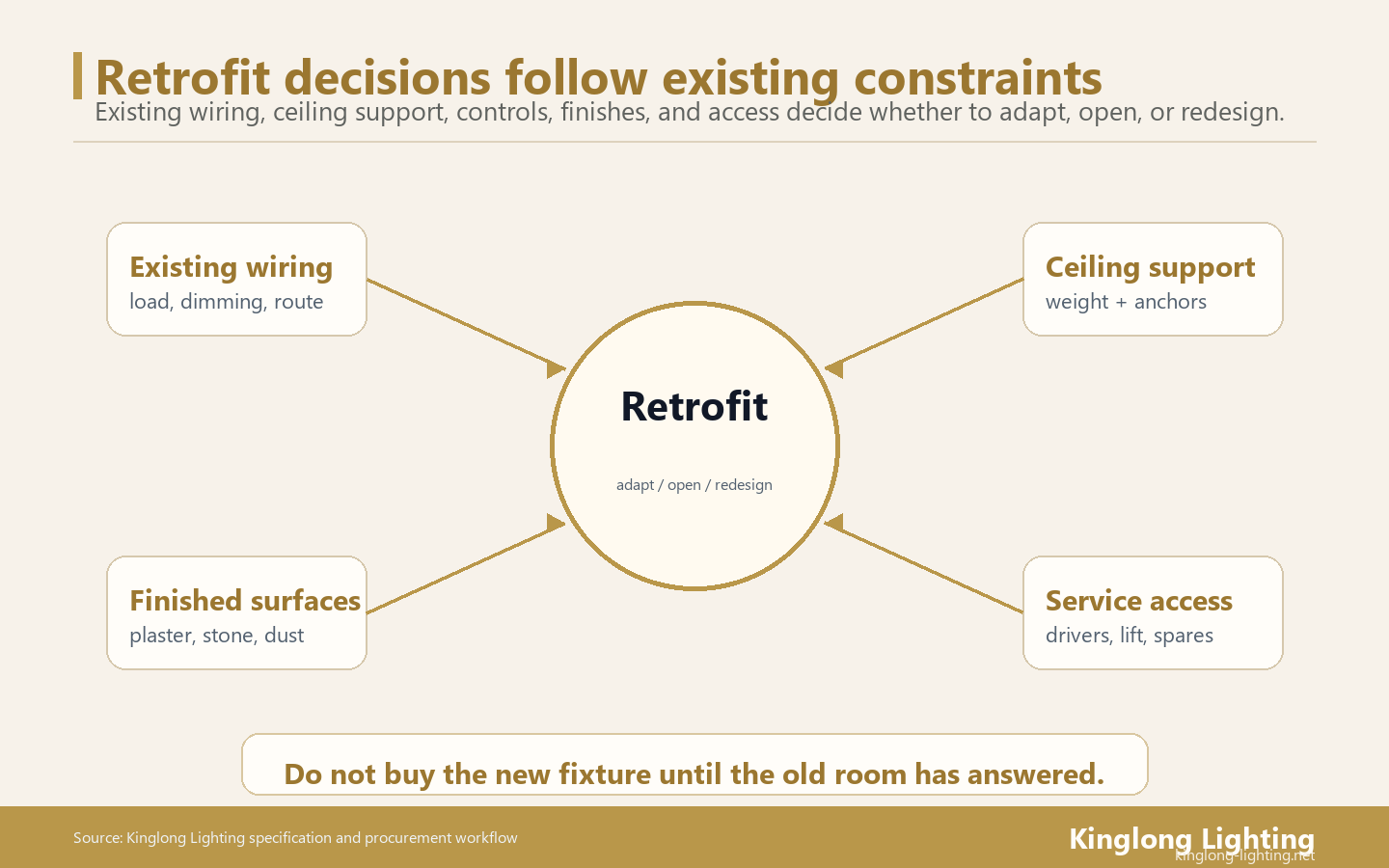
The existing power point may be off center. The ceiling may not have backing for a heavier fixture. The current dimmer may not match modern LED drivers. The plaster may be difficult to repair. The access route may be blocked by furniture or stair geometry. These constraints are not annoyances; they are design inputs.
The DOE lighting design page is helpful because retrofit lighting should still improve whole-space quality and efficiency. The new chandelier should not only be newer or brighter. It should solve the room’s present weaknesses while respecting its existing architecture.
Constraint 1: existing wiring and controls
Existing wiring can limit fixture location, circuit count, driver location, dimming behavior, and control scenes. A retrofit should begin with an electrical survey, not an assumption that the old point can carry the new design.
The NFPA 70 National Electrical Code page reinforces that electrical installations require code-aware local review. The manufacturer can provide driver, load, wiring, and product information, but the local electrician must decide how the existing wiring can be used or changed.
Ask whether the existing switch logic still works
A chandelier retrofit may need multiple zones, dimming scenes, remote drivers, or integration with a home control system. If the old room has a simple switch, the new fixture may not behave as desired. Decide whether to adapt the chandelier to the wiring or update the wiring to support the chandelier.
Do not bury service parts blindly
Retrofits often tempt teams to hide everything inside the canopy because opening walls or ceilings is inconvenient. That can make future driver replacement difficult. Where possible, place serviceable components in accessible locations that meet product and code requirements.
Constraint 2: ceiling support and architectural finish
A larger chandelier may need more support than the existing fixture. It may also need a canopy that hides old holes, coordinates with ceiling plaster, and looks intentional. Support and finish should be solved together because one affects the other.
The UL 1598 standard page is relevant because the new decorative object is still a luminaire. Product evidence, installation information, components, and market expectations should be available before the retrofit is released.
Use a pilot opening when assumptions are risky
If drawings are old or ceiling conditions are unknown, a controlled pilot opening can prevent larger mistakes. It may reveal backing, wiring, void depth, or obstacles. The opening should be planned with the contractor, not improvised after the chandelier arrives.
Design the canopy as a repair strategy
The canopy may need to cover old marks, align with a new centerline, hide reinforcement, and remain serviceable. A retrofit canopy that is too small can expose repair scars. A canopy that is too large can look like a patch. The right canopy is both technical and architectural.
Constraint 3: dust, access, and occupied-villa protection
Many villa retrofits happen while the home is finished, furnished, or partly occupied. Dust control, floor protection, lift access, furniture removal, and work timing become part of the lighting specification. A fragile chandelier should not arrive before the room can safely receive it.
The EPA RRP work practices page is relevant for older renovation contexts because disturbing certain painted surfaces can require specific dust and debris controls. Not every villa has lead-paint risk, but every retrofit should treat dust and containment as real planning issues.
The OSHA aerial lift page is also useful because chandelier retrofit work often happens overhead. The site team should plan lift type, operator qualification, floor protection, overhead clearance, and safe movement before the installation date.
Access affects module design
If a large chandelier cannot enter the room as one piece, the factory should design modules around the route. Elevator height, stair turns, doorway width, and unpacking area should be measured. The route determines module size, packing order, labels, and installation sequence.
Retrofit timing should match room readiness
Do not schedule chandelier installation while plaster is still being repaired, paint is curing, floors are unprotected, or controls are unfinished. A custom fixture should arrive when the room can protect it. Otherwise the chandelier becomes vulnerable to damage before it is even commissioned.
Choose one of three retrofit paths
| Path | Best when | Main risk | Proof before purchase |
|---|---|---|---|
| Adapt to existing | wiring and support already work | design becomes too constrained | electrical and support survey |
| Controlled opening | small ceiling work solves the problem | visible repair or dust disruption | cut boundary and finish plan |
| Redesign around limits | support, route, or disruption blocks the ideal | owner feels downgraded | new visual concept and scale proof |
Path 1: adapt to existing
This path keeps disruption low. It works when the existing power, support, canopy position, and access route can support the new fixture. The design may need to be lighter, shallower, or simpler, but the owner gains speed and lower construction risk.
Path 2: controlled opening
This path accepts limited ceiling or wall work to solve support, wiring, or service access. It should be planned with dust control, repair finish, and owner schedule. Controlled opening is often better than forcing a compromised chandelier into an unsuitable existing condition.
Path 3: redesign around limits
When the ideal fixture conflicts with route, support, wiring, or disruption limits, redesign is the disciplined choice. A cluster of lighter modules, a wider canopy, remote drivers, or multiple coordinated fixtures may deliver the desired room effect with less risk.
How Kinglong supports retrofit planning
Kinglong Lighting’s custom retrofit chandelier workflow can connect constraints to design options: lighter modules, remote service, custom canopy, finish matching, packing sequence, and handover documentation. The Mofun Design Platform can help test scale before the owner commits to ceiling work.
The villa lighting retrofit support path should begin with the existing room file. Once the team knows wiring, support, access, finish, and control constraints, the chandelier can be designed as an upgrade rather than a construction surprise.
Retrofit release packet
A retrofit release packet is different from a new-construction package because it must show what already exists. The packet should not only describe the new chandelier. It should explain how the new chandelier interacts with old wiring, old support, finished surfaces, existing controls, access route, and owner disruption limits.
Existing condition photos
Photos should show the current fixture, ceiling, power point, room access, floor finish, nearby furniture, attic or service access if available, and any visible repair history. Photos are not a substitute for professional review, but they help the manufacturer design around the real room instead of an idealized drawing.
Electrical and control summary
The summary should identify existing circuits, switch locations, dimmers, control system, available service space, and known limitations. If the local electrician has not yet reviewed the room, mark this as open. A custom chandelier should not be released with hidden assumptions about driver compatibility or control behavior.
Architectural protection plan
The protection plan should say how plaster, stone, timber, wallpaper, artwork, and furniture will be protected. It should also identify whether a pilot opening, canopy cover, or finish repair is expected. Retrofit success is not only measured by the chandelier; it is measured by how little damage the room suffers while being improved.
Service and future access record
The packet should show where drivers, connectors, spare parts, and maintenance access will live after installation. If every service item disappears behind a sealed surface, the retrofit has created a future problem. A good retrofit leaves the next technician a clear path, not a mystery.
Buyer checklist before retrofit purchase
Before paying for a retrofit chandelier, the buyer should complete a short checklist that separates known facts from assumptions. This is especially important when the owner is replacing an old fixture with something larger, heavier, or more technically complex. The checklist prevents the new chandelier from inheriting old room problems.
Known facts
Known facts include ceiling height, current fixture weight if available, power point location, visible ceiling condition, control type, access route, and owner schedule. These facts can be photographed and measured. They form the minimum package the manufacturer needs before giving a reliable custom recommendation.
Open assumptions
Open assumptions include hidden backing, wiring capacity, dimmer compatibility, ceiling void depth, repair difficulty, and whether a lift can enter the room after furniture is protected. These assumptions need local review. The buyer should not treat them as solved just because the new chandelier looks suitable.
Decision trigger
The decision trigger is the point where the project chooses adapt, controlled opening, or redesign. If most constraints are known and favorable, adaptation may work. If a few constraints are unknown but manageable, controlled opening may be safer. If the constraints conflict with the desired fixture, redesign protects the budget and the room.
When not to retrofit
Retrofit is not always the best answer. If the desired chandelier needs a support system the ceiling cannot reasonably accept, if the wiring route would damage important finishes, or if the control system cannot support the intended scenes without major hidden work, a restrained retrofit may disappoint everyone. In that situation, the better project may be a room-level lighting redesign or a phased renovation.
Do not force scale into a weak ceiling
A large chandelier can define a villa hall, but only if the room can safely carry and service it. If the existing support path is uncertain and opening the ceiling is not allowed, the team should reduce weight, divide the design into smaller elements, or choose another lighting strategy. Scale that ignores support is not luxury; it is deferred risk.
Do not hide technical compromise behind a large canopy
A custom canopy can solve alignment, cover old marks, and create a cleaner visual transition. It should not be used to hide inaccessible drivers, unsafe wiring assumptions, or unresolved structural questions. The canopy must remain part of the service plan, not a decorative cover for decisions nobody wants to document.
Soft next step before buying a retrofit chandelier
If your villa retrofit starts with an existing room, prepare a constraint file before choosing the final fixture. Include current photos, wiring location, ceiling details, control system, desired scenes, access route, finish repair concerns, and owner disruption limits. Kinglong Lighting can help you send the retrofit constraint file and decide whether to adapt, open carefully, or redesign before production begins.
FAQ
Can a villa chandelier retrofit use existing wiring?
Sometimes it can, but the existing wiring must be reviewed by a qualified local electrician. The new chandelier may require different load, dimming, driver location, circuiting, or control behavior. Do not assume the old connection fits the new fixture.
Should the chandelier be selected before the site survey?
No, the site survey should come before final selection. The survey may reveal support, access, wiring, or finish constraints that change size, weight, module design, canopy, or controls. Early survey prevents expensive redesign after purchase.
How can retrofit work avoid visible ceiling damage?
Visible damage is reduced by planning support, canopy size, pilot openings, dust control, and finish repair before installation. A custom canopy can sometimes hide old marks, but it should look intentional and remain serviceable rather than acting as a rushed patch.
What should be in a retrofit constraint file?
A retrofit constraint file should include room photos, ceiling drawings, current wiring, control system, access route, floor protection needs, finish repair concerns, desired scenes, weight limits, and local professional contacts. It becomes the basis for a realistic chandelier brief.