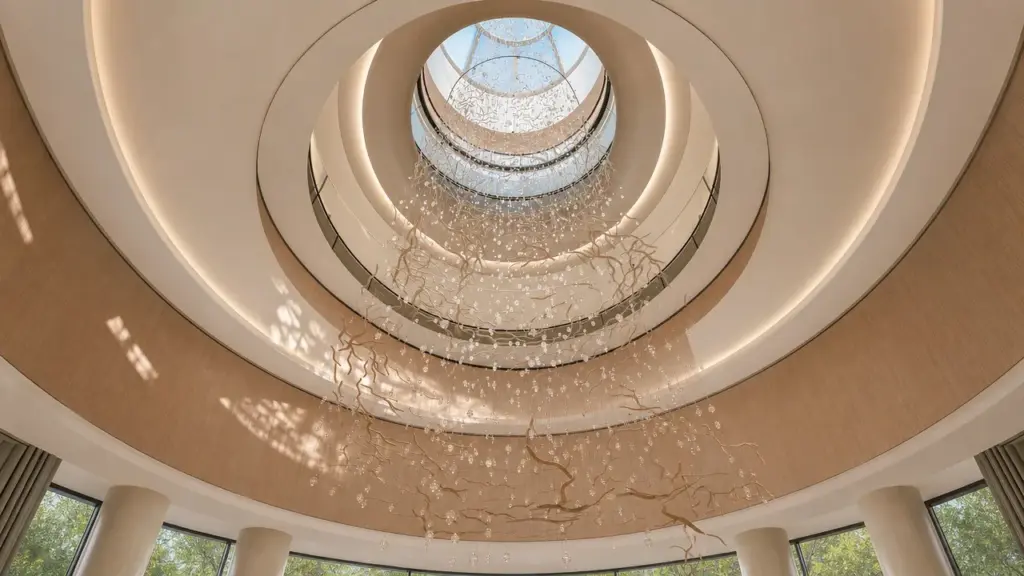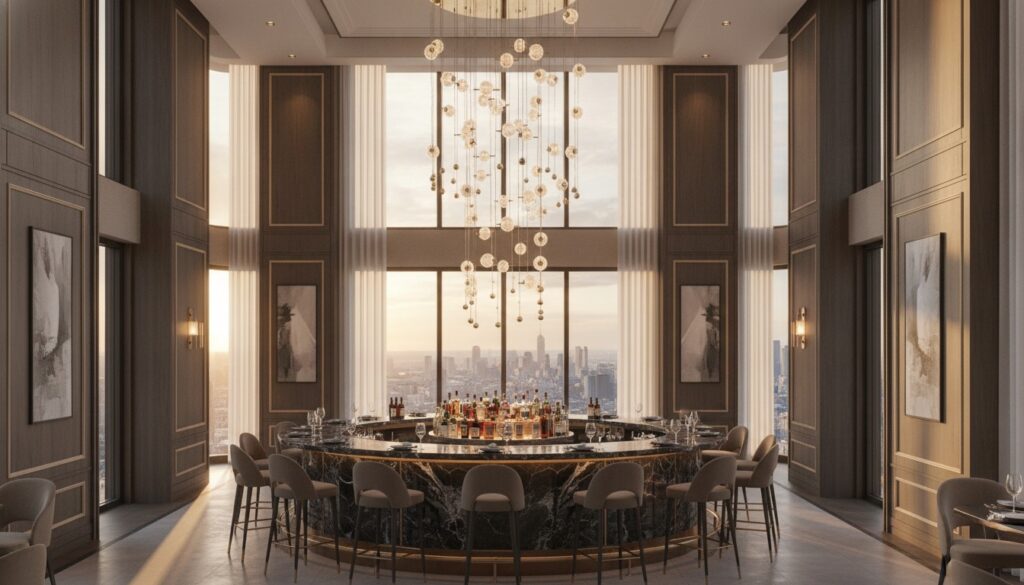
An Italian design studio and Chinese chandelier manufacturer collaboration works when each party’s value is clear. The design studio protects concept, proportion, material language, and brand identity. The manufacturer turns that intent into drawings, samples, engineering logic, production control, packing, and delivery proof.
The collaboration fails when the buyer treats it as a shortcut to “Italian style at China cost” without respecting design authority, intellectual property boundaries, manufacturing evidence, and project handoff. The right workflow is not imitation. It is disciplined translation from design intent to buildable chandelier.
Kinglong Lighting can support this workflow by providing custom chandelier development, sample proof, manufacturing documentation, and project coordination while keeping design ownership and no-copy boundaries explicit.
Key Takeaways
- Design and manufacturing are different value layers: concept authority and production proof both need owners.
- IP boundaries protect the project: collaboration should not become unauthorized copying of a known design.
- Samples are the bridge: finish, glass, crystal, proportion, and light behavior need physical or digital proof.
- Global workflow needs documentation: drawings, approvals, delivery terms, and change records prevent drift.
- The room is the final judge: collaboration succeeds when the installed chandelier supports the space, not only the sketch.
Why this collaboration exists
The studio protects the idea; the factory protects the proof.
The WIPO page on intangible assets is useful because it recognizes that ideas, designs, brands, reputation, and know-how can carry value. In decorative lighting, an Italian design studio may contribute precisely those intangible assets: taste, proportion, identity, and creative direction.
The OECD trade policy brief on global value chains helps explain why cross-border production is normal rather than exceptional. Services, materials, components, and production steps can cross borders before the final product reaches the owner.
For a chandelier project, the collaboration makes sense when the owner wants European design discipline and manufacturing depth in the same project file. It does not make sense when the brief is simply “copy this Italian product cheaper.” That approach damages design trust and usually produces a weaker technical result.
Stage 1: define concept authority
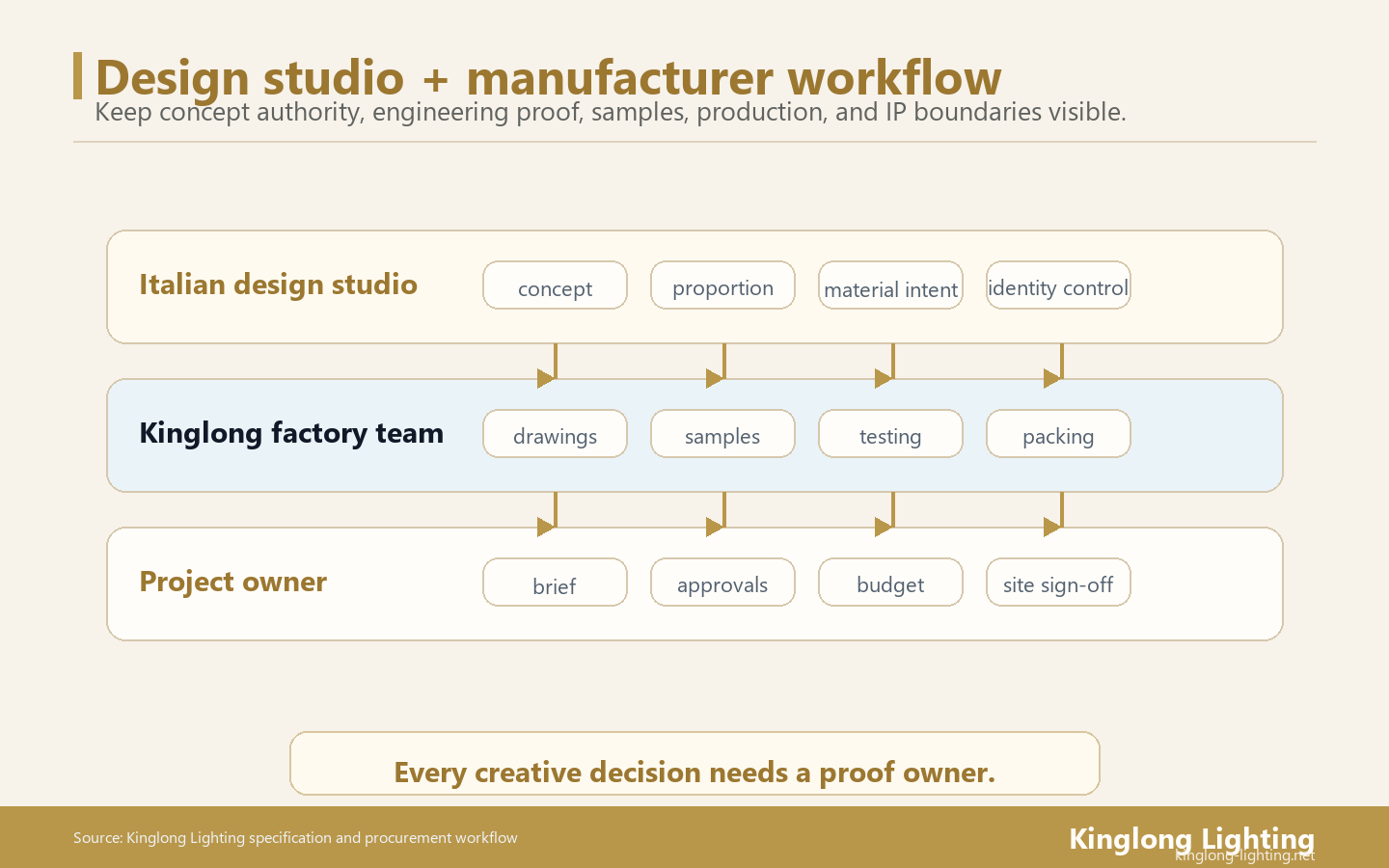
The first stage is to decide who owns the concept. The Italian studio may own the artistic direction, proportion, material palette, and brand story. The owner may own the room brief, budget, and final acceptance. The manufacturer may advise on feasibility, cost, weight, access, and production tolerance.
Design direction should be written, not guessed
A design direction should include room purpose, emotional target, geometry, material hierarchy, scale, brightness, and what the chandelier should avoid. If the factory receives only images, it may satisfy the surface while missing the studio’s deeper intent. Written design logic prevents that drift.
IP boundaries should be visible from day one
Do not ask a manufacturer to reproduce a protected Italian product. A serious collaboration should say what can be referenced and what cannot be copied. The goal is a distinct project solution, not a replica. This boundary protects the studio, manufacturer, owner, and final property.
Stage 2: translate design into manufacturing proof
Kinglong Lighting’s OEM/ODM customization workflow can support the translation stage. The factory turns concept into shop drawings, material options, finish masters, sample modules, weight estimates, suspension logic, driver notes, packing plans, and production steps.
The DOE lighting design page is a useful reminder that the final product still has to improve the quality and efficiency of the space. A collaboration that produces an attractive object but ignores glare, dimming, access, or room use has not completed the design task.
Samples should answer the highest-risk question
Not every detail needs a full mock-up. The team should identify the highest-risk question: Is the glass color right? Does the metal finish match the studio’s palette? Is the crystal density too bright? Does the module seam disappear? Is the drop too heavy? Samples should answer the risk that could change the design.
Digital tools help scale before sampling
The Mofun Design Platform can help test scale, module rhythm, and room proportion before physical production. That is especially useful when the studio and factory are in different countries. Digital proof does not replace samples, but it can reduce avoidable sampling loops.
Stage 3: keep approvals and changes traceable
Cross-border collaboration needs one current approval record. If the studio approves a finish, the owner changes the budget, and the factory adjusts module size, everyone should see which document is current. Untracked changes create disputes and production errors.
Origin and contribution are different questions
The European Commission page on non-preferential origin rules is useful because it separates origin from broader value-chain contribution. A chandelier can involve Italian design, Chinese manufacturing, global components, and local installation. Buyers should describe those roles honestly instead of turning one label into the whole story.
Delivery terms should be part of the project file
The ICC Incoterms 2020 page matters because delivery responsibilities affect cost, risk, and timing. For fragile chandeliers, the project file should clarify packing, insurance, documents, customs, unloading, and destination responsibility before shipment.
Workflow table
| Stage | Design studio role | Manufacturer role | Owner decision |
|---|---|---|---|
| Concept | intent, proportion, identity | feasibility feedback | approve direction |
| Boundary | IP and reference limits | no-copy manufacturing plan | confirm ethical brief |
| Sampling | material and visual judgment | finish, glass, crystal proof | approve or revise |
| Engineering | protect design language | weight, modules, drivers, packing | release production |
| Delivery | review final appearance | inspection and logistics file | accept shipment and install |
How Kinglong fits the collaboration
Kinglong Lighting’s manufacturing background gives the factory-side role: custom decorative lighting development, production coordination, documentation, and project support. The brand should not replace the studio’s creative authority; it should make that authority buildable.
A good collaboration makes both sides stronger. The studio avoids being pulled into production details it cannot control alone. The factory avoids guessing at design intent. The owner receives a chandelier with concept clarity, manufacturing proof, delivery planning, and a serviceable final result.
Governance model for design-manufacturing collaboration
The workflow needs governance because creative and manufacturing decisions move at different speeds. A designer may refine proportion after seeing a sample. A factory may discover that a module must change to meet packing or weight limits. An owner may adjust budget after reviewing finish options. Governance keeps these changes from becoming confusion.
One owner for each decision type
Assign one owner for concept, one for production proof, one for site constraints, and one for commercial approval. The same person does not need to own every decision. In fact, the workflow is stronger when authority is separated. The studio can protect the concept, Kinglong Lighting can protect manufacturing feasibility, and the owner’s representative can protect budget and site priorities.
Approval gates should be visible
The collaboration should use visible gates: concept approval, reference boundary approval, sample approval, engineering release, production release, pre-shipment review, and installation handover. Each gate should end with approve, revise, or hold. If a gate is skipped, the risk does not disappear; it moves into production, shipping, or site rework.
Commercial terms should match creative uncertainty
Creative projects often need sampling and adjustment. The commercial structure should reflect that reality. If the buyer expects unlimited design changes after production materials are ordered, the project will become tense. If the factory demands final approval before samples answer the main risk, the owner may feel trapped. Payment and change terms should match the actual uncertainty left in the design.
Quality review should protect both idea and object
A collaboration quality review should ask two questions. First, does the fixture still express the studio’s design intent? Second, does the object have manufacturing proof: dimensions, finish, assembly, electrical notes, packing, and service access? If either answer is weak, the workflow is incomplete. A beautiful but undocumented chandelier is risky; a well-documented but conceptually flat chandelier is also a failure.
Sample-to-production control
The hardest part of a design studio and manufacturer workflow is often the gap between the approved sample and repeatable production. A single sample can be adjusted by hand, photographed carefully, and approved emotionally. Production requires tolerances, batch records, inspection criteria, and a method for deciding whether variation is acceptable.
Define which sample is the master
The project should identify whether the master is a finish chip, glass piece, crystal assembly, metal prototype, digital model, or partial chandelier module. If several samples exist, one must become the production reference. Otherwise the studio, owner, and factory may each remember a different version of the approved design.
Convert aesthetic language into tolerances
Words such as soft, warm, smoky, hand-made, or champagne should become tolerances where possible. That does not mean eliminating craft variation. It means defining the acceptable range. The studio can protect the intended character while the factory protects consistency across modules and batches.
Use inspection criteria that respect design intent
Inspection should not reduce the chandelier to dimensions only. It should also check visible rhythm, finish continuity, glass variation, crystal alignment, canopy quality, and whether the assembled module still feels like the approved concept. Production quality should serve the design, not merely pass a box count.
Close the loop after installation
After installation, the studio and manufacturer should review what translated well and what required site adjustment. That feedback improves future collaboration. It can also guide spare parts, maintenance notes, and future phases if the property uses related chandeliers in additional rooms.
Commercial risk controls for the collaboration
A creative collaboration still needs commercial discipline. Many problems appear when the owner asks for a fast quote before the concept boundary, sample burden, revision count, delivery term, and inspection standard are clear. The result may be a number that looks attractive but excludes the work needed to protect the design.
Quote the scope, not only the object
The quote should show whether it includes shop drawings, finish samples, crystal or glass samples, mock-up views, engineering checks, packaging design, inspection photos, spare parts, and installation guidance. If those items are missing, the owner may compare suppliers unfairly. A lower fixture price can become a higher project cost when proof must be added later.
Use a change log for design revisions
Design revisions are normal, especially when an Italian studio refines proportion and a Chinese manufacturer tests production methods. The risk is not revision itself; the risk is undocumented revision. A change log should show what changed, who approved it, and whether it affects price, lead time, sample status, or production release.
Make delivery terms visible early
International projects can stall when delivery responsibility is discussed after production. Incoterms, destination, insurance expectation, crate handling, customs documents, and site receiving readiness should be named early. The chandelier is not truly finished when it leaves the factory if the receiving team cannot unload, inspect, protect, and stage the crates correctly.
Soft next step for collaboration briefs
If your project involves an Italian designer, design consultant, or studio reference with Chinese manufacturing, prepare a collaboration brief before asking for price. Include design ownership, reference boundaries, room drawings, material targets, sample needs, approvals, market destination, delivery terms, and site constraints. Kinglong Lighting can help you send a design-manufacturing collaboration brief that protects the idea and the proof.
FAQ
Is Italian-Chinese chandelier collaboration only about lower cost?
No, cost can be one factor, but the stronger reason is combining design direction with manufacturing depth. The collaboration works best when the studio owns concept and identity while the factory owns drawings, samples, production, packing, and evidence.
Can a manufacturer copy an Italian chandelier design?
A responsible manufacturer should not copy a protected Italian design. The safer and stronger brief translates room intent, material language, proportion, and performance needs into a distinct custom fixture. Copying creates legal, ethical, and brand risk.
Who approves samples in this workflow?
Sample approval should involve the design studio, owner, and manufacturer. The studio judges concept fidelity, the owner judges room preference and budget, and the manufacturer confirms production feasibility. The approval record should show which sample is current.
What documents should the owner keep?
The owner should keep the design brief, reference boundary, drawings, sample approvals, finish master record, production release, packing list, delivery terms, inspection photos, and maintenance handover. These documents protect the collaboration if questions arise later.